







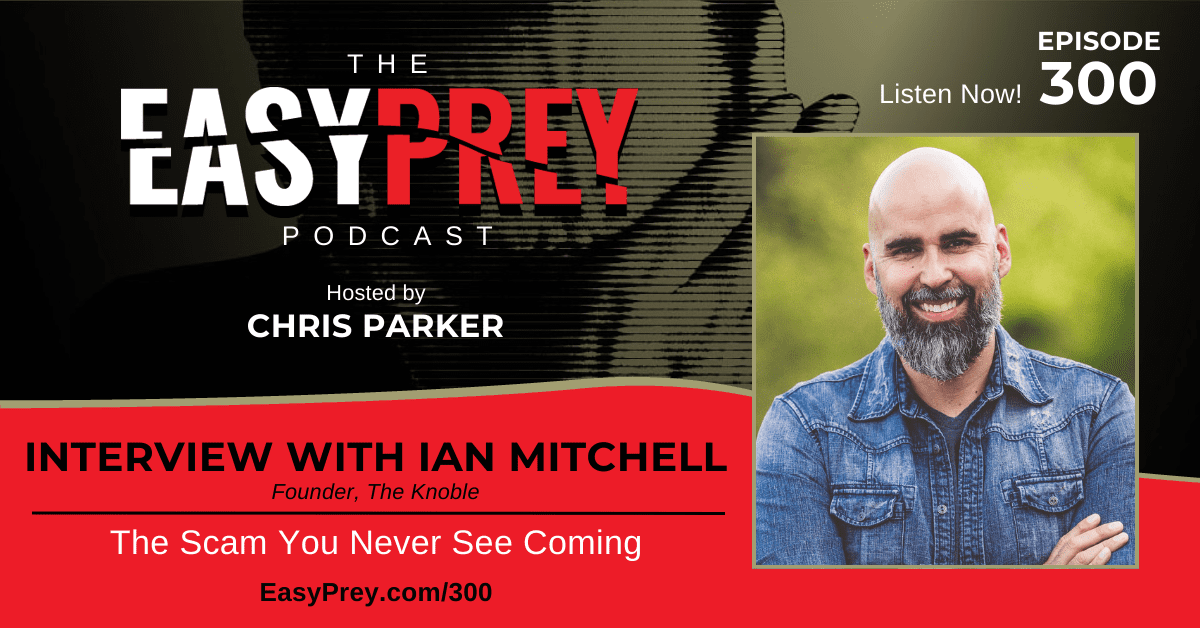

Fraud today doesn’t feel anything like it used to. It’s not just about somebody skimming a credit card at a gas pump or stealing a check out of the mail. It has gotten personal, messy, emotional. Scammers are building relationships, earning trust, and studying the little details of our lives so they can strike when we’re tired, distracted, or dealing with something big. And honestly, most people have no idea how far it’s gone.
My guest, Ian Mitchell, has spent more than 25 years fighting fraud around the world and leading teams in the financial sector. He’s the founder of The Knoble, a nonprofit bringing banks and industry leaders together to protect vulnerable people from scams, human trafficking, and exploitation. Ian has seen the evolution of fraud firsthand, from the old-school days of stolen cards to the organized global crime networks using technology, AI, and human manipulation to scale at a pace we’ve never experienced before.
What stood out to me is Ian’s belief that the strongest defense doesn’t start with fancy tools or tighter security. It starts at home. Real conversations with our kids about safety online. Checking in on aging parents. Talking openly with people we trust so scammers can’t isolate us and break us down. It’s serious work, but Ian is hopeful. He believes there are far more good people than bad, and when we look out for each other, we’re a lot harder to exploit.
“Criminals are creating trusted relationships that rival the ones we have with our banks, our families, and our friends.” - Ian Mitchell Share on XShow Notes:

- [00:58] Ian unexpectedly shifted from music and modeling into the world of fraud prevention.
- [01:19] Founding The Knoble and building a global network to fight human crimes and protect vulnerable populations.
- [01:49] A look at Follow the Money, the documentary project raising awareness about exploitation and financial crime.
- [02:19] Why Ian believes crimes of exploitation have moved directly into our homes and daily lives.
- [03:08] The early moment when Ian uncovered a major fraud ring while working at an internet company.
- [06:44] How canceling $300,000 in fraudulent orders changed the direction of his career.
- [08:11] Reflections on the “wild west” early days of online fraud and security.
- [11:01] How fraud evolved from stolen cards into emotional manipulation and trust-based scams.
- [12:49] The post-COVID surge in scams and the shift toward targeting individuals instead of systems.
- [14:03] Why fighting fraud today requires global coordination and an army of trained professionals.
- [16:38] Scammers coaching victims to distrust banks, friends, and even family members.
- [17:05] The longest romance-style scam Ian has seen — an eight-year manipulation before money was ever requested.
- [18:25] Discussion on timing, trust, and why even smart people can be caught off guard.
- [22:05] Ian shares his own experience dealing with identity theft and the complexity of proving it wasn’t him.
- [23:22] AI and big data transforming broad scam attempts into precise, personalized attacks.
- [25:31] The alarming rise of sextortion schemes targeting kids ages 13–16 and why awareness is critical.
- [26:40] The urgent need for uncomfortable safety conversations within families.
- [28:09] Why Ian believes the first line of defense isn’t technology — it’s communication at home.
- [29:30] The emotional impact on scam victims: shame, isolation, and loss of confidence in judgment.
- [31:13] How AI can be used for good and why the industry must move quickly to fight back.
- [40:40] Three essential conversations families should start having right now.
- [41:21] Protecting children through parental controls, boundaries, and digital safety.
- [42:42] Encouraging open dialogue with aging parents about financial protection and autonomy.
- [44:19] Finding balance: staying vigilant without living in fear.
- [47:57] A hopeful reminder that there are far more good people than bad — and collective action matters.
- [48:30] Where to find Ian, learn more about The Knoble, and connect with his work.
Thanks for joining us on Easy Prey. Be sure to subscribe to our podcast on iTunes and leave a nice review.
Links and Resources:
- Podcast Web Page
- Facebook Page
- whatismyipaddress.com
- Easy Prey on Instagram
- Easy Prey on Twitter
- Easy Prey on LinkedIn
- Easy Prey on YouTube
- Easy Prey on Pinterest
- The Knoble
- Ian Mitchell – LinkedIn
Transcript:
Ian, thank you so much for coming on the podcast today.
Hey, Chris. Thank you for having me. Thrilled to be here.
Looking forward to it. Can you give myself and the audience a little bit of background about who you are and what you do?
Sure. Twenty-six year anti-fraud fighter. I've led fraud teams in 14 countries. I've been fighting fraud for a long time. I didn't start out that way. I was in college, a model, and looking at getting into television. I've been writing and recording music for 30 years. I thought that was the path I was going and then somehow tripped into the fraud fight. I've been doing that for quite a while.
I founded a nonprofit about 2018-2019 called The Knoble. You've had guests from The Knoble on previously. The Knoble is a network of almost 742 financial services and institutions around the world who represent the network fighting human crimes, as we call it—human trafficking, child exploitation scams, elder financial exploitation. I co-founded the leading fraud fighting fraud services company called Mission Omega, which is fraud consulting for the largest financial and all-sized financial institutions in North America.
In the process of creating a movie called Follow the Money with a six-part episodic series, so I'm now back in the media space. We're developing a movie. My goal is to have a hundred million people watch it to raise awareness on how we protect ourselves from crimes of exploitation. Still do music, still record music quite regularly. I've got a couple other cool adventures that I'm in the process of, including an app to help us protect our houses.
For me, who am I? I don't know. I play all kinds of bases on a baseball field. I'm not sure what base I'm going to be on any particular day, but I'm unbelievably passionate that these crimes of exploitation, being a crime fighter for so long, have moved to our houses and our homes. There's really only one way we can fight back. Everybody involved in this fight from the most trained professionals and law enforcement down to our children in our household, we all have to be involved. That's what I spend my days thinking about, dreaming about, even writing music and singing about. That's who I am.
How did you make the transition from wanting to do music to getting into counter fraud? There's got to be an interesting story there.
I was working in an internet company—this is when the dot-com craze was going on. I discovered an opportunity. I was in a call center, actually, there just answering phones. I discovered an opportunity that was that these fraudsters were taking advantage of. I didn't know they were fraudsters. I contacted MasterCard. They started saying there was a bunch of fraud, and I went through and canceled a bunch of orders.
The fraud-fighting bug bit me. I went on to serve as the head of fraud in analytics and then the head of fraud at several financial institutions for quite a while. It wasn't something I planned. Like I said earlier, I was almost cast for one of a major motion picture. I just thought that was the path I was going, but this fraud fight and maybe the opportunity to do intrinsic good or to do good maybe was a part of it. I was fascinated by these criminals that are trying to circumvent the best controls to take what is not theirs. That's where it was.
Of course, my life still continued to do music. When I wasn't in Shanghai fighting fraud or nine countries in Latin America, seven in Europe, I'd be in a little white van playing music all around the country. I was previously doing a lot of faith-based music. I'd be at different events, whether it's addiction ministries or poverty areas all over the country, small churches, big conventions. I do music there with a band. I recorded under a different name, and now I record under my name. Music's been a part of my life, even in my corporate career. I've been that quirky, weird, fraud-fighting musician, singer guy, which I've fully embraced, by the way.
We need people like that in this space. It can't just be guys with glasses sitting behind computers all the time are the ones that are fighting the fraud. We need people who can actually work the crowd, smile, and make friends.
It's so funny because I figured there's a use for all of us. I don't carry a gun. In fact, I'm in the country and I don't own a gun, but that's a different conversation. I choose to say my guns, my guitar, and my voice. As we all use what we're made to do, get an understanding of what our skills are, and we're authentically ourselves, we can do a whole lot of good. We don't all need to be the amazing law enforcement people, but not all of us are made to be law enforcement. We all have an opportunity to get involved in our communities and do a little good with the skills that we've been blessed with.
We all have an opportunity to get involved in our communities and do a little good with the skills that we've been blessed with. -Ian Mitchell Share on XI like that. I want to ask you about the internet company.
Sure.
Did you find the fraud? Looking through stuff you thought, “Huh. This is fishy, something strange,” or did something else bring it to your attention, and then you just started pulling a thread?
No, I completely found it. What happened was I was noticing that I was working through the email orders that were coming in. I noticed there were these customers that were buying large—hundreds, 200 bottles of Centrum vitamins and perfume. I couldn't figure out why they'd be ordering so much. We would be charging them one flat fee on shipping, but our distribution center wouldn't have a hundred bottles of Centrum. It was one of the large internet companies. It was partnered with Amazon. It was big, we did a lot of.
I tried to get ahold of them to see if I could make it easier on them. Rather than send them for a hundred bottles of Centrum, 10 packages of 10 bottles, maybe they would be OK if we just kept the orders on the side, then ship them for one fee, they'd receive it at one time. I called some of the customers. Some of them were consumer product testing companies. Some were large corporations that wanted to fill their break rooms and that kind of stuff, but then there was a group of customers that I couldn't get ahold of.
After calling their credit card company, the card on file, that's when MasterCard said, “Hey, these are fraudsters.” I started finding traces in their email addresses and just doing searches of all the orders. I think over one week, I declined about $300,000 in orders. I was brought in as a customer service agent. I was brought unhappily. They were not happy with me when I came in to work on Monday as I stayed the weekend canceling orders nonstop, because MasterCard and Visa were saying, “Cancel these.”
I remember being ushered into the chief financial officer of a big internet company, his office. He didn't believe me at first. He thought he found a niche in the market on perfume, for example. I had to meet with the buyers, and all of a sudden, everybody realized we've got a problem.
They let some kid right outta college that was planning on moving to LA to go be a model and an actor. They gave him the opportunity to build one of the first internet fraud departments. I had an unbelievable experience of just digging into these trends and patterns. Every time I put something basic in—at the time, we didn't have a lot of systems back then—I’d put something in, and they would completely overcome it. I was the one putting in the little controls and designing the controls, and I was the one calling customers. It was a full-time job of just pure insanity, but it was so much fun.
I guess it was a good thing that I changed careers because my hair started falling out. I gained a little weight because I was sitting at computers all the time. I picked up the guitar and moved away from the print and the TV stuff.
It was very similar. I had worked for a mail order catalog company. I was part of the group that was watching. Once we started doing internet orders, I started doing the same thing of just casually looking at them, just making sure everything was good, nothing was weird, and then like you started, “Huh, this is weird. Let me pull this thread.” It's like, “Why do we have this big block of orders from customers from all over the place, but they're all shipping to this one small town, different addresses in the same town?” I'm like, “That's weird. Why would people be shipping all to this one town?”
It turns out that someone was using stolen credit cards and shipping him to his neighbor's houses and his friends' houses. I think that, for me, was a bug of like, “Huh, this is really interesting. How do I find those out in advance as opposed to after we've shipped them?”
That's right. It was the Wild West, and back then there weren't a lot of controls. A lot of the controls that were in place, very manual. The biggest frauds we were dealing with was credit card skimming and check fraud. All of a sudden, this internet thing opened up all these other types of fraud vectors that we just weren't prepared for. We learned the hard way. At the same time, I think we built the foundation for the type of fraud fighting we're having to do today.
To me it was an evolutionary time, where you had typical, traditional mail fraud-focused people moving to the digital age. It was this interesting thing, where even when I went to work at Citibank, they didn't have anybody that knew anything about internet fraud. I wasn't planning on going to a bank, but it was this understanding of what is an IP address structure. All the basics that we all take for granted today, it was a new type of fraud fighter that came in. I started learning how to do analytics using data. Scale was a brand new concept.
Just jarred to prime, I started to learn how to code analytics and code data. I wasn't very good at it, but I understood fraud. I was in this digital age, came up in it. The irony was I didn't have an email address all through college. I think I flunked one of my classes because email was new, and I didn't know how to check an email. I'm all of a sudden now in this internet fraud fight. I was a guy that just was in between the old school and the new school ways, I guess.
To me, that's one of those great times to be alive when you're at the switching point between things. You're seeing something new and exciting happen.
We're at it now. It's amazing. We're right in the middle of it now, and it's awesome. I think it's great.
When you started, the fraud that you originally started doing, it was stolen credit cards, things like that. To me, it's changed a lot now that there's so much more human manipulation as opposed to, “Hey, I was a server at a restaurant and I got this guy's credit card number off of it,” or “I had a skimmer at a gas station.” Those seem to be very unpersonal types of crimes. Now with the romance scams and all the crypto stuff, it seems a lot more personal now.
I think it's interesting. All the old fraud hasn't gone away. Fraud, from a bank perspective, used to be a rounding error, and now it's top of mind. It's because fraud has evolved and the old tactics aren't gone. They just added these new tactics. Every time we open a channel or a new instrument or a way of moving money, there's new ways of committing fraud. I've seen this move from card fraud and check fraud. They're really focused on the instrument and the item of how money is, then we move to identity theft and the different types of identity theft from new account fraud, taking over your tax, identity theft around taxes, identity theft around account takeover, or taking over your existing account. That was a new wave.
It's because fraud has evolved and the old tactics aren't gone. They just added these new tactics. Every time we open a channel or a new instrument or a way of moving money, there's new ways of committing fraud. -Ian Mitchell Share on XWe got into this first party fraud or a type of authorized fraud that basically the customer is the fraudster, and there are all these businesses that opened up to train people on how to commit fraud. The customers of these institutions became fraudsters, if you will, or people would come from overseas for a short amount of time and commit fraud. There was this wave of first-party fraud. They realized, as all these banks, internet companies, and telecommunications started putting in controls, they had to go, “That exists and it's profitable, but where is the weakest link?” What they discovered is the weakest link is all of us.
After Covid, they scaled up this scam problem that we're all dealing with. Now, the card fraud's not gone away. Check fraud doesn't ever seem to want to go away. Identity theft is still a problem. Bad customers […] first, but those are all there. Now add on this scam problem that we have, and it's scaled to a point where across the world, the amount of fraud attempts, the technology they're using, and honestly they're enslaving people to commit these frauds in these scam centers, the amount that they've been able to mobilize armies using technology and people.
Fraud is no longer rounding error for a lot of banks and companies. Fraud leaders, while there used to be 20 of us, and the same 20 of us used to get the same phone calls to go lead fraud at this bank and that bank—that’s probably why I've worked for about five or six banks—and we would go help a bank for a season and then we'd go to another bank. Now there are hundreds and hundreds of very unbelievably skilled professionals that are fighting fraud day to day. The fraud fight is now armies.
In my estimate, there are 600,000 people that wake up every single day around the world that just have a job of fighting bank fraud. -Ian Mitchell Share on XIn my estimate, there are 600,000 people that wake up every single day around the world that just have a job of fighting bank fraud. It's gone. I've spoken to more boards of directors of banks in this last year than I did all the years prior. It's because now, the fraud problem has reached a level that the most senior executives, not only are aware of it on a personal basis because we're all at risk, but then as a company basis, their customers, the losses that they're experiencing of these, that's all become such a giant challenge that we're in a world, how has it evolved? We are now in a world where we are fighting criminals that have diversified their organized business crime model. They've diversified it and are able to scale it using technology and people. We need an army to fight an army basically.
We are now in a world where we are fighting criminals that have diversified their organized business crime model. They've diversified it and are able to scale it using technology and people. We need an army to fight an army… Share on XHas it changed the way banks interact with their customers? It used to just be like, “Hey, we're going to call and verify this.” Now it seems like it's so much more complicated in that the scammers are now coaching people on how to interact with tellers and customer service people. Is it just this escalating cat and mouse?
I think to answer your question, twofold. One, when we talk about interacting with our banks, for example, it's one of the most sensitive interactions that we can have as a human being. As a citizen of a country, as a human being, our assets, our retirements, our savings, our mortgage payments are tied to all these financial institutions. It's one of those most sensitive and hopefully trusted relationships you have as an individual in a country, in a society.
What banks have realized and financial institutions realized, and they've started actually talking about fraud as a financial institution 20 years ago, you never wanted to mention the term fraud because we would lose trust. We think that my bank's getting hit by fraud and not realizing every bank's getting hit by fraud. It was a word we avoided. What happened over the last 20 years is we've actually allied as a consumer. As an individual, we ally with our bank. A lot of the things that we deal with on a daily basis we don't realize are put in there to mutually, together, fight back these fraudsters.
There's a lot of things we take for granted now around authentication, getting asked questions when we open a new account, and click on this little captcha thing that has all these changes. How many buses do you see and how many motorcycles? All this is to fight this crime. We just have accepted it, not realizing that we're actually involved in fighting fraud and financial crime every day. That's the good news.
How many buses do you see and how many motorcycles? All this is to fight this crime. We just have accepted it, not realizing that we're actually involved in fighting fraud and financial crime every day. That's the good news. -Ian… Share on XThe bad news is the criminals, again, move to all of us individually. They are grooming in creating trusted relationships that rival the trusted relationship we have with our bank. Actually, to the point where these scammers have been really successful, there's a recent scam victim I was speaking to that had been in a relationship for eight years with a scammer. The scammer didn't start talking her into sending money until year six. That's a long time, longest one I've ever heard of. Normally I hear long time was two to three years. This was the longest one.
When you start looking at all of us, they're creating these trusted relationships that now rival the most sensitive, I would argue, commercial, financial, professional business relationship we have, being our banks. In a lot of cases, these criminals are coaching all of us when we find vulnerable relationships to say, “Don't trust your bank; they're in on it.” They're coaching.
I hear stories all the time from The Knoble network and The Knoble community of how hard it is. I think Freddy talked about this as they did a post-scam victim guide for banks. We hear stories all the time of these criminals are coaching these victims while they're in a bank. They're on the phone with the criminal. They're talking to the teller, and the teller's trying to say, “This is a scam,” and the criminal's saying, “I told you they'd say that.” It's this constant thing, where they actually want to have one device on while you're talking and they can hear the conversation. That's the world we're in today.
Where we're going is with AI, but where we're in today, these criminals are using manpower. They're using relationships, and they're creating bonds that rival the most trusted relationships we have in our society. That's a problem.
Yeah. That is one that has always amazed me at the ingenuity of it. They've been able to convince people, “We want you to go to your regular bank, not to a different one because we think there's a teller there that's in on it, but we don't know which one it is.” They convinced the victim to trust the scammer more than the bank teller. You have to believe us and not them. To me, in my mind, I think, “Why wouldn't I go to a different bank?” They've been manipulated past that process already, unfortunately.
That word trust you use is so important. It's one that, when it was introduced in the professional world, I didn't quite value it as much as I do today. You start looking at, just even at a human level, when we get a text message about a toll booth and we've been driving across the country, how they get some of the timing right. I don't know. There's all kinds of data profiling that goes on. When we get something from a retirement company, how do they know that I am at this investment company for my retirement? The trust factor when I get an email, when I get a physical piece of mail about a piece of property I own or don't own and just saying, “Hey, you owe back taxes.”
I got a phone call about a year ago now from a hospital saying, “Hey, you need to pay your bill for your ambulance.” It's a hospital in Las Vegas. I went, spoke, and sang in Las Vegas six times last year. Unbelievable events. I get to bring my guitar everywhere I go and I get to sing to professionals. I have the best life. I was there six times last year, five times too many, as far as I'm concerned.
I got a phone call from a hospital that said, “Hey, you owe us a bill for an ambulance ride you took while you were in Las Vegas.” People were following me. They probably knew that I was in Las Vegas. I don't know. Basically I thought it was a scam at first. They kept calling me, then it went to a collections company. I'm ignoring it. Finally I called them back, and I basically talked to them.
It turns out there was somebody with my name that gave them my personal address, which I don't publish, my phone number, that rode an ambulance ride from a casino to this hospital that said they were Ian Mitchell. They committed identity theft on an ambulance ride. When they got treated for whatever it was, they gave them credible information on insurance. For me, this poor collections company is looking at my website of my speaking and saying, “You were in Las Vegas six times. You're telling me that wasn't you?” I'm like, “I'm telling you, it wasn't me.”
This awkward conversation, for the better part of probably eight months of trying to go and convince them, it got to the point where I'm like, “Hey, you know what I do for a living in addition to the music and all these other crazy things, I'm also a trained fraud fighter. I've got some amazing investigators that'd be happy to help you.” They're trying to navigate this also when every indication that they would have says, “Ian probably took an ambulance ride from a casino to a hospital.” But it wasn't me.
That's an interesting thing that you talk about who this person was, why they chose me. I have no idea because I'm being outspoken on this financial crime fraud fight, and whether it's through The Knoble or whatever, I tend to get some interesting targets that blow my mind all the time. Some simple, some very complicated, some I'm just not sure how they figure it out. I had a security firm do an assessment of me personally and came very high risk. To me, it's an interesting thing. We are in this fight against, honestly, criminals that are scaling evil. That's what it is.
Yeah. I look at the confluence of AI—we’ll call it lots of data or big data and scams. It is interesting because I've interviewed so many people, even people in the counter fraud and counter scam and cybersecurity space who've all been victims of crimes. The most common thing is it comes down to, “Well, it was just the right message at the right time, in the right context, and I just happened to have my guard down. I was expecting an international shipment. When I got a text message about tariffs I needed to pay on an international shipment, my mind put those two things together. Obviously, it was what I was doing.”
They get down the road and realize, “Oh, wait. This is a scam. Let me stop.” Or they got scammed out of a little bit or a lot of money. I worry that you take the AI, you take the big data, you take the scammers, and now this shotgun approach of, “I'm in town golfing and I want to hang out.” Instead of sending that to a million people who don't play golf, they now mention the golf course that's near my house. They know that I play golf, and they know my name and it's associated with my telephone number, so they use that, and a couple of other things that are out of big data. All of a sudden, what was an attack against millions of people becomes a spear-phishing attack.
That's a hundred percent right.
At scale, it's not just the CEO of a Fortune 500 company or some outspoken cryptocurrency influencer. It's just now anybody and everybody gets spear-phishing targeted.
The interesting thing, and I'm sure you've covered this quite a bit, is we're all vulnerable. It doesn't matter what your job is. If you're a career fraud fighter, financial crime fighter, I can't tell you how many chief risk officers and heads of financial crimes have called me in a trusted environment and said, “Hey, this has happened to me.” I've got another story for you, but we're all vulnerable.
We all have certain life transactions that we're doing. We're all, at some points, a little bit greedy, some points we're a little bit lonely. They prey on these on all of us. It's the human factor they're going after. -Ian… Share on XWe all work too fast. We're all too busy. They prey on us being too busy to double check. We are all doing life transactions. It's actually pretty predictable when you start talking into certain age groups and such. We all have certain life transactions that we're doing. We're all, at some points, a little bit greedy, some points we're a little bit lonely. They prey on these on all of us. It's the human factor they're going after.
When we look at our vulnerability heat map at various points in our life, certain messages resonate. Some of these YouTube algorithms have found a way to give me videos I've never asked for. How they know what's in my head, I have no idea.
When we look at our vulnerability heat map at various points in our life, certain messages resonate. Some of these YouTube algorithms have found a way to give me videos I've never asked for. How they know what's in my head, I have… Share on XThese criminals are doing the same thing. I'll tell you, we're talking fraud, but my passion is the human crime side and the crimes of exploitation. That includes scams, but this problem of sextortion where they're targeting children, 13 to 16-year-olds primarily, mainly boys. They're basically looking to get them to infiltrate their friend network. They get them to take compromising pictures of themselves. The minute they do, they extort them for small dollars.
I've done a lot of work through The Knoble and through a lot of amazing people to try to prove out that we can look at financial transactions to protect our children. That's a huge passion for me. I wrote a song and released it called “Protect Our Children” a couple months ago. When we talk about the most vulnerable and innocent among us, it's these children that don't have years of mistakes behind them.
I now have 10 people in my network after I'm on stage speaking and singing about living a life of purpose and coming up. I remind everybody that not only is it in your profession, but it's in your home life. We need to have awkward conversations in our household. No shortage of 10 people have come up to me afterwards. These are heads of very senior executives, these are people that are managers. These are people that are entry level, but they have kids that are in that 13 to 16-year-old timeframe. They have healthy home lives, but their kids have fallen victim to sextortion.
In several cases, their children were about to commit suicide and their last ditch effort was to have a conversation. These are all words that probably I'm not supposed to be saying on YouTube, so I'm sorry to be potentially flagging your video. Beep them out if you need to. This conversation that needs to happen in our home, we're all at risk. Our children are at risk. Our elders are at risk of financial exploitation.
My dad fell victim to a financial scam while living with me, hearing about these stories all the time. This goes back to our inherent vulnerability that we all have. This has got to be top of mind. It doesn't matter how successful, how well-off, or how much you're struggling. It doesn't matter if you have kids. We are all at risk of these crimes of exploitation. I think that's the part that's really changed for me in my personal life is understanding that there's a level of urgency around protecting ourselves, our communities, and the ones we love. The only way to do that is to speak to them, talk to them, and have awkward conversations at home that nobody likes having.
It doesn't matter how successful, how well-off, or how much you're struggling. It doesn't matter if you have kids. We are all at risk of these crimes of exploitation. -Ian Mitchell Share on XIf we're not doing it, it's happening on platforms like Roblox and all these other gaming platforms. If we're not doing it, it's happening through Insta direct messaging. If we're not having these conversations proactively, there's a void of discussion that's happening. It creates vulnerability.
To me, that is one of the most important things I see as a community. Yes, there are things we need to do at a national level, international level, as a private sector, but I do believe that the best line of defense starts in our homes. The first line of defense starts in our homes to know that we can trust our bank when our bank gives us a phone call.
How do you know that it's your bank calling you, not a scammer pretending to be your bank? There are just some basic life skills that we're not having as part of our interactions. That's a big void that they're preying upon because right now, there are giant gaps of open dialogue on very tough subjects. That's a miss. We need a national awareness campaign around this, but we can start one in our homes at first.
Yeah. That's the theme I have heard from victims. A family member had passed away, or there had been often some significant life event, which left them in a place where they were seeking something or had a deficit, not in a bad way, but not as something of their fault. There was a gap in their life and that the scammer was able to fill that void.
The challenge is afterwards, there's so much of the embarrassment and the humiliation about talking about it, but also, the common theme was I don't trust my own ability to be able to assess other people. To me, obviously the financial hardships are immense, but then being able to like, “Well, as part of the scam, they pushed me away from my family and friends, and I've damaged those relationships, but now I don't know how to rebuild them, and I don't know how to even trust again, or to trust myself to be able to assess where I should be building and where I shouldn't be building.” It's that human squishy side. We'll figure out the technology, but the human squishy side, the brain, and the heart side are the things that are always going to be able to be manipulated at some extent.
The word that I've now not backing off of and how I describe it because of what you describe is pure evil. It's what it is. It creates even more isolation. It creates more distrust in you as an individual, being able to rationalize something and trusting people that may be out there that their job is to care for you, let alone family members that do or don't. Preying on that. Even healthy environments is absolutely the pattern that we're up against.
They're doing it very credibly. They are using technology to be credible in their manipulation. That's the thing that we're up against now. A friend of mine, another YouTuber, Kitboga, says AI is being weaponized and we need to use better AI to fight this. We do need professionals to start upping our game and realize that there's an intrinsic good in our society, whether or not we can justify the return of making investments to secure and make better relationships.
We, as a private sector, have got to lean in here because this is the breakdown of our social fabric and our interaction model. That's what's at stake here, this idea of trust that we can't even trust notes from the government, phone calls we get from our banks because it looks like our bank. I could get a call from Brad Pitt and not know that it's not really Brad Pitt. It's this breakdown of the social construct that we as a community, especially the private sector because I wish I could say the government sector was coming in, I'm very encouraged by conversations I'm having on that. I'm involved in quite a bit of it. I like to see what I'm seeing, but the level of urgency we're at right now is going to take the private sector.
A former senator, I was meeting with him on this human trafficking topic. This senator did so much in this human trafficking space. As I'm talking to a person who I very much respect and I'm spending hours over meetings with him talking about this, he said something that I didn't understand in the moment, but I understand now. He said, “The government's not going to fix this. The private sector needs to.”
As I am talking to financial payments people, C-suite of banks, fraud fighters, law enforcement, telecommunications, there was a giant telecommunications event in DC just a couple weeks ago there, as I'm speaking to the private sector, that's why I wear this heart on my t-shirt. Every time I'm done speaking, I sing a song called “Living with Heart.” We need everyone that's in the private world that is trying to make money, provide money for their families, have a solid income, all these things that are intrinsically good about, just the capitalistic model. There's a lot of it that is really in its best sense is very powerful. If we can't figure out how to justify protecting community, society, and the most vulnerable, we've got a problem.
I'm now having really wonderful conversations with very powerful companies that are coming in. They can't justify any investment from a pure monetary perspective, but they're needing a whole lot less convincing on why they should be doing it. That, to me, is when I look at my world and where I started nine years ago, having this conversation to where we are now, this idea of getting involved, living with heart, doing good. Because we're all vulnerable at home, it's not a giant leap for them now to bring it into the workspace and realize there's something I can do about it.
I think while we talk about all this crime, one of my lines of that song is “there's more good people than bad.” I think that's something that we can't forget. Yes, they're using AI. Yes, they're enslaving people. I pray for those people that are enslaved all the time. Yes, there are criminals in this world. There's an old movie, Bug's Life, where the ants finally realize there's more of them than the grasshoppers. There are more good people on this planet. The bad people, I'm just going to say times 10 times, a hundred times, a thousand times, a million.
It just takes all of us to open our aperture, just a percentage, to let some more light in and express that in our work. I don't care if that's at a taxi, working at a ride share, at a hotel, in fast food. You look at Delta and what they've done on human trafficking and raising awareness. It doesn't matter what sector we're in and what problem we're talking about. We all have that opportunity to come in through work and be a big part of solving that problem. I think that's changed, and I'm seeing that fabric change in the last nine years. It's a beautiful thing. We have a long way to go, but so many sectors are getting involved.
It doesn't matter what sector we're in and what problem we're talking about. We all have that opportunity to come in through work and be a big part of solving that problem. -Ian Mitchell Share on XYeah. That's the reason why I do the podcast. It's not an ROI. I'm never going to make money off of this, but it's how can I help the world to be a better place? I think as more and more people start to realize, yeah, there will be technology to help us fight some aspect of this. A lot of it's going to be relational. It's going to be helping people to have relationships, helping people to have trusted friends and not just one, but to teach us how to trust our tribe in a sense.
When we don't go to our tribe about, “Hey I've met this person and now they're giving me financial advice.” Or, “Hey, I'm about to make this big investment.” If we don't have those tribes of people to go to, someone outside the box who can look at that and say, “That doesn't seem right. Let's talk about this. Let's look at it together,” as opposed to, “I'm just going to make all my decisions inside my own little headspace, not talk, and not trust anyone.”
It's one of the challenges we have on the human side. This is, again, a line in that same song. We're not only fighting some isolation that's come out of whether it's the pandemic in some good ways. We now are a little bit more self-capable. There's a word I'm looking for too, but this world of distraction. We could be in the same room with people we're supposed to have hard conversations with, and it's just easier to get distracted and not have those conversations. I know I battle that all the time personally.
This world of increased distractions is creating a challenge. With the world of distraction, there are so many platforms like yours that actually, whether or not we want to have a conversation, we need to share these conversations. There's more content with the world of influencers. Yes, there are plenty of distractions that say, “You need to buy this shirt, Ian. It will make you feel better.” All that stuff. There's also just as many.
One of the things we can do is leverage some of these destructive tools and operate in the ecosystem we're in to share and promote content that has that reinforcing message. Also, I just think all of us need to be authentically ourselves. We're all uniquely gifted and made to have certain skills. Whether you're a musician, you're a YouTuber and you have podcasts, whether you're at work, it doesn't matter where, you're in social work, or you're a grandparent that is retired now, we all just need to activate a little bit.
Just by the very nature of what's going on in society, we all have platforms, abilities, and unique skillsets to serve and have conversations in our unique communities in our unique way. Not everybody needs to start a nonprofit, become an anti-scam expert, or become an anti-human trafficking expert. What you need to do is just take interest. When you find experts, promote that and raise it up, or just have very basic conversations about love, communication, and things that we're just not. I think we're well positioned.
I think there's a general hunger, though, again. It goes back to that tide turning. We've come a long way from the fraud fight of our initial conversation, but I think it's all tied because these criminals have diversified their business model, they're committing fraud, they're money laundering, they're scamming, they're human trafficking, and they're doing child exploitation, because behind this is a desire for money. We're all vulnerable.
As we start raising up platforms like yours, Chris, as we start having hard conversations at our dinner table, as we start caring a little bit more for our neighbor and checking in on them, we start challenging ourselves that we start actually fighting back in a very meaningful way. That's one thing that AI can't compete with. You knocking on your neighbor's door next door and saying, “Hey, I just want to make sure you're OK.”
Yeah. AI is never going to give us a human connection. I think that's what we all crave. We just need to figure out how to act on it and, say, go to our neighbors, go to our friends, and, “How are you doing?”
By the way, I'm really excited about AI. I know the doom and gloom around AI, but honestly, as a fraud fighter of 26 years, what I'm seeing it able to do is unbelievable. I think as we take these powerful tools—that’s what they are, they're a tool—and apply it to really complex, dynamic, changing problems like financial crime, money laundering, and validation of identity, the power of AI is so amazing. We have to just get it in the hands of the good people. We need more of that because us sitting and saying it's not coming, we've missed that already. We need to now embrace the areas that are real in our life that don't need AI. The places that need AI, we need to go all in.
As we wrap up here, the three tough conversations we need to have, what are those three tough conversations?
I'll have to start with one that's near and dear to my heart, my personal life. This is one that might get you in trouble with YouTube again, and I'm sorry.
Sorry, YouTube, that's not my problem.
This problem of children having devices. As parents, I'm going to plead, put parental controls on your children's devices. I thought I did. I have three kids. If you don't do it well enough, protecting your child's eyes, it's got to be so important. We have to create that safe environment for our kids to experience the beauty of the internet and the digital media. Curate, please. We have to protect our children.
What I would ask is, the first thing we have to do is, as anybody who's in the world of children, whether you're a grandparent, you're a parent, you're parents that are together, you're divorced, please come up with that child safety program. There are devices you can buy that will protect your children, but protect your children. So much of where we see a problem manifest when they get older starts as children.
What I've seen when I was at the United Nations a couple of years ago, speaking there the first day I'm hearing from these giant leaders around the world, and talking about the very genetic, cellular level that damage of abuse happens as a child, so please protect your children. That's my first thing. That means having awkward conversations with your kids about not taking compromised pictures of themselves. It means you as a parent, them hating you because you won't let them go to certain websites. We have to. For us to fight back and win in a decade or two decades, that's where it starts.
Second thing, your aging parents. Create a safe word. Have conversations. I know my dad, I love him to death. He's in his eighties now. He's an unbelievably smart man. He's still sharp as a tack. His body's failing, but having financial conversations, that's something that I even struggle with him because he's so knowledgeable. He can run circles around me, but we have to have these conversations.
It's not just the elderly that are being attacked, it's all ages. Really, for some reason because they're in retirement and there's a lot of money sitting there, generational wealth is being stolen. Start having conversations with the elders in your communities.
I think the last one on scams, just in general with your homes. Actually, this is even human trafficking too. I'll add one little quick story. Do you have time?
Yes, absolutely.
This movie came out called, Sound of Freedom. It was about human trafficking. There's a lot of negative stuff that came on that movie, but I thought the movie did a great job. I was sitting, I watched it next to two human trafficking survivors. I asked them afterwards, and they thought it was very well done. It got a conversation out that was so powerful. There was a lot of good that was done through that movie.
I was at the Atlanta airport. I was renting a car, and the woman saw my pin for The Knoble and said, “What is that?” I talked about what we do about fighting human trafficking. She said, “Hey, Ian, have you seen Sound of Freedom?” “Absolutely.” She said, she's 16 years old, and I don't let my daughter go anywhere without me now.
I don't want to create a spirit of fear when we talk about these crimes. I don't want every text message that comes in to think it's a scammer. That destroys the fabric of us being a human in a society. We need to have a balanced level of knowledge and vigilance, but not create fear. The only way that happens is we take training, we go and we educate ourselves, and when we get something and we don't recognize, we don't initiate that fear response. We realize that we're the ones actually in control.
Fear happens when we don't think we're in control. Fear happens in the void of love, and it feels like we're out of control. -Ian Mitchell Share on XFear happens when we don't think we're in control. Fear happens in the void of love, and it feels like we're out of control. We have to understand, when somebody's coming and asking something from us, whether it's a text message saying, “Hi, I miss you,” or, “Hey, you owe me $10,000 for these back taxes,” the fear response will create urgency, will spin, or whatever. That's what they prey on. If we don't let fear come in, we just pause and try to just analyze this, and have conversations, that is the way that we actually create a working society and a working fabric of culture.
Until all these tools and until law enforcement starts taking down these, I'm so excited about what federal law enforcement's doing. Still, they start taking out these criminal enterprises. We need to, as a society, make sure that we are sober, pause, and don't let fear invade the way we view all these real crimes. That's something for me. Again, it just happens with conversations around it.
Yeah. I just try to have conversations with people about, “Hey, are you getting the toll road texts also? Are you getting the, ‘Hey, do you want to go play golf text message?’” I just try to bring it up and not in an accusatory way, or you've got to protect yourself, they're all out there to get you, but just as a more conversational, “Hey, is this happening to you?”
I know one of the challenges with dealing with our parents is they don't want to lose their autonomy. There's fear again, a fear of losing their autonomy. There's this growing reluctance to talk about things that they're uncomfortable to talk about. But if we start having those little bits and pieces and not making it, “Hey, do I think you have dementia,” but rather, “Are you getting these silly text messages also,” it's less threatening. It's not about trying to take away their autonomy.
I have fun talking with people like, “Are they getting any better, or are yours just as silly as the ones that I'm getting,” and try to make it light but still have those conversations. Someone's listening in and going, “Oh, is that what those are? I thought it was someone who just got a wrong number.” I was always replying to them saying, “blah, blah, blah, blah.” Let's try to avoid that.
That's a hundred percent right. If I can add just one little thing too. I need you to walk. Anybody listening, walk away and encourage that I get to interact with thousands of people in the financial profession that are trying really hard to fight back. As we talk about these, again, the sleeping giant of the financial community has woken up. I will tell you, having been a banker for 26 years of my life, there's probably going to be nothing scarier than the full force of the financial community using the technology, the data, and the infrastructure it has to protect ourselves.
Again, I'm not talking about the banks themselves. I'm talking about the amazing people within the banks. I'm very excited about what I'm seeing come out of that world. We have a lot to do. I will tell you, I was, like I said, at telcos. They're trying to figure this out, so we've all got to figure out, but there's a lot of good people that are really trying to figure this out. If you walk away with anything on all these crimes, just know that there are people that wake up every day trying to be a part of protecting you. Yeah, it's a good thing.
If you walk away with anything on all these crimes, just know that there are people that wake up every day trying to be a part of protecting you. -Ian Mitchell Share on XI love it. I think that's a great note to end on. Ian, if people want to connect with you, The Knoble, or any of the other organizations that you work with, how can they do that?
You can check out www.theknoble.com. Please check it out. Want to learn more? There are plenty of ways to contact there. My music—Ian Mitchell—Spotify, Apple, all the rest of them. You can look at my music if that interests you. Any other way that you can find me on all the normal channels, LinkedIn, Instagram, and all the rest of it. Thank you, Chris, for your time and I appreciate you bringing me on.