


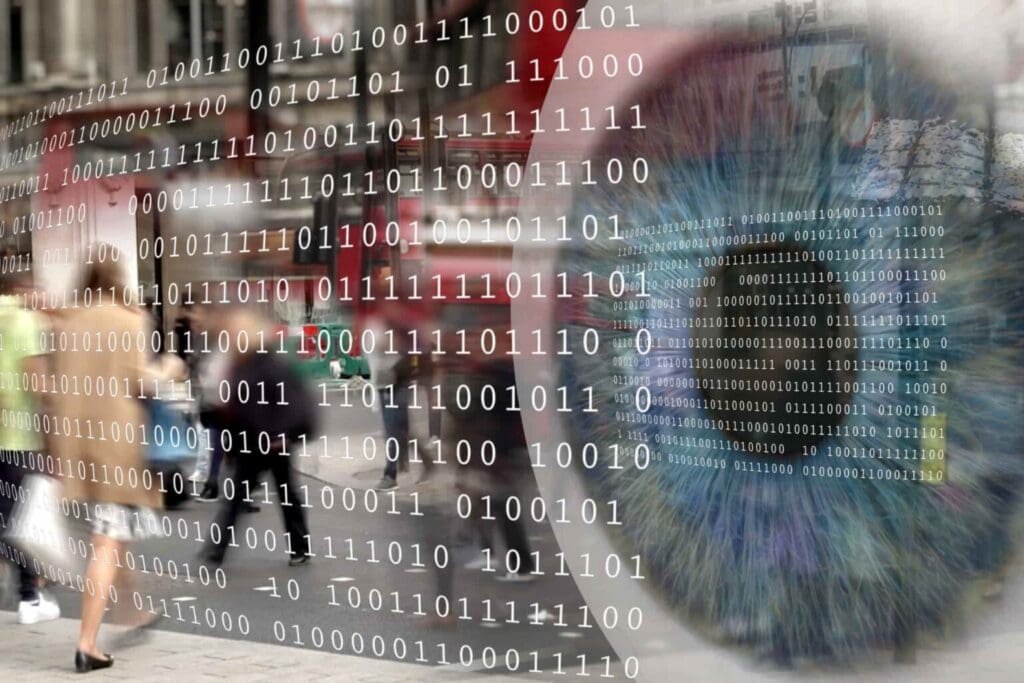
If you’ve ever felt like your smart devices are “spying” on you and silently collecting your personal data to feed the almighty algorithm or control your actions, you’re not alone. Thankfully though, our smartphones and television sets aren’t nefarious spies, gathering information to use against us.
Nevertheless, AI surveillance through video cameras used by governments, businesses, and law enforcement is a growing part of our reality, and raises important ethical questions: Are invisible forces watching us with AI (Artificial Intelligence)? Why? Is this an invasion of our privacy?
Although AI surveillance has numerous benefits for public security, it’s vital to examine the toll it may take on our right to personal privacy. As AI technology continues its rapid advance, the ethics surrounding how we use it need to be addressed.
What is AI surveillance?
AI surveillance is the analysis, collection, and interpretation of video footage to identify objects and patterns through the use of artificial technologies (including behavior tracking, facial recognition, and predictive analytics).
Without the need for constant human input and oversight, AI surveillance tools monitor digital activity, people, and places to help companies, governments, and law enforcement agencies increase efficient security measures. These tools can analyze behavior, detect potential threats, and track individuals in real-time.
Some important statistics to note about AI surveillance include:
- AI surveillance is used by governments in at least 75 out of 176 countries
- Both China and the US are leaders in advanced AI surveillance technologies
- Facial recognition systems, and smart city and policing are the most widely used AI surveillance tools
- 83% of businesses use cloud-based AI surveillance tools
Real-world examples of AI surveillance
AI surveillance is already integrated into the security protocols in a vast number of industries. As AI grows more sophisticated, its use in surveillance will continue to expand.
Here are some real-world examples of how AI surveillance is already used:
- Law Enforcement and Public Safety:
In the US, Europe, UK, and Asian countries, law enforcement and public safety officials use AI surveillance tools for the following purposes:
-
- Body Camera Analysis: AI analyzes law enforcement behavior, identifies potential biases, and improves training.
- Facial Recognition: Officials might use facial recognition to identify individuals, locate missing persons, and to track activity.
- Smart Cities and Traffic Management:
- Smart cities, like New York, Seattle, and Washington DC, have implemented interconnected AI surveillance systems that include cameras and sensors to optimize city services such as public transportation and waste management.
- By analyzing traffic camera feeds, AI can monitor traffic, detect accidents and red light violations, manage congested roads, and more.
- Healthcare:
-
- AI surveillance through analysis of wearable sensor data, medical images, and patient data can enhance healthcare by improving diagnosis, preventative care, and treatment plans.

The security benefits of AI surveillance
AI surveillance offers numerous benefits for public security, including:
- Crime Prevention:
One of the greatest benefits of artificial intelligence in any industry is its ability to analyze vast amounts of data in real time. AI surveillance can analyze behavioral patterns, camera and video footage, public records, social media, and other databases to identify potential threats and prevent crime.
- Enhanced Threat Detection:
AI algorithms used in surveillance are trained to analyze vast amounts of video data, detect unattended objects (like baggage in an airport), and identify suspicious behavior (like erratic movement, loitering, violent behavior, and unauthorized access).
This allows security systems to create real-time alerts and improves swift response times from law enforcement.
- Reduced False Alarms:
AI surveillance tools can be trained to differentiate between genuine threats and false threats. This allows security and law enforcement officials to avoid responding to bogus risks and improve responses to actual threats.
- System Integration:
AI surveillance systems can integrate with other security systems in place, like alarm and access control systems to create more comprehensive protections.
Ethical and privacy concerns of AI surveillance
While AI surveillance can boost security and efficiency, it also raises serious concerns about consent, potential misuse, and privacy. Think of cameras that not only record you but analyze who you are, where you go, and even predict what you might do next like in the dystopian film, Minority Report.
As this tech becomes more powerful, the line between protection and intrusion gets increasingly blurry. Some of the most concerning ethical and privacy concerns of AI surveillance include:
- AI Algorithm Bias and Facial Recognition Discrimination:
Algorithm bias has been problematic in many recent AI tools. Researchers from the USC (University of Southern California) Information Sciences Institute found that at least 38.6% of AI “facts” contain inherent bias.
Similarly, AI facial recognition systems often exhibit racial bias against minorities and gender bias against women, and have high risks of potential misidentification. Ethically, this becomes concerning as false arrests, unjust harassment, and racial profiling can result.
- Predictive Policing and Overpolicing:
AI surveillance tools can analyze historical crime data patterns to predict future crime hotspots. However, this predictive policing tool isn’t error-free and can perpetuate existing biases and overpolicing in minority communities.
Law enforcement AI surveillance provider Clearview AI got into legal hot water for scraping billions of facial images found online without consent, and the company’s practices raised serious ethical questions and privacy issues.
- Privacy Concerns:
Where does personal privacy supersede the need for greater public security measures? Many countries and over a dozen U.S. states have variations of digital privacy laws in place to protect consumer privacy rights.
There are serious questions about whether or not AI surveillance violates privacy rights by surveilling without consent and potentially misusing personal data.
Robust regulations and ethical guidelines on the use of AI surveillance can keep employee oversight and government monitoring in check. However, without any regulations, surveillance would run rampant — our smart devices and AI tools could be used to monitor our behavior. A balance between privacy and security is vital in the future use of AI surveillance.
How to find the ethical balance between security and privacy
AI surveillance has many benefits, can increase law enforcement efficiency, and can optimize public safety. Nevertheless, its ethical implications must be addressed. Federal and state online privacy laws can curb its oversight and allow us to maintain our individual privacy.
Similarly, transparency in the use of AI surveillance can help consumers to exert some control over when they are being monitored.
State and federal laws that regulate AI surveillance
There are several existing laws that keep AI surveillance overreach at bay, and protect data and privacy, including the following:
- Biometric Information Privacy Act (BIPA):
Passed into Illinois state law in 2008, the BIPA protects consumers from having their biometric data collected, stored, or shared without their consent.
- California Consumer Privacy Act (CCPA):
Enacted in 2020, the CCPA gives consumers control over the collection of their personal data by data brokers and other digital data collectors.
- Algorithmic Accountability Act:
The Algorithmic Accountability Act of 2023 has been introduced to Congress, but not yet passed. The proposed federal bill would protect consumers from AI bias and discrimination in credit, education, employment, and housing.
It seeks to mandate companies to assess the adverse impact of any automated decision-making processes they use, and identify and mitigate potential AI biases.
Federally, the government is still determining what regulatory measures are needed for AI surveillance and other AI tools. President Biden signed an Executive Order for the Safe, Secure, and Trustworthy Development and Use of AI. However, President Trump has taken a more permissive approach to AI’s use and in his first days in office, signed an Executive Order for Removing Barriers to American Leadership in AI.
Transparent Use
Clear privacy notices that inform consumers about how and why their data is being collected and when it may be used to inform AI surveillance systems can help curb unethical practices.
AI systems should also transparently communicate to users how input may be used for training purposes and other uses that may impact individual privacy.
Ways to protect your personal privacy from AI
It’s important to understand your digital privacy rights and remain informed on how your data may be used for AI surveillance and other purposes. Here are some other proactive ways that you can protect your personal privacy:
- Turn off data collection settings:
Many states require that websites post an opt-out option for data collection. If you have this option in your online browsing, ensure that you use it. If you don’t have this option, you can toggle to a website’s privacy settings to turn off specific data-sharing features.
You can also protect your data privacy by using data removal tools like DeleteMe and Incogni.
- Use encrypted messaging:
When communicating online, use a messaging app with end-to-end encryption capabilities like Google Messages, Signal, or WhatsApp. Encrypted messaging protects your privacy by providing a secure form of communication that prohibits data collection.
- Utilize VPNs:
Using a Virtual Private Network (VPN) any time you get online is the best way you can consistently protect your digital privacy. VPNs like IPVanish, NordVPN, and Surfshark create a private, secure, and encrypted connection between your device and the Internet.
Regulated AI surveillance can offer many security benefits. However, ethically, our collective and individual privacies need to factor into how, when, and why it’s used.