







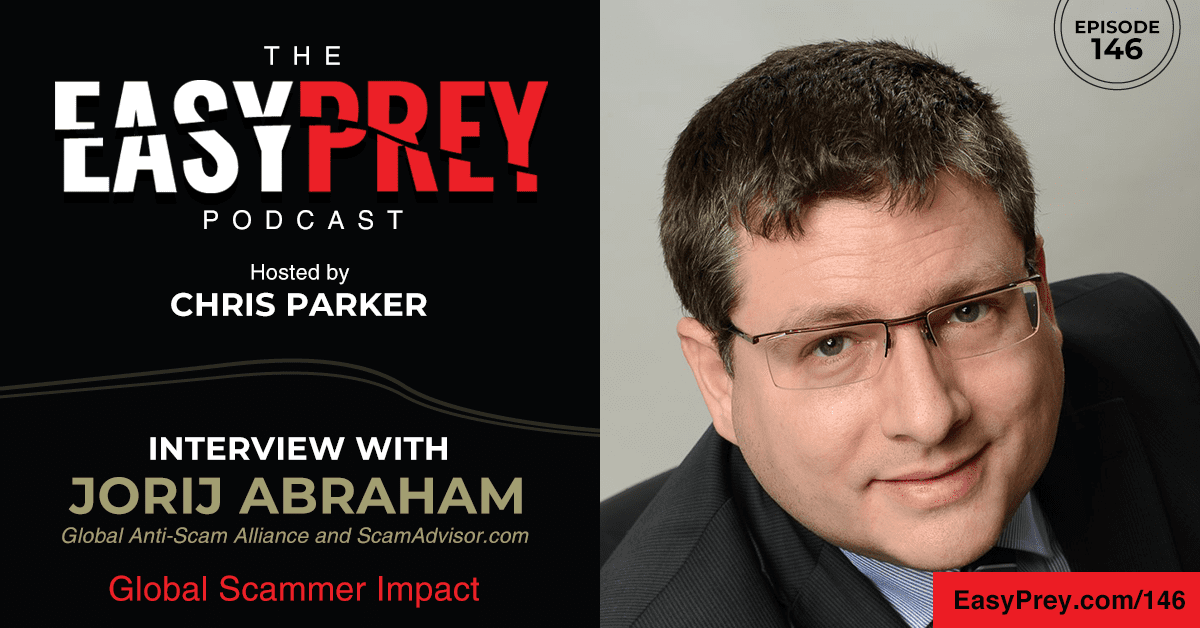
Scammers are brilliant at targeting the vulnerable and then often using the fear of exposure to extort even more out of them. Education about these manipulators isn’t enough. Can we do more to make a global impact knowing that less than 0.1% of scammers are ever prosecuted?
Today’s guest is Jorij Abraham. Jorij Abraham is the Managing Director of the Global Anti-Scam Alliance with a mission of preventing consumers worldwide from getting scammed. He is also the General Manager at ScamAdvisor.com, the global blacklist for malicious websites. In addition, Jorij is an ecommerce professor at University of Applied Sciences TIO.
“We specialize in answering the question, ‘Is this website a scam or legit?’” - Jorij Abraham Share on XShow Notes:
- [1:01] – Jorij shares his current roles and background in the field.
- [2:27] – He fell into ScamAdvisor when working in ecommerce.
- [3:42] – Scammers are remarkably smart when it comes to marketing fake sites.
- [5:12] – Subscription scams are specifically successful in getting quite a lot of money from victims.
- [6:18] – Scammers tend to take advantage of current events such as the energy crisis and abortion and then extort their fear of exposure.
- [7:26] – ScamAdvisor.com sees over 4 million visitors per month and they are from all over the world.
- [8:24] – In most countries, victims of scams are unable to get any help.
- [9:49] – Jorij explains how the laws work regarding scammers and the pitfalls of the process.
- [11:40] – It’s important to educate consumers, but there’s only so much that can be learned.
- [12:56] – The tips and tricks that helped just a few months ago are already not working all the time.
- [14:33] – Jorij describes a Ponzi scheme that took down the government in Albania.
- [16:10] – One little bump in supply and demand has drastic ripple effects.
- [17:32] – Scams are not simple anymore. The marketing power is extremely impactful and mostly successful.
- [19:11] – Even in the Netherlands, FBI phone scams are successful.
- [21:00] – Jorij predicts that legislation will be necessary.
- [22:10] – Awareness is good, but consumers need more protection.
- [23:35] – Phishing scams are created to filter out specific groups of people.
- [24:37] – Jorij shares his thoughts on retraining scammers to do good, especially since they are skilled hackers.
- [26:34] – How can we reduce scams?
- [27:41] – The Global Anti-Scam Alliance is a networking organization with the goal of pushing everyone together to define new ways to combat scams.
- [29:17] – Jorij describes the changes coming to ScamAdvisor.
Thanks for joining us on Easy Prey. Be sure to subscribe to our podcast on iTunes and leave a nice review.
Links and Resources:
- Podcast Web Page
- Facebook Page
- whatismyipaddress.com
- Easy Prey on Instagram
- Easy Prey on Twitter
- Easy Prey on LinkedIn
- Easy Prey on YouTube
- Easy Prey on Pinterest
- Jorij Abraham on LinkedIn
- ScamAdvisor.com
- Global Anti-Scam Alliance
Transcript:
Jorij, thank you so much for coming on the Easy Prey Podcast today.
Thank you very much for having me. I look forward to it.
Great. Can you give myself and the audience a little background about who you are and what you do?
Sure. Jorij Abraham. I'm Dutch. I live in Amsterdam. I've got two hats. I run the Global Anti-Scam Alliance, which is a nonprofit organization, and I am also the managing director of scamadviser.com where we help consumers not get scammed.
Was there something that happened to you, like a scam that got you interested in this field, or did you just fall into the field?
 Very honestly, yes, I've been scammed in the past, but thank God it's a while ago. I ended up in the anti-scam business by accident. I took over ScamAdvisor from a developer, Mark. He got scammed in 2012. Story goes that he bought a goal set, which is typical for a person from Great Britain, proved to be fake, and as you know, nothing is as dangerous as an angry developer. He started to develop ScamAdvisor. In 2018, I took over from him and continue to grow it.
That's great. How did you fall into it?
Into the scam or into ScamAdviser?
Into ScamAdvisor. What got you interested in taking on that role?
Very honestly, the reason I took over from Mark was I wanted to launch a global trust seal to allow web shops in developing countries to sell to the Western world. For that, you need trust, and they trust you, can help you to communicate that trust. We needed an algorithm to determine very quickly, is this website legit or not, and does it stay legit? That's the reason we acquired ScamAdvisor.
The entire Trustmark business was a nightmare—it didn't work. But ScamAdviser became bigger, and bigger, and bigger. In the end in 2020, we decided, “OK, let's go full time for ScamAdvisor.” That's how I ended up in this scam business.
That's a great business story. You try one thing, it doesn't quite work, you pivot and inadvertently, you come across an incredible idea that benefits society.
It's what I like. I always like to combine doing something good for the world with making money. I like the combination.
I can relate. As we're recording this, it's the end of 2022. What were some of the most commonly reported scams of 2022?
The funniest one, the thing I find remarkable, as you know, we were having an energy crisis. What always surprises me is—you have to give them that—how entrepreneurial and marketing smartness the scammers have. What we've seen in the last two months is an incredible number of online stores selling goods, offering that for very low prices to consumers, and of course, never delivering it.
The reason why this scam is very successful is that consumers understand that it might take a few weeks to get a big pallet of wood from Russia, Sweden, or Finland to your house. They only start complaining to law enforcement and others after weeks of waiting. Together, we're getting a lot of fake websites that are from France, Germany, the UK, not so much USA, I have to admit, the Netherlands. That's one of the remarkable scams we come across.
Also energy-related are, of course, great offers for cheap electricity, which are subscription-based. People fall for those as well. That's where a lot of money goes because those subscription scams, they are able to get a lot of money from victims.
With the energy subscription scams, isn't that totally a scam in that they have nothing to do with the energy market, or they're just charging a rate in the terms and conditions that goes crazy?
No, they're real. They're a real scam. They say, “Hey, we can lower your cost by 50% or fix your energy expenditures at a very low rate.” These are, for many people, desperate times. People who are desperate are unfortunately easy to victimize.
I think that's one thing that's consistent about scammers. They will take advantage of international crises, local crises, and tailor the scams towards those specific people that are in dire circumstances.
Absolutely. One of the examples, which really, how do you say, grabbed me, in Texas one year ago you had to change in legislation about abortion pills. Independent of what you think about that, what we saw already three months before that legislation came into effect is the scammer starting online stores offering abortion pills targeting Texas young women. And then not only not delivering the products, but then also starting to extort them that, “Hey, you ordered from us. If you don't pay more or do other things, then we're going to tell your family.” That’s scamming people in a very terrible way.
Attacking people in a vulnerable situation and then throwing extortion and blackmail on top of it is just absolutely hideous.
Yeah, it is.
Does ScamAdvisor help people track down the scammers or just be more aware of what the scams actually are?
No. We have four million visitors per month and they're from all over the world. Unfortunately, we decided to really specialize in, “Is this website a scam or legit?” Of course, we get a lot of emails: “I lost my money. Can you help me?” As good or as bad as it is, we try to refer them to the right source.
That's also one of the reasons why I actually started with the Global Anti-Scam Alliance, because victims are not helped. In most countries, it really sucks to me. It already sucks to […] and then you don't get any support from law enforcement or other organizations to get out of the scam, to get your money back, or at least get help.
That's the unfortunate thing that I've run across as well. It appears that law enforcement is really not in a position to be able to help, particularly when it comes to international scams. It's one thing if it's a contractor who doesn't show up to do the job and he's local. It's another thing if the person who conducted this scam is in another country where we don't have strong cooperation laws.
What I understood, there's a person at the World Economic Forum who was focusing on cyber crime. He did a large study, and 0.05% of all cyber criminals are being caught at the moment. Unfortunately, it's great to be in this business because it's easy to make money and the chances of getting caught are currently very, very low.
Do you think that's because there's poor cooperation between governments, or is it technically hard to find these people?
Both. I want to make it clear. I don't think it's the fault of law enforcement. Law enforcement officers’ hands are tied. It's the politicians who should change legislation in their country. But even more importantly, start working together, sharing data.
At the moment, if a police officer in country A wants to exchange data with a police officer in country B, it takes six to nine months to get all the paperwork done. The cyber criminal is gone.
I think there's a big role for Europol and Interpol, but countries don't like the idea of giving more power to these kinds of organizations. But I don't think we have a choice because the cyber criminals are way ahead of us.
Do you find that most of the scam victims are US- or EU-based? Or is it pretty diverse?
It started that way. Many people can speak English and then, especially in the UK and USA, they're easy victims. Apart from being, like me, male, 50 years old and I'm a little bit overweight. It started there. Since the Corona epidemic, we've seen the number of scams in India, Nigeria, and other developing countries going through the roof. The scammers no longer only target English-speaking countries. They also target the people in their own country.
The scammers no longer only target English-speaking countries. They also target the people in their own country. -Jorij Abraham Share on X
If you and I lose $50, we will survive. But for somebody in India, that's going to be a lot of money and really hurt very much. No, scams are now a global epidemic. It's no longer a Western disease.
Scams are now a global epidemic. It's no longer a Western disease. -Jorij Abraham Share on XWhat role do you think that education plays into helping? It's not going to prevent scammers from scamming, but how much do you think education can help reduce the number of people that actually get scammed?
It helps and it's always good to educate consumers and keep on educating them. But there is a maximum floor in it. You can only grow to a certain extent.
Actually, I just read a paper by a researcher. She made a statement that when a person reaches a certain level of awareness, it doesn't help to make them more aware. It's actually the reverse, because they feel more confident online and they start to fall for other kinds of scams. Plus the fact that scammers are becoming, very rapidly, more professional. It also takes me an hour to, “Is this now a scam? It looks bloody professional.”
That’s the biggest challenge. All the new tech, the AI, the deep fakes coming out. We are in for a ride because it will be very difficult to detect scams in the future.
One of the things that I used to tell people, and I'm starting to question whether it's good advice or not, was get the person on a video chat.
It’s a good advice. Same with, “Is there a valid SSL certificate?” 10 years ago. Or check the reviews on Trustpilot. The scammers are evolving. With deep fakes and deep voices, it will be very difficult to see, “Am I now speaking to my son or not?”
Unfortunately, that certain amount of…anytime that you're interacting with someone, assume that it could be a fake. It could be a scam. Even if you think you're talking to your mom. It might not really be your mom.
I've gotten emails that purport to be from a family member. I could just tell from the writing that no, this family member doesn't talk that way. I know it's not them. If they happen to get the grammar and the language right, I very easily could’ve responded to them or started to go down that rabbit hole of finding out what’s happening.
What do you see as the future of scams? Where do you see it going? I think people are always going to take advantage of crises. If there's an energy crisis, oil crisis, hurricane, tornado, they’re always going to take advantage of those sorts of things. Where do you see scams going in the future?
My worst-case scenario, some countries will really have a national crisis. I always refer back to the 90s, there was a Ponzi scheme in Albania. It took down the government. It’s got a Ponzi scheme taking down a government.
A nice example. It was still good enough that I got an email a few days ago from one of our fans. He was forwarding an email where there were food riots in the streets. Now, get your emergency food rations. The scammers, I fear in the future, will become so good at creating, they’re not waiting for the crisis, they’re going to create the crisis.
The scammers will become so good at creating, they’re not waiting for the crisis, they’re going to create the crisis. -Jorij Abraham Share on XAll the social media, I think they’re able to create a crisis and people start to buy into the scam before we can say, “No, this is not really not true.” Or what we’ve seen in the crypto currency exchange. It’s so easy to create a crisis now that I think we are going to see that a lot more with your president making an online address, which is completely fake, but people are reacting to it and benefiting the scammer.
If you think about it, I don’t know how it was in Europe, but where I live early on in the Coronavirus, there was a run on toilet paper. The production of toilet paper didn’t drop off, people’s usage of toilet paper didn’t increase. But because there was a perception of a shortage, everybody went out to stockpile causing a shortage. Kind of with this new, global, just-in-time warehousing models that we live in, one little bump seems to have ripples that go quite a ways.
You remind me, we saw the Australians going for toilet paper. The Dutch went to their CBD and marijuana stores, the Americans went to the gun stores. I’m just kidding. That’s exactly an example. It’s so easy to create a crisis or a hype.
We see scammers also invest a lot, especially with cryptocurrency. They run escapades for millions because they know their return on investment is 100%. If you run an ad for $100 and you get a victim to pay $150, keep going. It's no longer a simple scam. They can set up campaigns higher, well-known people who are then endorsing it. The government can yell, be careful, it might be a Ponzi scheme, but their marketing power just overrules that.
I think particularly with the crypto exchanges, with FTX just went under. When you hear so many people having huge wins and maybe even people that you know, there's this eagerness and the fear of missing out that people jump in the things that they're maybe not super familiar with, they don't understand the risks of. Then on top of it, it turns out to be a Ponzi scheme.
Fear, greed, or needs in the sense, with Corona of course, I need the masks, I need the vaccine, I need to protect my family. Those are three very strong drivers. Scammers are very good at using those.
I frequently talk about scammers exploiting emotions, urgency, and authority. We're calling from your bank, your government, we're a respected member of your community and if you don't do this in this short period of time, something bad's going to happen, or you're going to miss out on something good.
That's a good example. At the moment, in the Netherlands, we get a lot of phone calls automated. This is the FBI, you are under investigation, press one. I mean, come on, we're in the Netherlands, but it works. One percent of the people are pressing the one, are connected to a call center and getting scammed. Because we know who the FBI is. They don't know that it has officially no authority here, and it's a scam. And that's the problem with all these scams. It's so easy to automate and mass roll out. We know that with phishing emails, 1%–2% clicks and base. It's good money.
To me, that's one of the challenges, whether it's SMS messages, emails, or phone calls, those things are so scalable and so inexpensive that in regular business, you're happy if you get a 1% response rate. With a scammer you need .01% response rate to have a windfall.
True. One of the things where I think things should really change is that the platforms which are supporting that communication should take more responsibility. I hope with either voluntary or via legislation, these platforms are going to take more responsibility.
You hope that the platforms on their own decided, “Hey, we better do something.” I believe they should because government regulation is never as cleanly executed as well as if you do it on your own.
I think it’s always better if business takes its own responsibility to prevent legislation. I fear that legislation will be necessary because if one platform takes this responsibility, great. But, how do you say in English, it always sinks to the lowest level? There will always be bad players.
Recently, I spoke to one of the top three SSL certificate providers in the world. Really big. I talked to him and I said, “A lot of scammers are using your free offering. What are you going to do about it?” “I don't care. As long as many people use our services at the lowest cost possible, it's not my responsibility.” I think that is no longer acceptable.
Like we were talking earlier, that’s an SSL certificate. It means they've jumped through enough hurdles that you should feel safe. That was the marketing—S means safe. It doesn't mean secure, it means safe. Now we're trying to retrain people, just because there's an SSL certificate doesn't really mean they are who they claim to be. It just means your data is secure in transit.
That's the reason why I say awareness is good, but we have to protect consumers more. We have an army to protect our borders. We should also have more digital protection protecting consumers. Of course, we need to work internationally to do that right.
We have an army to protect our borders. We should also have more digital protection protecting consumers. -Jorij Abraham Share on XOne thing I wanted to ask you because you deal with seeing so many scams and in contact with so many people, I've heard this philosophy and wonder if it resonates with you that scammers sometimes intentionally use bad grammar in their emails in order to sort out. I see the bad grammar and I go, it's absolutely a scam and I delete the email. But they intentionally use the bad grammar to weed out people like you and I, who work at the catch up and that way person who doesn't catch it is a little bit more scared, a little bit more in a rush, and more likely to fall for this scam.
That's true. They don't want to waste their time on the scam baiter and they're not interested in going into debate if this is a scam, yes or no. They just want easy victims. Yes, there are a lot of emails sent out which only purpose are filtering out. They're targeting a specific group. But we see that continuously that they're getting better at targeting.
My son, who is 13 years old, is continuously being bombarded by Roblox scams. Roblox, I don't know if you have children, but it is a very popular game. He gets targeted with Roblox scams continuously to see if they can get to daddy’s PayPal and credit card information. They’re good marketeers, unfortunately.
You'd wish that they would use their marketing skills for good and not evil.
Last week we had our Global Anti-Scam Summit. Everybody could post ideas. One of the ideas posted is to retrain. A lot of scammers, the foot soldiers. They're poor people, and honestly, if my family would have no food, I would take any job to support them. I understand it.
Retraining those people into developers or online marketers might help in the solution. It's not Nigeria. It’s specific villages in Nigeria, specific villages in Romania. If we can retrain those core groups into doing something good. We have programs for turning hackers into white hackers. I think we should do the same with scammers.
We have programs for turning hackers into white hackers. I think we should do the same with scammers. -Jorij Abraham Share on XDo you think that the rise of globalization is a positive direction for that happening? It used to be, 10 years ago, it was, at least from the US perspective, it was, “I don't know if I want to hire someone overseas. I'm not sure.” But now you know, people are outsourcing their entire call centers. They're starting to outsource their entire development teams offshore.
Do you think that because there are more and more global opportunities for people to get jobs, like I don't have to be in the US anymore to work for a US company if I'm a good developer. Do you see that as working towards reducing these people-have-skills-but-can’t-apply-them issues?
Yes. We're not going to solve scams with a silver bullet. We have to implement tens and maybe hundreds of different solutions to combat them. Retraining them, helping them, yes. I'm personally in big favor of trying to create a more global community, because in the end, we have one globe. We have to work together.
Reducing scams by reducing poverty, yes. We interviewed a lot of scammers to better understand them. They don't do it because they like it. They need money. The more we can solve that problem—and I know it's a problem we're not going to solve in our lifetimes, but it will help.
I think it's just a matter of can we make headway? We don't expect to be able to solve this tomorrow, but what can we do today to reduce the impact of scammers as well as get them into a position where they don't feel the need to do that.
Yeah, we have to fight this fight in many different ways, on many different fronts.
That's what the Global Anti-Scam Alliance is doing. Is that a policy organization? What direction does that go towards?
I see the Global Anti-Scam Alliance more as a networking organization, with our goal to push everybody together to define new ways of combating scams and that's it. It can be a re-education program, it can be sharing data to make scammers more visible, it can be awareness. But also reinventing your wheel.
We see many countries, they're coming now with the same solutions. If we develop that solution well and then roll it out across the globe, also to developing countries who cannot afford it, then we're making headway. The goal with the alliance is really bringing together all the people to share expertise and accelerate the fight.
I think that is a great plan. What are the future plans for ScamAdviser? Where are you wanting to take that next?
So many ideas. I'm going to misuse your program. We need developers. Please contact me. No. ScamAdviser has been focusing always on, “Is this website legit or a scam?” The number of emails and stories we get with, “Yes, this is a scammy domain, but I got it find this email address. Then remove me to this Telegram group, and I paid with that crypto address.”
What we want to launch in Q1 next year is give us all the data and we will make it available to any law enforcement groups so that they can see this cryptocurrency address is being used a lot and it's that Telegram group and that Facebook page.
That's our big ambition for next year. That people can not only search, check out domains, but also check out cryptocurrency numbers, phone numbers, and anything.
We have four million visitors per month. We're not there yet. I think you got more. I hope we get more data and we share the data as much as possible. But we also have great partners. We have several partners who are helping us develop the cryptocurrency search engine and the phone number search engine. That's the big plan for next year.
Those that disagree things. Any tools that people could use to do research themselves that you think are a huge benefit?
Sure. We offer an API so people can shoot us a domain name and we give you back all the data we have about the domain. If it's reliable, what are the reviews on Trustpilot and Sitejabber? How popular is the website? We offer an API for that. It's free for law enforcement and nonprofits because in the end, our goal is to share as much and our goal is not to make money but at least to pay for the hosting cost, which is huge.
Pay for your developers, cover the bills is always a good thing to do. Where can people find more about you, the Global Anti-Scam Alliance and ScamAdviser. We’ve got three sets of information here.
My name is Jorij Abraham. Look me up on LinkedIn. scamadviser.com and gasa.org.
Jorij, thank you so much for coming on the Easy Prey Podcast today.
Thank you very much for having me. Thank you.