







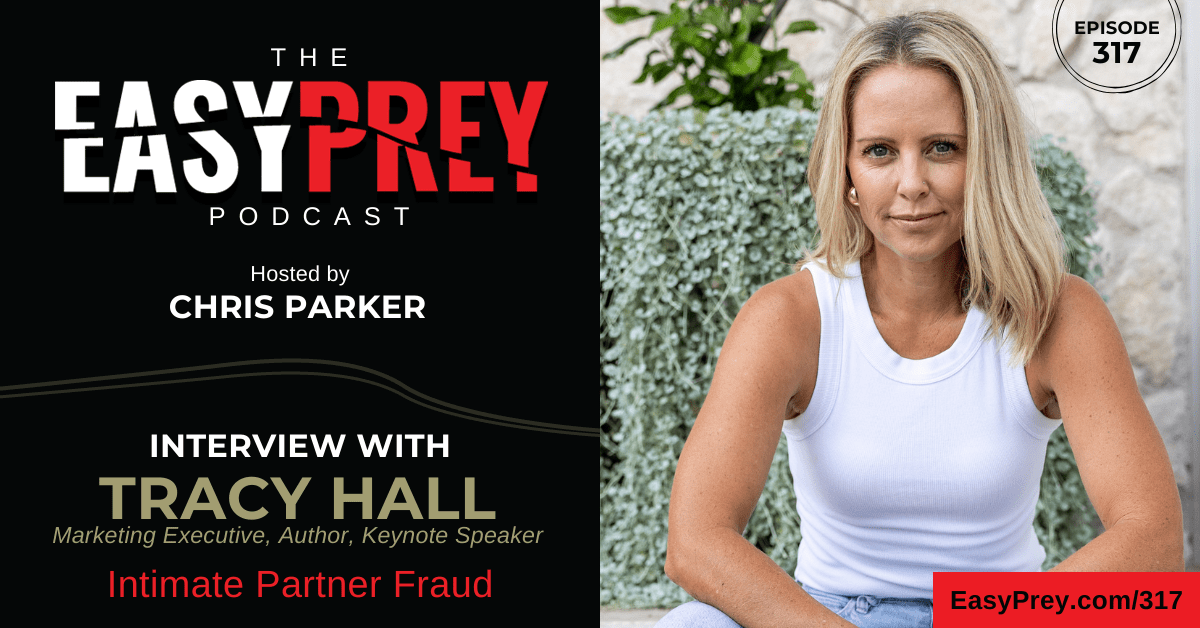

Most scams leave a digital trail. A fake email, a spoofed number, a fraudulent website. You can trace them, report them, sometimes even reverse them. But what happens when the scam has no digital trail at all, because it isn't happening on a screen? What happens when the con is standing right in front of you, making you laugh, meeting your friends, and planning a future with you?
My guest today is Tracy Hall. She's an author, keynote speaker, and senior marketing executive with over 25 years at some of the world's most recognizable tech companies including eBay, Virgin, GoDaddy, and Afterpay. She is sharp, successful, and by every measure, exactly the kind of person you'd assume would see it coming. She didn't. And neither would you.
In 2017, Tracy woke up to a Crime Stoppers video of an unidentified man being arrested outside a Sydney apartment. That man was her boyfriend of 18 months. Except he wasn't who she thought he was. The man she knew as Max Tevita a Bondi surfer, a finance executive, the person she was building a life with was actually Hamish McLaren, Australia's most infamous conman, a man who had been running long game cons for thirty years across multiple countries, stealing somewhere between eighty and a hundred million dollars from victims around the world.
Tracy was his last victim before his arrest. He had stolen her entire life savings of $317,000 and far more than that. This is a story about what happens when the scam isn't a phishing email. It's a relationship. And it will change the way you think about trust, manipulation, and what any of us are actually capable of missing.
“He didn't only steal my money and my future, my financial security. He preyed on the fact that I was emotionally invested in him. And that just makes it twice as gross.” - Tracy Hall Share on XShow Notes:

- [1:03] With 25 years as a senior marketing executive behind her, Tracy shares how a year after separating from her husband she began online dating, where she met a man calling himself Max Tevita.
- [3:25] Presenting himself as a Bondi surfer and chief investment officer, Max spent 18 months slowly and methodically guiding Tracy to invest her entire life savings with him.
- [5:55] A crime stoppers video changed everything. The man Tracy knew as her boyfriend was actually Hamish McLaren, a professional conman who had been defrauding victims globally for 30 years and stealing an estimated $80 to $100 million.
- [7:36] A masterful shapeshifter, McLaren adjusted his persona in real time based on Tracy's reactions, including quietly getting rid of his five cars after she called him out on it.
- [9:54] Tracy breaks down the psychological mechanics of the con, including similarity bias, mirroring, and how McLaren constructed a character she was essentially telling him she wanted.
- [11:05] Through elaborate “movie sets and scenes,” McLaren built layers of authority and confirmation bias over 18 months, making investing her life savings with him feel completely logical.
- [14:21] Some moments only made sense in hindsight, including a childhood friend accidentally calling McLaren by his nickname “Ham Bone” and his instant, convincing cover story on the spot.
- [18:22] Humans default to truth, and Tracy explains how that biological wiring makes us uniquely vulnerable to manipulation, especially around emotionally charged stories.
- [19:29] Every victim got their own version of McLaren barrister, triathlete, business strategist as Tracy describes meeting others who had each been conned by an entirely different character.
- [22:53] Learning to trust other people wasn't the hard part. Tracy reflects on why rebuilding faith in her own judgment was far more difficult, and how shame dominated the aftermath.
- [25:21] Through professional help and a conscious daily decision not to let McLaren turn her into a cynical person, Tracy describes how she slowly rebuilt both her finances and her sense of self.
- [27:05] Understanding the psychology behind scams, cognitive biases, invisible contracts of trust, emotional exploitation is the best defense we have, and Tracy breaks down exactly how it works.
- [31:33] The medium may be different, but the tactics aren't — Tracy draws striking parallels between her in-person experience and digital romance baiting scams, showing how the emotional manipulation is nearly identical.
- [34:00] There is no demographic, age group, or intelligence level that is immune. Tracy makes the case that scammers hunt for vulnerability, and at the right moment, we are all soft targets.
- [36:12] By subtly discouraging Tracy from socializing with friends, McLaren was limiting outside scrutiny and Tracy explains why getting a new partner in front of your personal network as quickly as possible is one of the most important protective steps you can take.
- [40:24] No digital footprint is a major red flag. Tracy outlines key warning signs to watch for and recommends reverse image searches as a basic but powerful verification step when meeting someone new.
- [42:08] Every single time Tracy speaks publicly, someone approaches her afterwards with a story they have never told anyone a reminder that silence is exactly what these criminals depend on to keep operating.
- [43:45] Now fully dedicated to education and awareness, Tracy introduces her memoir The Last Victim and explains how she has channeled her experience into a mission to help others recognize and recover from fraud.
Thanks for joining us on Easy Prey. Be sure to subscribe to our podcast on iTunes and leave a nice review.
Links and Resources:
- Podcast Web Page
- Facebook Page
- whatismyipaddress.com
- Easy Prey on Instagram
- Easy Prey on Twitter
- Easy Prey on LinkedIn
- Easy Prey on YouTube
- Easy Prey on Pinterest
- Tracy Hall
- The Last Victim
- Who the Hell is Hamish? Podcast
- King Con: The Life and Crimes of Hamish McLaren
Transcript:
Tracy, thank you so much for coming on the podcast today.
Thank you for having me, Chris.
Normally I would ask people a little bit of background about what their corporate history
is and how they got into the job field they are, and your situation is a little bit different. And I would normally ask people, “Hey, I want to destigmatize—have you ever been a victim of a scam, a fraud, or cybersecurity incident?” And usually it's, “Well, almost, or there was this little thing here.”
But this entire episode is really about what happened to you. Can you, in spite of what I just said, can you give a little bit of background about who you are, and then we'll go into the conversation.
Of course. I was a high-level corporate marketing executive working in tech for 25 years, and I had separated from my husband. I was 40, and I decided about a year later that I wanted to start online dating. I went on the apps, as you do, and I met a man by the name of Max Tavita. He was 40, he was a Bondi surfer, he was a chief investment officer for a family office. And we started an intimate and very much in-real-life relationship that lasted for nearly 18 months.
He told me all about his work. There was a lot of information that came at me in relation to his role as a finance executive. And over the course of that 18-month relationship, he essentially convinced, groomed, and guided me to set up a self-managed super fund, which is like your 401(k), I believe, and invest my 22-year career superannuation into that fund with some tech shares that I had.
I believed everything was in my name, and we were merrily going on our relationship and building our future together. It wasn't until mid-July 2017 that I woke up to a Crimestoppers video of an unidentified man being arrested outside of his Bondi Beach apartment. And of course, it was my boyfriend, Max Tavita.
Oh my goodness.
But I very quickly learned that it wasn't Max Tavita. It was a man by the name of Hamish McLaren, and he had been arrested for swindling 15 Australian victims out of $7.6 million. I had invested $317,000 with him. I believed it was in my name, but I very quickly learned that it wasn't, and he had stolen that money from me. He was sentenced to 16 years in prison through a criminal trial that lasted three years, and that sentence was reduced to 12 years, and he will be eligible for parole in July this year.
I had invested $317,000 with him. I believed it was in my name, but I very quickly learned that it wasn't, and he had stolen that money from me. -Tracy Hall Share on XOh, that's scary. The thought that he is getting out soon. I appreciate the framing of having been recently divorced, because that seems to be unfortunately a common thing in relationship scams is that there's been a major life change for people. How did he originally present himself?
He presented himself as this finance executive. He was very down-to-earth, very Australian. He told me he'd lived in the US for 16 years, and he had come back to Australia in his 40s to have a simpler life. He loved surfing. He loved running, and he obviously loved his work. He spent a lot of time doing it. There were Bloomberg monitors in his lounge room in his apartment. I met his CEO.
There was a lot of discussion about the markets globally. And he presented himself as this high-level executive. But of course, he was also this guy that was really Aussie. We had grown up in the same kind of era in Australia, so we had very similar cultural references. He had a great sense of humor. He was a fantastic listener. And we built this relationship sort of slowly over this period of 18 months. It was, for all intents and purposes, I felt like everything was heading in the right direction. I was genuinely happy.
He had a great sense of humor. He was a fantastic listener. And we built this relationship sort of slowly over this period of 18 months. It was, for all intents and purposes, I felt like everything was heading in the right… Share on XEssentially he was living this double life. Everything about him was fake. It wasn't until he was arrested that I found all of this out in the subsequent years afterwards where there was a podcast that was created by our major masthead here called The Australian. The podcast was called Who the Hell is Hamish? That was essentially an investigative journalism piece into the life and crimes of Hamish McLaren over the last 30 years.
He had been at this game for 30 years. And through that investigation, the journalist had worked out that he had stolen somewhere between $80 million and $100 million from people globally. Victims in the US, Canada, UK, Singapore, Hong Kong, South America, New Zealand, Australia, Bali. There are victims all over the world, so it was a pretty huge criminal case here.
He was doing this from the time that he was a young adult then, right?
From what I understand, he’s never had a normal job. He's never lodged a tax return. This is his profession. And I guess if you do anything for 30 years, you get pretty good at it. -Tracy Hall Share on XYes. From what I understand, he’s never had a normal job. He's never lodged a tax return.
This is his profession. And I guess if you do anything for 30 years, you get pretty good at it.
Yeah. I mean, he was a professional scammer. Did you ever find out whether he was actually ever in other countries or was he always in Australia?
No. He lived in Canada for a while. He went to the US. He went to Singapore. He was in London. He traveled a lot before he was arrested, of course, basically finding victims all over the world.
And I assume because of the amount of money he had previously stolen, he had a lifestyle and a means to support the persona that he'd built about himself.
Yes. And there's a lot of reports where he had a very affluent lifestyle back in the early 2000s. When I met him, he had a decent lifestyle, but we weren't going to fancy restaurants every night. He wasn't buying me designer clothing. There was none of that. He did have five cars, which I thought was quite excessive for a single man living in the city.
And that was all part of the ruse, but of course he was so great at mirroring that when I had a go at him, I said to him one day, I said, “What single guy needs five cars when you're living in Sydney?” You're a bit of a jerk, basically, is what I said to him. And slowly, slowly, slowly, the cars started disappearing. Now, I don't know where they went. I don't know what happened, but I'm pretty sure if I had been impressed by that, then maybe more cars would have appeared. Who knows?
He adjusted his game based on the response that came from it.
He was a shape shifter. He listened to what people needed and he doubled down on that. He obviously leveraged trust, vulnerability, emotion, and he exploited all of those things. -Tracy Hall Share on XYeah. He was a shape shifter. He listened to what people needed and he doubled down on that. He obviously leveraged trust, vulnerability, emotion, and he exploited all of those things.
Do you know if all of his other scams were in person or was he doing other ones online and remotely?
No, pretty much all of the ones in Australia were all in person. They were all based on relationship. Some of them were even based on referrals. People that were working with him and then they recommended them to friends.
OK. And you had earlier mentioned the CEO. Was that an accomplice or did he actually have a company that was just an illegitimate company?
No, there was no family office. It was somebody he was working with, but I guess what is still unclear is whether that person was aware of what was going on or whether she was part of his scheme as well. Unfortunately, she has since passed away, so we'll never know, but she didn't make a claim as a victim when he was arrested, so we can't be sure.
Let's talk about early on in the relationship. Often you hear things of the mirroring, the love bombing. Was that sort of the scenario for you as well?
It's interesting because it was what I kind of describe as a slow burn. It wasn't this overarching love bombing. I'm a single mum. I had a five-year-old at the time, so my time was quite limited in terms of when we could see each other. We spoke to each other all the time on the phone constantly, but in terms of the face-to-face, sometimes there might have been a week to 10 days in between us meeting up.
He was an incredible listener, and in doing that listening, he could mirror back. When I look back and I think about the red flags, as we call them that aren't red flags at the time, they're just flags, they were things like he would listen to what I wanted. He'd get information from me, and he would essentially just present that back to me in the form of him.
He created this character and this persona that he knew I would fall in love with because it was exactly what I was telling him I wanted. -Tracy Hall Share on XHe created this character and this persona that he knew I would fall in love with because it was exactly what I was telling him I wanted. That's a really interesting kind of—it’s a bias that we have inside ourselves, a similarity bias because that essentially says that we will trust, love, and like somebody who is similar to us, has similar values, has similar morals, has similar language, has similar upbringing.
That is what he was doing in that regard. Then, of course, there was this authority in him that he had this high-level executive finance role, and I saw the Bloomberg monitors. I heard him talking to back office about the trades they were executing. I met his CEO, and they discussed business deals. I described it as a movie that was sets and there were scenes and there were characters that had me believe he was exactly the person he said he was.
I heard him talking to back office about the trades they were executing. I met his CEO, and they discussed business deals. I described it as a movie that was sets and there were scenes and there were characters that had me believe… Share on XTo the point where I just thought he was the perfect person to invest my money because I had confirmation bias. Every piece of information he had given me over the course of nearly 18 months led me to believe that he was a high-level finance executive. Why wouldn't I invest my life savings with him? We were building a future together. When you don't suspect somebody is betraying you on that level, you don't question anything. You just believe that they love you and they have your best interests at heart.
That's what we do as humans because it's the way we're wired. The crime in that whole thing was that he exploited that in me. There was a lot of authority bias, confirmation bias, there was a similarity bias. Of course, I was a year out of a marriage and I wanted to find somebody to spend the rest of my life. If I didn't want to get married, I wasn't going to have any more children. I just wanted somebody to spend my weekends with. There's nothing wrong with that.
Everyone goes, “Oh, that's a vulnerability.” No, it's just a human desire and that's OK. It's just he exploited those things, and that's the crime.
It's not like you were going, “I'm going to go through the apps and I'm going to look for a multi-millionaire guy with 16 cars and I'm going to be whatever.” That wasn't what you were looking for.
No. Even in our conversations as he understood that about me, the wealth market started drifting away because he knew I wasn't impressed by that. In fact, I used to be kind of like, “You're a jerk, why have you got that? That's just excessive.” I had no problem telling him what I thought and over time he thought, “You know what? You're right, Trace. You're right. I don't need five cars. I'm going to get rid of this one, get rid of that one.”
It was kind of interesting in that regard how he did that, but of course, these things I can only really see in reverse. He really didn't want me to meet his family and he didn't have a lot of friends, but he explained that away because he'd lived in New York for 16 years. That made sense to me. The family thing, I would push for that. I really want to meet your sister and her husband and the kids. Met the husband. I met his brother-in-law a few times.
I met a few people, but it was always a future promise, “Yeah, we'll do that next weekend.” Or they'd be in town and I'd have my daughter and he'd say, “Oh, don't pay for it, baby. It's OK. We'll see them next time.” Of course, there were all these little breadcrumbs that make you think, “He really wants me to meet them.” Of course, next weekend never came.
There was always something that would happen. It got to be a problem where I called him on it and he essentially said, “Well, Trace Bridges, why differently?” But if you really want to do it, then we'll do it. When it got to a point and I pushed for it, he would appease me and then he got arrested.
How much interaction did you end up having with his family members, and were they really his family members or were they just actors in his play, so to speak?
I met his brother-in-law a few times and it was definitely his brother-in-law. I would see his nieces and nephews or nieces, sorry, on a FaceTime call or hear his sister in the background.
He spoke to his sister a lot, but I never got to meet her. Of course, he must have been, excuse my language, but shitting himself when I met his brother-in-law that I would have said, “Hey, Max, pass me the newspaper” in his apartment.
Of course, that would have brought something up, but what I've realized is that we very, very rarely use each other's names when we're in company. That never happened. Gosh, he must have been scared that it would, but there was one situation where I met his childhood friend of his and we were in his apartment and the friend said, “Hey, Hambone,” and it was his nickname and I didn't think anything of it.
Then when the friend left, I said, “Hey, Max, why did your friend call you Hambone?” As quick as a flash without even thinking, he goes, “Oh, when I was a kid, when we were kids together, I was really skinny and everyone told me I need to put more ham on my bones, Hambone.” That is Hamish, Ham, H-A-M, so that's where it came from. He had an answer like that, and of course, I didn't suspect, so why would I even question?
There was a lot of stuff like that that when I look back, I go, “Oh, that's what that was. That's what that was,” but at the time, I didn't think anything of it.
It doesn't sound like any of these things were, at the time, would have been red flags.
No.
It's one thing to look back and say, “Oh, yeah, he had to explain these nicknames and people would call him something different,” but in the moment, those were all very plausible, reasonable. It's not like his friend said, “Why are you going by the name of Max? Your name's Hamish.”
Yeah. There was nothing as obvious as that because that would have been pretty clear. I think there were some other things, and I list them out in my book, and they're marked by a little flag because in retrospect, I guess they are red flags, but at the time, they didn't see it, so things like he had these really big stories, because he's quite a larrikin, and sometimes I didn't know whether his stories were just him being funny.
Max moves on pretty quickly, so someone will tell a story and you go, “Oh, OK.” Then you're onto the next thing, and you don't even think about it, but then when I thought back on those stories, I thought, “Yeah, that was a big story.” For example, he told me that he was in New York when the planes hit the Twin Towers. He worked on Wall Street. He had friends in those buildings.
He told me this story one day that was in so much detail. The names of the people that he worked with, their first and last names, what floor they worked on, the jobs and titles that they had, their wife's names, what companies they worked for, so much detail, and he told me that all of them were there at the time they were going down. Him and a friend were going down to meet one of these women for lunch, the plane hit or whatever it was, and they had to get out of it.
It was a huge story. In retrospect, even saying it now, I feel ridiculous for even believing it, but if someone tells you that in a situation like that, and it seems plausible based on all the other things he said, he was in New York at the time, he worked on Wall Street, he had friends there, all the things, I'm not going to sit there and say, “Were you really maxed there?” You don't default to doubt, you assume honesty and you default to truth because that's how humans work. Yet, in retrospect, I go, “That was a big story, can't believe I believed that.”
But I could see people not wanting to challenge it because it is such, at least for us in the US, it is such an emotionally charged story that if I question someone, “Well, were you really there?” That's sacrilegious, that's mean-spirited, that's calling into question everything about them when they're saying, “What were you doing? Where were you at when this happened?”
Everybody in the US knows exactly where they were when that happened, and so it makes sense of why someone wouldn't question it, and it would be one thing if he was a yacht trader or something like that, and now there's this Wall Street connection that just doesn't fit, but it all just fits in with his story.
It all fitted in. It was to garner compassion and empathy. In the same vein, he told me his parents had died when he was young, and he must have known at that point that my father had died when I was in my 20s, and this whole story that he concocted about his parents, I felt so much compassion and empathy for him because I had been through a similar experience.
I had lost a parent, and so in that moment, even though in retrospect the story seemed big, I never questioned it because all I felt was compassion and empathy for him, and of course that story of him being an orphan carried on over the months that we had and explained away a lot of his quirky behaviors, and people that he introduced into the movie and all the things. It's a very, very insidious, coercive, behavioral situation where you get pulled into this world, and because we are human, and we want to believe, and we do default to truth.
I would never, ever question someone telling me that their parent had died. All I feel is empathy and compassion, so he just played on that, and that's what makes it so dirty and so disgusting is that he didn't only steal my money and my financial future, my financial security. I ended up 41 with nothing apart from my job and had to start again, but he preyed on the fact that I was emotionally invested in him, and that just makes it twice as gross, really.
I want to come back to that because I have a question about that, but I do want to go back. Have you talked to some of his other victims, and was he the same person but a different flavor with them? Was it still the same general storyline, or did everyone have a vastly different storyline?
Everyone had their own movie. Yes, I met a lot of the victims. I met his ex-wife. I didn't even know he was married. Through the podcast and that investigation, I was connected with a lot of people that were associated with him, both victims and others, and it felt like almost every week someone would reach out to me and say, “I knew Hamish when he was doing futures on the trading floor in Sydney in 2000. I knew him here. I went to school with him.”
Everyone's got a version of the story, but in terms of the victims in Australia, he was a barrister for one victim. He was a business strategist for another. He was a triathlete for another. He was a chief investment officer for me, for a family office. He was mostly known as Hamish or versions of Hamish. I was the only person that knew him as Max Tavita, and what I understand is things were catching up with him, and so he was creating this new persona, this new identity, and he was starting to develop that identity as he went through.
On some level, incredibly intelligent to be able to carry out that many lives, that many people all the time. I don't know about you, Chris, but I can't even remember what I had for breakfast yesterday. I don't care how on earth do these people—and of course, my brain doesn't operate like that. He's obviously a top one-percenter psychopathic offender, but it's just wild to me that he never tripped up. He never once tripped up on his story.
Do you know if any of these people overlapped, or was he just one person at a time?
No, there was a lot of overlap. There was no one else that's part of the victim cohort in Australia that were in a relationship with him, so that was sort of a layer that I sort of had to deal with on the side. Everyone else, it was like a business transaction.
Gotcha. I've heard from other relationship scam victims of, “How do I learn how to trust”—not so much how do I learn how to trust other people—“but how do I learn how to trust myself in ascertaining, in evaluating other people?” How have you managed sort of that?
You've hit the nail on my head, because everyone asks me, “How do you trust others now?” I'm saying, “That's not my biggest problem.” My biggest issue was learning how to trust myself again, because I never thought it would happen to me. I've had a stellar education. I've had the most incredible career. I have traveled the world. I thought I had a good intuition, and I thought I was a good judge of character.
My biggest issue was learning how to trust myself again, because I never thought it would happen to me. I've had a stellar education. I've had the most incredible career. I have traveled the world. I thought I had a good intuition,… Share on XAnd none of those things seemed to be true in this experience. When it happened, all I felt was shame, embarrassment. I had made the biggest mistake of my life. There was so much in there, and it was so layered because of the financial and emotional deceit, and learning how to trust myself in my own judgment, again, has probably been the hardest thing for me to rebuild over the last nearly nine years.
I've done that with the help of professionals. I have worked really, really hard on it. When I wasn't able to trust myself, so, for example, rebuilding my finances, there was absolutely no way I would trust myself to make the right decision in relation to my money because I've had such a big experience and so much trauma around it. I went and found a professional I could trust.
I made sure I did all the checks and balances, and I found this incredible financial advisor that has helped me rebuild a level of security again over the last nine years. That is one area where I knew there was absolutely no way I could have made those decisions on my own. I had to go and get psychological help. I have done a lot of work around rebuilding that sense of strength within myself to go, “You know what? When I meet someone, here are my markers.”
I would say that I definitely see the world differently now. But I made a very, very conscious decision that Hamish is an outlier. Most people that we meet are good people. They want the best for us. They want to help us because that is the way that the world operates. There are just a few bad apples amongst us that compromise the integrity of that. But I can't let him ruin and create a cynical version of me because I don't want to live like that. The shame is on him. He is the criminal.
Most people that we meet are good people. They want the best for us. They want to help us because that is the way that the world operates. There are just a few bad apples amongst us that compromise the integrity of that. -Tracy Hall Share on XI get to have a good life. And that was a decision I had to make very, very consciously. And to be honest, sometimes I still have to make that decision every day on a hard day. But for the most part, I have rebuilt that. And I'll continue to do that as I go through the rest of my life.
How has it changed, given all of that, how has it changed in the way that you deal with people and relationships? Is there a little bit more of a barrier, a little bit more of a checklist running in the back of your mind of, “Hmm, that seems a little bit off”? “Oh, nope, I don't want to go there, but I still need to have a little bit of extra defense.”
Yeah, I think my spidey senses are more attuned now. I think that's one thing. The second thing is, and I say this in my keynotes all the time, we are living in this world where we don't know what is real or not anymore. Digital deception is at an all-time high. AI is eroding trust faster than anything else we've ever seen.
We are living in this world where we don't know what is real or not anymore. Digital deception is at an all-time high. AI is eroding trust faster than anything else we've ever seen. -Tracy Hall Share on XWhat I do say is trust, but verify. And then verify again. My critical thinking brain is a lot more attuned. When I'm given information, I will double-down and triple-check it because I think if I'm really honest, I take a lot of things on face value. There are a lot of mistakes that I made in that situation with Hamish that I will never make again.
When information is sent to me, I double-check, I verify twice. And of course, when it comes to scams and fraud, there are some very clear ways you can do that. But it could be just someone telling you a story about something. I will go and check those things now, but previously, I was probably quick to just believe what was presented to me, but because of what's happened, I do my verifications now quite thoroughly.
Yeah, and I think most people take what people say at face value up to a point. When you know someone or you are getting to know someone, there's this threshold that it goes from, “Yeah, I guess that's reasonable. It's not unusual.” And sometimes with some people, there's the little like, “OK, that just seems a little bit off.” And I assume you're much more attuned to that. That just seems a little off.
Yes. I'm aware of these cognitive flaws that we have. I talk about this as well in terms of the psychology of scams. It's this exploitation of our vulnerabilities, our cognitive biases, urgency, emotions, all of this. These heuristics that we have, which are our cognitive flaws, that essentially have us jumping from one point to another quite quickly. Because if our brain was to do all the checks and balances every time, we'd get nothing done.
And we'd be constantly looking at each other sideways, and the world just wouldn't work like that. There are these invisible contracts of trust that exist in the world because of our biological beginnings. You go to a doctor, for example, you don't ask to see their medical degree. You just trust that they have the right qualifications. You go to a narrow plane and you don't swing left into the cockpit and pull out your portable breathalyzer.
You trust that the pilots are operating under the rules and governance that is there to keep us safe. But those shortcuts and those invisible contracts of trust, when we're presented with somebody who is a bad actor, we have to really think about how we separate those invisible contracts of trust with what is being presented to us, and how do we actually lean into that from a more critical place. And that's really how, because a lot of what we do is subconscious.
Understanding the psychology behind scams and Ford and people like bad actors like Hamish is really integral to us protecting ourselves more from scams and Ford. Knowing that it's a UPS scam or a government agency scam, it doesn't matter. All of the scams are the same. They're just different versions of the same thing. But if you're in a heightened emotional state and they're applying urgency and you're leaning into it because they say they're from the federal police, then there's these things going on that you may not have even thought about because it's all subconscious. That's what I try and educate people on. It's more that psychology behind a scam so that you can catch yourself before you do the thing they're asking you to do.
In some sense, it's different than what happened to you. The scammer who's trying to make a quick buck, whether it's $1 or millions, they're trying to do this in a very short frame, and what happened to you was something that played out over the course of months and months and months. While there is still a certain amount of—we all get that random text message like, “Hey, how did my dog's surgery go? How did my dog's surgery go today?”
Of course, the part of us that, “Oh my gosh, someone was trying to get ahold of the vet and they got ahold of me, and I have a dog, and let me tell them they got the wrong number.” And now we've engaged with a scammer, unfortunately. That is, in my mind, somewhat fundamentally different than someone who has decided I'm actually going to be in a relationship with someone and that I'm willing to let this take its course over months or years.
Yeah, it isn't and isn't. What I've learned is that specifically in the case of romance forward, or we call them these pig-butchering scams, it's not a term I like, but romance-baiting scams, there are digital relationships that will exist over many, many, many months to extract the money. Now they're not in real life, I understand that, but the connection and this kind of world, this spell that a victim falls over, it's very real for them.
And the tactics and behaviors are very, very similar, they're just digital. There are others that are these spray-and-pray effects, like click on the link, do this and suddenly you're fleeced. There are those as well. I think it's fair to say there is a scam for everyone and they take many, many different forms, but there are some similarities around the online digital relationship romance-baiting scams that end up with crypto losses and things like this.
And what happened to me, I guess what I acknowledge is that what happened to me is very extreme. Most people who lose money to scams and fraud won't meet their perpetrator, they will never see their perpetrator come to justice, their perpetrator will never be arrested. In some ways I feel very lucky that that was my experience because he has been brought to justice. Now other people who get targeted through transnational organized crime and these romance-baiting scams, or it could be any other type of digital scam, they will never, ever see their perpetrators come to justice.
Every scam is about honing in on somebody's vulnerability and that vulnerability could be you're going through a divorce, a huge one, could be a major illness, could be you're grieving the loss of a loved one. It could be you've just had a baby and you haven't slept for three weeks. It could be you're a CEO of some big company and you travel internationally through different time zones every other week in your jet and maybe you've had a big night. There are so many vulnerabilities that people are exploiting that it doesn't matter who you are. I don't care who you are, there's a scam for teenagers, and there's a scam for our seniors, and there's a scam for everyone in between if they get you at the right time with the right offer where we are self-targets, we are.
I don't care who you are, there's a scam for teenagers, and there's a scam for our seniors, and there's a scam for everyone in between if they get you at the right time with the right offer where we are self-targets, we are. -Tracy… Share on XTo me, that's the key thing is we are all vulnerable to something at the right time. I was talking with a cybersecurity guy for his company and they had just been doing something about open enrollment for their health plan and he got an email about a health plan and said, “Oh, this must be what I was looking for,” and he started to go down, and at some point realized, “Oh, wait a second, this isn't the real one,” but because it was exactly what he was expecting, all those guards of, “I shouldn't click on this. I shouldn't open this. This was unexpected,” because it fell right in line with something he was expecting, he just went for it.
Yeah, it's relevant. I say a lot, scammers don't hack systems, they hack people. Sadly, the weakest link in the defense ecosystem is still humans because we're human and this is what the exploitation is. It's not the fact that we're vulnerable that's the crime, it's the exploitation of the vulnerability that is the crime. I think the most intelligent thing that we can all do when it comes to scams and fraud is actually to humbly accept that it could happen to us.
I say a lot, scammers don't hack systems, they hack people. Sadly, the weakest link in the defense ecosystem is still humans because we're human and this is what the exploitation is. -Tracy Hall Share on XIf that is your starting point, then you're automatically more vigilant and more aware, and then you go from there and you layer on your education and your knowledge on top of that, but most people, sadly, it's like there's some crazy statistic that the majority of burglar alarms are bought after somebody has been robbed. You don't pay attention and you don't take notice to things until you are personally impacted or someone you love is personally impacted. That is how these criminals are stealing $1 trillion a year from us.
Another question, I know a lot with relationship scams, there's often a trying to isolate the person from their friends and family. Did that happen with you as well or was there not the pressure to kind of disassociate with other people?
There wasn't too much pressure, however, he was not keen to share our time with too many other people. The example I gave you with his sister, he really didn't want me to meet her. When we did have time together and I'd say, “Hey, my friends want to meet you. There's some drinks happening on Friday night,” he was very selective in what he engaged in and he would say things like, “I haven't seen you for two weeks. We've only got Friday night. I just want to spend time with you. Let's go get dinner. Let's watch a movie. Let's do something.”
And for me, that was music to my ears. That's a really nice thing for someone to say, “Hey, I just want to spend time with you. We don't get a lot of time. I'm trying to get to know you,” and so it was all very plausible that when I look back, that was him just not wanting to engage with my friends because the more eyes that you have on your relationship and the more you share of your relationship with other people, especially friends and family, the more chance there is that they will spot a red flag that you haven't.
The more eyes that you have on your relationship and the more you share of your relationship with other people, especially friends and family, the more chance there is that they will spot a red flag that you haven't. -Tracy Hall Share on XOne piece of advice is if you are dating someone, as quickly as humanly possible, meet their friends and family and have them meet your friends and family because you'll be able to verify the information that they're giving to you through their world, and your friends and family are standing side of stage and they might see something that you don't. If your person is resisting that, then that's a red flag.
As quickly as humanly possible, do that. And if you're having an online relationship, no longer is it OK to say, “We'll do a video call,” and then you'll know because we all know that real-time deepfakes and voice cloning—have your friends verify. Sit in on that call. Don't be afraid to share your relationship with your closest network because when we're wearing our rose-colored glasses, all the red flags are just flags; they will see what you can't. It might feel weird, but in this day and age, you can't afford not to. You can't.
Don't be afraid to share your relationship with your closest network because when we're wearing our rose-colored glasses, all the red flags are just flags; they will see what you can't. It might feel weird, but in this day and age,… Share on XI think, to me, it's like people should want their significant other to fit in with their friends. In a sense, that should be a red flag. I get it. I'm an introvert. I would rather not be around crowds of people, but I'm good with going with a group of three or four other people. Not 10 or 12, but three or four. It makes sense that I do like that because your friends are not going to have the same biases that you have. They're going to see things more objectively. They don't have the oxytocin going on that you do. They don't have the history to them “Let's see if this guy is as good as he claims to be.”
Someone once explained it to me. It's like being in an illusionist show. As the person in the relationship, you're sitting front and center. You never see the tricks going on. The people that are standing at the side of the stage that see all the sleight of hands, they see all the tricks going down. That is your friends and family.
They are seeing what you can't because you're in the front row. I think that's a really great analogy to think about when you are dating and when you are meeting people. I like sharing that one. I like that analogy.
Any other, as we kind of start working towards wrapping up, are there any other red flags that we've skipped over or haven't mentioned with enough emphasis?
I believe doing some really deep research on people in terms of their digital footprint. Max Tavita did not have a digital footprint. Now, he didn't have social media, of course, but he explained that away by saying, “Don't you understand, Tracy? You're the product.” A lot of people I know don't have social media, and that's fine, but to not have a digital footprint in this day and age is really weird. Of course, there was no digital footprint because Max Tavita doesn't exist. Hamish McLaren exists. There's a very, very long and lengthy digital footprint on Hamish McLaren.
If you do your research and you can't find someone on a reverse image search, or you can't find any information, then I would say that's a pretty big red flag. -Tracy Hall Share on XIf you do your research and you can't find someone on a reverse image search, or you can't find any information, then I would say that's a pretty big red flag. Just go a bit deeper into that. Do the reverse image search. Make sure the person that you're meeting or dating is who they say they are, that it's not a stolen identity. There's a lot of different checks you can do in relation to that. Meet friends and family as quickly as you can. I think that's a key one.
Have your critical thinking brain on. I know it's hard when you've met someone and you're in love. I know how hard that is, but think about things skeptically, not cynically. Just be thoughtful that these people exist amongst us. I've never met anyone like Hamish. I never thought it would be me, but you hear these stories more and more, and part of me expressing my story is to lift that veil of shame and to shine the light on this type of crime because it happens more often than you think.
You just don't hear about it because people are too embarrassed to talk. Hopefully, in talking about it, someone else's shame gets lifted today and they don't have to come forward to media, but just tell someone that you love, report it to the police. Let's solve this massive global crime by actually exposing the criminals for what they are because the shame is on them. It's not on you.
Let's solve this massive global crime by actually exposing the criminals for what they are because the shame is on them. It's not on you. -Tracy Hall Share on XHow many times when you've been on the speaking circuit and you've told your story has someone come up to you afterwards and said, “I haven't told anyone else this, but…”?
Every single time, Chris. Every single time, and it may not be their personal story. A lot of times, it is. It might be their mum. It might be their son. I talk a lot about teenage sex extortion as a scam crime that is happening right now that frightens me incredibly. The amount of people that come up to me after I have that discussion and say, “That happened to my son. That happened to my nephew. I haven't told anybody.”
That is what frightens me because scammers and these types of crimes actually thrive in silent secrecy. The more that we shine the light on them, the more that we understand them, the more that people come forward and talk about them, the greater the chances that we can solve this issue. If I can play a part in that and if I can encourage people to do that, then that is what I'm here for. But every time, every single time without fail.
Awesome. Tracy, you've written a book about this as well.
I have, yes.
Tell us about the book because there's only so much detail we can talk about here on the podcast.
Yes. There's a lot to this story. In 2023, I wrote my memoir called The Last Victim. I was Hamish McLaren's last victim before he was arrested. It details my life before, during, and after my time with Hamish and goes into a lot of detail about what happened in the hope that it will act as a bit of a warning siren for other people. It also is a beacon of hope that no matter what happens, and this is the worst thing that had ever happened to me, you can rebuild. You can move forward.
You can make a life for yourself that is still positive and hopeful. I hope that in doing this, I've turned my whole life now, dedicated my whole life, to educating people on scams, romance fraud, all of the things that we need to learn to protect ourselves. It's been an interesting journey, but the book has been released in the US now, which is awesome. You can find a paperback and audio, all of the different ways. It's a great read for anybody who wants to learn more about this topic.
Can they also find you online?
Yes. My website, tracyhall.com.au, or Instagram, Tracy Lee Hall, or LinkedIn. I'm pretty active on LinkedIn as well.
Awesome. I super appreciate your mission of shining a spotlight on this. I know the more people that tell their stories, the more people will catch something that's going on in their life, and the cockroaches scurry when we turn on the lights, and hopefully more of these stories will brighten the lights and get these people running and hiding where they can't be found and get them away from us.
I hope so too, Chris. Thank you so much for having me. I really appreciate it.
Thank you very much.