



Kids are growing up with technology in a way none of us did. Phones, games, social media, school devices, and now AI are all part of everyday life, and parents are left trying to figure out how much access is too much. Keeping kids completely away from technology probably isn’t realistic, but neither is handing them everything and hoping they figure it out.
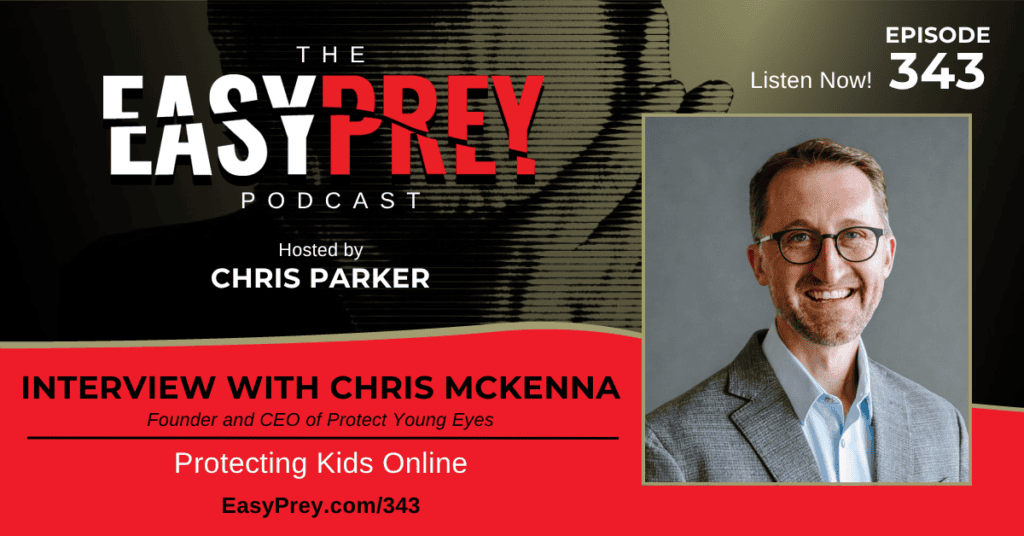
My guest today is Chris McKenna, founder of Protect Young Eyes, author, and digital safety advocate. Chris works with families, schools, churches, legislators, and technology companies to help create safer digital spaces for kids. His path into this work began after a career in business and ministry, where he started seeing firsthand how quickly smartphones and other devices were changing childhood and the kinds of risks young people were encountering.
In our conversation, we discuss what “the right tech at the right time” can look like, how parents can introduce more independence without handing over everything at once, and why relationships and conversations matter just as much as parental controls. We also get into social media, smartphones, gaming, AI, and the pressure kids face when everyone around them seems to have access to the same platforms. Chris also shares practical ways families can lower risk, build digital discernment, and give kids room to make smaller mistakes while they are still learning.
“We want parents doing certain things regularly and consistently because the algorithms our kids face are sophisticated and persistent.” - Chris McKenna Share on XShow Notes:


- [00:50] Chris McKenna shares how his background in business and ministry eventually led him to work in digital safety and launch Protect Young Eyes.
- [02:52] We discuss why parents began giving smartphones and tablets to younger children and how technology gradually became part of nearly every area of life.
- [07:39] We look at the pressure parents face when other kids already have smartphones, social media, and unrestricted access to the internet.
- [10:54] We discuss how online risks have changed the old idea of “stranger danger” and why kids need to recognize concerning behaviors instead of simply avoiding strangers.
- [12:09] Chris explains why he believes in giving kids the right technology at the right time instead of either banning technology completely or giving them unrestricted access.
- [17:00] We discuss the five habits Chris recommends for families, including modeling healthy technology use, building strong relationships, delaying addictive technology, and adding layers of protection.
- [20:32] We talk about digital leadership and why adults and kids both need to learn how to slow down before reacting emotionally online.
- [22:19] We discuss what parents should consider before giving young teens access to smartphones and social media.
- [25:44] Chris explains how parents can create a gradual path toward greater technology access instead of simply saying no without explaining what comes next.
- [30:00] We discuss the shared responsibility of parents, technology companies, schools, policymakers, and others when it comes to protecting children online.
- [35:12] We turn to artificial intelligence and discuss how parents can begin conversations with kids about AI through curiosity rather than condemnation.
- [36:16] Chris explains the difference between relational and technical tools for managing AI and why parents should know which apps their children are downloading.
- [38:28] We discuss AI companions and why Chris believes minors should not be using highly personalized AI relationships without strong boundaries.
- [40:11] Chris explains his seven-day rule and why parents should try apps themselves before deciding whether their children are ready to use them.
- [44:24] We discuss some of Chris’s strongest recommendations for families, including monitoring devices and keeping parents in charge of the technology in their homes.
- [46:03] Chris explains the idea of helping kids “fail small” so they can develop better judgment while parents are still there to guide them.
Thanks for joining us on Easy Prey. Be sure to subscribe to our podcast on iTunes and leave a nice review.
Links and Resources:
- Podcast Web Page
- Facebook Page
- whatismyipaddress.com
- Easy Prey on Instagram
- Easy Prey on Twitter
- Easy Prey on LinkedIn
- Easy Prey on YouTube
- Easy Prey on Pinterest
- Protect Young Eyes
- Chris McKenna – LinkedIn
Transcript:
Chris, thank you so much for coming on the podcast today.
Well, thank you, Chris. Glad to be with you. Here we go, right?
Here we go. We were joking earlier that anyone who's doing a transcript of this episode will have to do with the dueling Chrises.
That's right. You got it.
Chris, can you give the audience a little bit of background about who you are and what you do?
I came from a business background. I was called then into ministry, so I jumped into a role working with students. And the timing of that, Chris, after 12 years in risk advising at Ernst & Young was around 2009. When you think about sort of the arc of technology, when we started doing certain things, right, that's right after iPhone and right before parents started giving kids what I started to observe, which was their old hand-me-down iPhone 5.


That's what started to show up in ministry with me around 2012 or so. I was in middle school with junior high kids, and so that gave me concern. I was a guy who, for years, had struggled because of some things that had happened in childhood with compulsive use of pornography. I'd come through that, and then I watched us put that in kids' pockets. That was a problem to me with that consulting background. I'm like, “Hey, that's a problem, right?”
I launched a website, protectyoungeyes.com. After ministry, I went into a software company, did marketing for them, an anti-pornography software company called Covenant Eyes. And now, for the last three years, I've been full-time at Protect Young Eyes, helping families, schools, and churches figure this thing out, create safer digital spaces. We're not anti-tech. We're just right kid, right tech, at the right time in the face of million-dollar marketing campaigns that would say everybody needs everything. That's how I got here. Didn't expect to be a CPA working in digital safety, but here we are.
Sometimes, life calls you to a particular path, and it's not something that you were like, “Hey, I want to go do this, but I need to go do this.”
Yeah, that's definitely it. It's a mission that I get the pleasure of waking up every day and helping, you know, thousands of families, and that makes it worth it.
As a parent, and I'm not a parent, so I see these things and I say, “Why would a parent do that?” and not being a parent, and I very quickly bite my tongue and say, “I'm not in their shoes, I don't know what's going on in their head, and I don't know what's going on in their life.” And we'll kind of start this with the iPhone 5. Why did parents start giving iPhones and iPads to small children?
Right, so I am a parent. I have four kids, a daughter who's in college, and then three high school-age boys in grades nine, 10, and 11 right now, so this is exactly what I wrote about in chapter one of my book, because I think a lot of parents like me, whether you're Gen X or kind of older millennial, we experienced things that heightened our just sort of senses around being more skeptical and afraid of the world.
There's some events that I point toward, whether it was something as simple as missing kids on milk jugs, then to Columbine and watching that happen sort of in real time. Then 9/11, these were things that in sort of the early days of a constant stream of news started to show us things as they were happening, and it was terrifying, and then we start to have children. We believe then that we're dropping our children off in a world that is a little bit more dangerous than the one that we grew up in, and this became a way to be in contact and to know where they were.
At the beginning, most of technology that was presented to families to use in the home, there was a lot about it that was to love. It was fun, it was great, it was a sort of a gathering, a computer that was out in public, you played, you kind of interacted on games together, whether it was Oregon Trail, whatever it was, showing my age there, right, a lot about what technology gave us was pretty good for humanity, and you could walk away from it and do the rest of your analog life.
But slowly, as we know, over time, that started to change, and it became more entwined in every part of our life and more driven by algorithms and all the things we're dealing with today. That’s a whole different thing, but the marketing stayed the same. I think we still at times suffer even good, awesome parents from a bit of techno positivity that, “Hey, it's big tech. This is great. This is awesome.” Yes, convenience and all these things I have access to and yet we know all that now comes with it.


There's a lot of complexity to, I think, that answer, even more than I've uncovered here, but you can see how good parents who believe they're not harming their kids intentionally are handing them something that maybe they've just been sort of groomed to believe can't be quite as bad as everyone says it is.
Yeah, and is some of it now that when we're, you know, on the second half of our life stage probably that now, there are parents with toddlers that, like, they grew up with phones, they grew up with screens in their hands, they were born after 2000.
They're adults now and they're having kids. It's interesting to me to see so many, like, you know, at the restaurant, you know, the kid makes the slightest noise, the toddler makes the slightest noise and outcomes the iPad. It's kind of the instant, placate, or, “I want my kid to be quiet in public,” and I feel I can understand the pressures of parents wanting to do that. But it's surprising to me how, like, that has now just become so much the go-to response is, “Let's just put screens in front of people.”
Right. I would say that that still happens; we've all seen it. I would say what is new in that batch of young millennial-Gen Z parents is a growing group of them that because of what they now know, because of what they experienced in total freedom with technology. They're the ones that are saying heck no, and they're not giving their kids as much access as they had. Instead of there being a fairly even distribution across the spectrum of, “Give them the iPad,” versus total lockdown and everything.
Instead of that being more evenly distributed, I'm seeing greater extremities on either end of that, greater numbers at both ends of that, those that are still just like scales over eyes, don't buy into this being bad or for whatever reasons just are still handed over and those that are like, “No way, I know now. I've read The Anxious Generation,” or whatever they've done. And they're saying, “That's not going to be my kid.” That's my observation from being in hundreds of schools and churches around the country.
And I can see the challenge with that as parents, you know, have kids growing up that are like, “Well, but all my friends have this, all my friends who had access to this.” Then the parents’ friends say, “Well why don't you give your kids this?” I can imagine that there's a lot of pressure on the parenting side. And it's not like prior to some of this technology, the changes were generational in terms of, what, when should kids start driving and how dangerous is the driving.
It's not like we went from horse and buggies to Teslas over the course of, like, three years and now we're giving high-performance cars to 15-year-olds. I mean, maybe we've gotten to that point, but it's not something that happened over night, and so we could see the timeline of, like, in the 50s and 60s and 70s and 80s we started realizing, “Oh, teens aren't good drivers. We should, you know, not give them the high-end cars.”
And so I think because that technology seemed to progress slowly, there wasn't this we could see the challenges playing out over the course of years and decades as opposed to going from that first iPhone to iPads was only a matter of 10 years or something like that. Now we have instant access to the entire internet, the entire knowledge—good and bad—of humanity in the toddler's hands.
That's right. And what we used to have with technology was something that was narrowly applied to a specific thing. It was a technology that improved the microwave or the typewriter or something specific. Using a term that I first sort of heard through Tristan Harris at the Center for Humane Technology, there's this entanglement of this big thing called technology in everything. It's in the classroom, it's in your friendships, it's on the school bus, it's at youth group, it's on the TV that you watch. Everything has become entangled with some way to get to the internet.
It's in the classroom, it's in your friendships, it's on the school bus, it's at youth group, it's on the TV that you watch. Everything has become entangled with some way to get to the internet. -Chris McKenna Share on XIt makes it difficult, as you said, to parent in that environment. You have to be extra vigilant. Even the whole mindset of, “Well, just let your kids play outside.” Yeah, I get that. I want my kids riding their bikes, but I can't control the two friends that show up to meet them who are carrying that unfiltered iPhone in their pocket, which is a supercomputer. It was different than when I was in the 80s and moms had to go outside, and the number of things that could radically change the trajectory of my 12-year-old life in the 1980s was pretty small.
I had to exert a ridiculous amount of effort in order to do those things because there was separation of time and distance and relationship. That's the difference, so that's where it's even complicated. We all kind of agree, “Yeah, kids should be outside and playing more and enjoying an analog childhood.” That entangled in that analog childhood, and those decisions to get them outside is porn hub is a predator, right, are these life-changing possibilities talking about risk and mitigating risk and that's the complex part.
I want to ask this question now, and you don't have to answer it now. We can get into it later, is when you and I were kids, it was stranger danger. As kids, don't communicate with anybody that you don't know, but you're safe with the only person you should communicate is with your family and the police officer. Then at some point, it was the realization that most kids are abused by friends and relatives and people that are known to the child, and so all of a sudden, like, that concept of stranger danger.
The kids on the milk carton that you and I grew up with is all of a sudden like, well, we thought that was the right way to deal with the situation and we learned that, oh gosh, that we had the wrong message and we were, you know, telling kids to be wary of the wrong people, of a particular set of people, as opposed to a particular set of behaviors. Is it corollary with technology in the sense of, like, are we kind of now with parents saying, “No way in heck my kid’s ever going to have any technology until they're 18 and moved out of….” I'm exaggerating.
“But my kids not going to have any technology until a certain point of their life, period.” Or is there a, “Well, they need to have access to the technology, but we need to figure out how to manage the relationship and the risks that are associated with the technology.” Are we in that second phase yet?
I'm a big fan of right tech at the right time. Based on what we know about our kids, your first path that you were on before with stranger danger, which was sort of the white van, puppy, and candy sort of thing that you know the message that we got that was the message that parents also knew that the chances that were pretty low because the instances in which we were going to either be out of sight, out of a community that was generally more jointly caring for kids when you and I were kids than we have today.
We're deceivingly safe in our bedroom with access to 15 digital parks that we access from the bed in our room. The way in which people we don't know have access to our children has changed and has grown exponentially, that's just a… Share on XAgain, there are a lot of things bringing down the risk of that happening. The problem today is they're not, we're not in parks and we're not out in unmonitored places. We're deceivingly safe in our bedroom with access to 15 digital parks that we access from the bed in our room. The way in which people we don't know have access to our children has changed and has grown exponentially, that's just a reality.
We go back to the behaviors. We don't teach them what to look for, we teach them for what they sound like, what they asked for and we go through phrases. We have a post on our site called Tricky People. It's not even strangers because they sometimes even look and feel, especially with AI and deepfakes, kind of like people you know. You're looking for certain interactions. Are they asking you to go to Discord after you've been on Roblox? OK, that's a red flag. These things are red flags. Those are the realities. On a device that, Chris, that we asked our kids to do homework on an iPad or a Chromebook even, is it possible that strangers, you know, that people that our kids don't know could interact with our device, which is meant for education.
The access points are that much greater than the history book you and I carried around. It didn't have 10% of the content being pornographic access to people we didn't know. -Chris McKenna Share on XYes. The necessity for our kids to know how to handle right in a world where they are using technology, how to handle these situations. Absolutely. Again, because the access points are that much greater than the history book you and I carried around. It didn't have 10% of the content being pornographic access to people we didn't know. And content related to entertaining things that we love like baseball cards and Mad Magazine like that wasn't in our history book.
Yet that is every Chromebook and iPad that we ask our kids to carry around and focus on education today so it's just a reminder constantly, and whether you're a parent, grandparent, and uncle, whoever, you’re going to have young people somewhere in your circle of influence that you care about. We actually asked our kids, Chris, to exercise discernment and self control as children in ways that we never had it.
Yeah.
We ask them to do ridiculous things. Things are empty to be high. It's when you understand tech like you and I do, like behind the curtain how these things are constructed, what's going on with the design and the features, then you understand our kids a little bit better. Man, it's almost foolish to get mad when they make a mistake. It's like, “Oh, wait a minute. You got tricked by an MIT-trained software engineer, how dare you? Like, that's what I want our mindset to be as caregivers in a digital age to have this deep empathy, and just come alongside our kids in a digital world.


Yeah, how could you expect a 15-year-old boy in a Tesla Model S to think at some point they're not going to go, “Hey, there's not a whole lot of cars on the road. Let me slam the accelerator and see what happens—faster.” Yeah, it goes fast. Like, we would never think that that's not, like, clearly that's it's going to happen.
That's a possibility.
You're an adult, so we're going to do it at some point, so of course a 15-year-old boy is going to do it. What are kind of those stages of the right tech at the right time? And then layering in, well, how do we communicate what is acceptable, unacceptable behavior for the kid, and for the people that they might be interacting with?
Being a CPA/left brain/spreadsheet kind of guy, I tend to work in frameworks, and just list of things, especially with something as overwhelming as quote, “the internet.” We've developed habits, Chris, that we want parents to be doing regularly, consistently, persistently because the algorithms we've giving our kids are pretty dang sophisticated and persistent, so we've got to do certain things over and over again.
These are the five habits that we want in a home related to modeling, related to pursuing authentic relationships with them so they feel comfortable bringing difficult digital situations to us. Encouraging work and play to give them slow dopamine in a fast dopamine world so they feel significant outside of a screen. To delay addictive, not all, but addictive technologies—that’s the fourth habit. The fifth habit is to diligently prevent harm with layers of protection more on the hardware and software of what are we doing at the whole network level, what are we doing with software on the device?
What are we doing just practically to keep devices out of certain locations like bedrooms, bathrooms, buses, sleepovers, etc.? Then what are we doing on apps? They're in the kind of the top front of the stack. What are we doing with the parental controls that exist in Snapchat, TikTok, YouTube, etc.? Those are the layers of protection. These are the ways in which we sort of break down that overwhelming complex thing that we call technology into these bite-size, practical tips that parents can apply.
Whether we're talking about gaming porn, social media, artificial intelligence, companion AI, whatever it is, I believe, and I've seen it work all over the world. These are the principles that will stand above whatever technology comes out next that you and I haven't even conceived yet that I think set our kids up for success in a digital world. Not bubble wrapping them from the digital world, not giving them free access to technologies crafted by adults for adults, but giving them discernment.
In fact, that's the topic of our primary presentation that a team of seven, that we travel all over and do talks is called digital discernment, and it's how to help families put those five habits into play because that's ultimately what we want is for kids to navigate a narrow road that is discerning how to use technology while it is narrow, and we want parents to be pointed in the right direction.
Teaching them these things will help them well beyond just adults dealing with technology as an adolescent, right?
This is where it becomes a part of even a bigger discussion. You know, if I'm in a faith-based Christian school, I talk about the concept of digital discipleship. If I'm in a secular situation, I refer to it as digital leadership, not just citizenship existing in a digital world but leading with integrity in the digital world. That sits even above sort of all of this to say, yeah, because, Chris, when was the last time you received an email that was inflammatory and you just wanted to fire off another one right back right?
Sometime in the last 24 hours.
Right, it's still sitting in your drafts hopefully because what you learn with digital leadership or digital discipleship is technology as a way of encouraging us to respond now in the middle of emotion. When our limbic system is firing again, understanding why the brain is so important in this intersection with technology. When I can recognize as a 52-year-old man that I have a limbic system that fires about 100 times faster than the logic center of my brain and I get that email, then the last thing I need to do is respond. I need to wait 24 hours to let the frontal cortex kick in so that I can send something that doesn't get me fired or canceled.
This is that intersection between humanity and technology that I want parents having these kinds of conversations showing them how because what I just said to you is valuable, whether you're 14 or 40. That's really what we're aiming for here is what are the behaviors, the traits, the learnings, that are going to help beyond the should they have Snapchat or not.
Which I have a pretty strong opinion about that are how do I navigate this which is technology in my life, and that's an example of, I think, just a simple one, because I have—I get those emails all the time, you know, in my role, and parents don't like what I say, or even kids, we get some kids who don't always like the boundaries that we suggest, so you delete those and you move on.
You know you have. What do they talk about in politics? If nobody's happy with the solution that is probably on track for being the right solution. If the kids are annoyed by what you're going to do, and the parents are kind of annoyed by what we're going to do, that might be the right path to what we're going to do.
It might be the narrow annoying path that is necessary. That's right.
Let's talk about young teens. What are some of the things that parents should put in place for young teens?
Yeah, let's do that.
We go through a couple of these issues they should have.
Yeah, sure. Because we just kind of touched on—I want to just even come back to some things that are happening right now related to some of that legislation that I think will help parents. When it comes to young teens, again, based on what I know, Chris, about neurology and just development, our self and how we become knowledgeable about who we are. Identity formation, right, because of these things that I know about decades of working with kids and studying childhood development.
Their best most thriving junior high version of themselves doesn't include Snapchat, doesn't include Instagram, doesn't include TikTok. -Chris McKenna Share on XI say there are very few kids in junior high, and that's the age I used to work with in ministry. The statement I make is no junior high child is the best version of themselves, emotionally, spiritually, relationally, or physiologically up here, because of the presence of social media in their life. Their best most thriving junior high version of themselves doesn't include Snapchat, doesn't include Instagram, doesn't include TikTok.
Now, I'm going to say that there is one exception to what I just said. And it comes from a conversation that I just had this weekend on another podcast. I do a lot of work here in Michigan and in other states with health and human services to work with families who are in the adoptive kinship or foster care system. Children who have experienced horrific trauma, neglect, and abuse.
I just want to recognize that because sometimes when you make absolute statements, people will point toward the edges and go, “What about this?” I recognize those things, but I want the 99% to hear me very clearly that what I just said doesn't apply to you. [Inaudible] know is what's best for your junior high or young teen situation. Just based on what we know.
There are some kids where the digital world is the only salve for a physical, analog world that has been horrible to them. It's the only place where they can find community, find connection with those who understand them, because… Share on XHow do you navigate that conversation as a parent? “No, you're not going to have access to these things, and you're not one of the kids on the fringe; you're part of the 80% or the 99%, however you want to classify as.” How does that conversation go, because every other pressure in their life, every other kid that they're interacting with says, “No, no. This is the most important, but social media is the most important thing.”
Being connected is the most important thing. How do you navigate those types of conversations in a way where the kid is not going to feel like maybe they're always going to feel this way? “You hate me, you don't love me, you just want me to be a social outcast.”
Well, this is where hopefully these conversations started a long time ago. This isn't just something you drop on them at age 13 the night before they're asking for it or whatever it might be, or their birthday or whatever. Like, you've been prepping them, you have created a family culture related to technology that is based on the values of your family they understand.
It's not always that you're saying no; you're showing them the roadmap to yes and what that looks like based on certain behaviors, trust, other things. -Chris McKenna Share on XThere's a progression that maybe starts with a smartwatch that then leads to a non-internet but talk-text GPS kind of device so I can see how you handle that. Then I move to something like the Bark phone and do that long before I get to an iPhone when you're in high school, right? There's training that's involved and I'm observing behaviors to make sure that you're ready for this supercomputer that you're asking for.
There's a lot of things that swirl around that when it comes to how do you say these things. I think a lot of times as parents we just have to say the things we're worried about, say the things we're concerned about, be open and authentic. You've done your homework so you understand, you're explaining to them what you're preventing in them.
You know what development looks like and you're protecting their brain from certain risks that could present themselves in their lives and on. It's not no forever, but it's no for now. I need to be the thinking logical part that holds off for now and what I'm even going to do as a parent is I'm going to talk and this is the part that's on us. It's on us. We live in a time, Chris, where we are more reluctant than ever to talk to the parents of the friends of our kid.
This is on us. We've got to go and have a conversation. “Can we find other ways for them to communicate? Can we collectively create experiences that don't depend on smartphones and social media for them to be friends with each… Share on XThat's on us to have the courage to go have those conversations, and I talk all about that in my book as to how to ask those questions so you don't sound judgmental, how to open up doors that invite them in, and, Chris, what I found is our fears often get in the way.
When parents have had the courage to do this, they're surprised at how often the other parent agrees with them and just didn't have the courage to say it. Jon Acuff, who's an author, he talks about the gift of going second. I think that's a beautiful thing in this situation. Sometimes parents need the gift of going second, which means we have to have the courage to go first.
Someone has to go first. You're mentioning social media. We mentioned before we are now kind of in the midst of one of many trials about social media platforms and Meta’s currently in their latest lawsuit. They're talking about all the internal documentation that was coming out of people inside the company.
Raising red flags and saying, “We're concerned about what this is doing to youth and how this is impacting people and the companies. Those are overblown; we're just going to move forward.” Where do you view kind of the responsibility of the social media platforms, and how do you kind of see these things playing out?
It's a great question because what sometimes happens when you talk about legislation or a trial like this are people saying, “Well it's the parents’ responsibility, it's the parents’ responsibility.’ Chris, this is what I would say: Two things can be true at the same time. Parents can and should own more of protecting and preparing their kids online, and companies who harm children knowingly should pay significant financial penalties when that happens. Those two things can be true.
Two things can be true at the same time. Parents can and should own more of protecting and preparing their kids online, and companies who harm children knowingly should pay significant financial penalties when that happens. -Chris… Share on XIn other words, a lack of parental responsibility should never excuse knowing corporate negligence. That's just the world I come from. I mean, my business background was Sarbanes-Oxley, and risk mitigation, and trying to help a company not become the next Enron through all of these financial-reporting controls. What happened when Congress passed the SOX Act 2002 and made it personally liable for CEOs and CFOs to fraudulently issue their 10-Q or their 10-K? You know what never happened again? Enron never happened again. Why? Because now you made it painful for them to do this, and that's what we're missing is that pain that changes corporate behavior.
A lack of parental responsibility should never excuse knowing corporate negligence. -Chris McKenna Share on XI am all for massive penalties to change corporate behavior when they knowingly harm children. At the same time, parents are going to step up and own what they can control. There’s a big case happening in Northern California right now. Tt's pretty unique, actually. There’s, like, a state component, and a federal component happening at the same time. A hybrid, which is unique but good, where you've got the state side, arguing consumer protection law that these were products that were designed to harm citizens of a state.
But then you also have the federal violations where 29 attorney generals have come together and have said you've got COPPA and privacy, and for those listening, Children's Online Privacy and Protection Act violations going back to over 25-year-old legislation, so really fascinating to see what's going to happen here. Minimally, this is just going to be the next in line of a bunch of lawsuits, so if this one doesn't happen to work…. Every time we get to discovery and get to trial and get more information, we just create a clearer roadmap for what the next one's going to look like, and sooner or later, that is going to have to respond to that.
In my mind, this is—and I've heard some of this is the parallels between tobacco company, kind of the public and tobacco companies and the public and social media companies. It's a very similar parallel because in the sense, like, if you go back a few decades, parents are telling their kids don't smoke, or maybe they're not telling them, or maybe they are smoking. And yes, it's the right thing for the parents to get kids not to smoke cigarettes.
But then you also had the merchants. “Hey, if you sell to a kid who's under 18, you're legally liable. You, as a manufacturer, if you're marketing to kids, you're legally liable for that.” You were talking about that dual responsibility of yes, parents have responsibility and parents and companies have responsibility. And one doesn't negate the other.
That's right. And what I'm a big fan of is seeing technology as a multi-layered—you probably picked up on this multifaceted issue where multiple layers in society have responsibility. I often point to five, right? First and foremost, the home has responsibility, but then places of worship have responsibility, schools have responsibility, policy and laws have responsibility, and then companies have responsibility. Those five layers have all, let's just say, not done their part in some way over the past sort of 20 years that we've really been in this. That's got to change. All five layers have got to change.
Is it home outwards or the farthest reaches outwards going back in? Do you think that it's going to change?
Yeah, that's a great question. As an organization, I try to press from both sides. I'm working with law firms to write laws that will rein in abusive technologies. And I've got a team of boots on the ground that organically grab us up, grassroots up. I want homes owning this and understanding the role of their router and protecting their kids kind of stuff. Chris, that's the nature of some listening probably familiar with this terminology. There are things in the world that are characterized as wicked issues, wicked problems.
That's a term that I didn't come up with; some economist or Nobel person did. Think of, like, poverty or climate change or these kinds of multifaceted, multi-stakeholder, massive issues. Solving technology that is harming humanity is a bit of a wicked issue, which means all these different facets, up and down society, up and down the stack, all these layers really need to be doing their part because we're not.
Let's pivot a little bit. And I've done a lot of AI content and so I don't want to, like, beat AI like a dead horse. You were talking about talking to your kids young, and these are conversations that have hopefully happened over the course of a decade. AI went from this ethereal concept to the number one app in every app store, whichever flavor of AI you want to use, the number one app in every app store in a matter of less than a year.
How do you talk about that, because we weren't talking about that five years ago? Maybe there's practical application of the concepts that you've been teaching, but specifically about AI. How are you telling parents to talk to their kids about AI? And what do those conversations look like?
Well, right now we tell parents that AI is the new porn talk. That's, it needs to be woven in. I think parents would be surprised at how kids are using it already. You look at the data number as they get older. Obviously, it is a savant when it comes to cheating. It's really good at that and easy access for kids to do that. On the other hand, I think there are some kids, and the data would prove this out, that really are sort of silly with asking it to do certain things and create, you know, characters and videos and so forth.
I think our approach with kids going through the doorway of curiosity instead of condemnation, I think just provides more fertile ground to have the right kinds of conversations about it. This is where I ask parents, again, with every issue, whether it's pornography or gaming or social media or AI, in our hands, think of both hands, we have two kind of buckets of tools to use for the issue. There are relational tools and technical tools. Relational tools are what I've just spoken about and how we maybe approach the conversation, which starts with our education so we can talk about it intelligently.
There's technical tools. So yes, in the face of AI, as I tell all parents, every parent whose child has a smartphone or an iPad—remember, iPads are really just big iPhones—should have controls over what apps are being downloaded. Every app that a kid wants to download should receive approval. When you look at the intelligence of the apps that are available in the app store today with a variety of age ratings from age four to 18.
You never know, right? You've got Grok that's aged 16, you've got Gemini rated age 13, and you've got Claude from Anthropic rated age 18. Even the parental controls start to break down a little bit in terms of what you think is appropriate. That's just a simple technical solution. Make sure that you know what they're trying to download so then that can put you back on the relationship side to ask, “What are you curious about and why is it you want to download that app?”
Think about those two opportunities when it comes to something like AI. If I'm going to draw some bright lines, Chris, when it comes to education, like school-issued content, devices, Chromebooks, no elementary schooler needs to be using AI, period. Should they be maybe learning about it and, you know, from a literacy or just understanding? Yeah, maybe. They don't need to use it. Junior high, I think it should only be used when accompanied by an adult and guarded heavily. I do have some non-negotiables when it comes to the technology itself, but I do want us to also engage in something that is not going away.
What are the non-negotiables?
Well, some of those things that I just pointed out in terms of some of the ages. The unsupervised use, I would even say up to age 18, no minor should be interacting with an AI companion, those highly anthropomorphic, highly sycophantic, replica companion AI. Examples like Nomi and Character AI, those should be outlawed for all minors, period, just because of how they exploit these vulnerabilities of wanting friendship and connection and getting rid of loneliness. I mean, having a drama, friction-free, you know, drama-free, friction-free, agree with everything, even your horrible idea friend in your pocket, that is intoxicating and horrible for teenagers.
Yeah, that's going to generate a kid who, their first boss who looks at some work that they do, goes, “I don't like this.” They're going to lose their ever-loving mind.
They are. I hope that's helpful just a little bit, maybe, for parents, like, what can you do? Again, we're not trying to go Amish and avoid it all, but there are some things we have to be very intentional about to get this right.
I've heard a lot of people kind of talking in this space about, “Parents, you need to install these apps, and you need to play with them, and you need to see what they do so that you have an understanding.” Are you an advocate of that, or are you just kind of like, “No, even as adults, we shouldn't be installing Snapchat.”
No, in fact, I mean, for 10 years, I think that maybe I'll take credit because we've been saying some things for a really long time. Now, you can look at our feed. We've had what we call the seven-day rule for a long time. I want parents to download and create a profile of the same age and attributes of your kid and interact and play and see what the algorithm feeds you and what happens on level four that didn't happen on level one.
I want parents to download and create a profile of the same age and attributes of your kid and interact and play and see what the algorithm feeds you and what happens on level four that didn't happen on level one. -Chris McKenna Share on XOne of the ads that are fed to you, because at least in Apple's App Store, the age rating of the ads does not necessarily have to agree with the age rating of the app you just downloaded. Android's a lot better about that. That's only stuff you're going to figure out if you're in there using it. Moms and dads, because I need more dads in this fight, get that thing downloaded, use it like a kid, and then at the 714, whatever, ask yourself, “Is my kid ready for all of that? Do I want them to see and feel and experience?”
It's not just the content, Chris, the intensity. Roblox is a neurologically intense experience just because of how fast it moves and you can jump from game to game and avatar to avatar and skins. There's just a lot that I’ve got to be honest, when a 10-year-old spends a lot of time in Roblox, no matter how safe you make it, there is nothing that happens in history class the next day that competes with that. And that's not the teacher's fault. That's ours. Those are all the things I want us to experience first.


But I would say that even adults with news apps, it can be challenging for adults because it's breaking news, it's breaking news. We'd like to say that this is a kids’ issue and how do we raise kids, but these things apply to us as adults as well, and maybe it's not Roblox for us, maybe it's whatever the breaking news app in your neighborhood. But we get fixated on these things, we get fixated on what other people are doing almost as easy as our kids do.
Well, because we have brains with the same functional areas, they're more developed in certain ways, but Chris, you and I still have a dopamine reward loop. You and I still like novelty. You and I still are guys who, from a stimulus perspective, are excited to see certain things. I mean, that's a human condition. That's not a kid versus an adult condition. You better believe it, man. You think about sports gambling. At the end of the day, almost everything that pulls kids in is built on a gambling mindset, a slot machine mindset. How many adults can't handle that?
Yes. We know that number is pretty high. Look at all of the gambling anymore. We're going to call it prediction markets and just something else, the massive amounts of money that are flowing into those things is a means to, “Oh, but I'm not gambling.”
Right. No, I'm gambling basically at everything.
Yeah, exactly. It's not everything. “Is it going to rain today? How much is it going to rain today?” Yeah, it's pretty crazy. Let's follow up with two things. As we wrap up here, a couple of things like, don't ever let your kids do this. I think we snap as one of them. Then something positive that we could finish on a positive note where you see things going in a good direction.
Yeah, I've covered a few things. I believe that Snapchat is so horrible for young brains because of its features. It weaponizes things that are vulnerabilities with, “I have to send the next snap. I can't break the streak. I've got a score that's giving me this false sense of worth.” Just all of these things that really are not contributing to the thriving of a young brain. That's an app that I just can't stand. If I could get rid of it, I would.
That's easy. Every single digital device in every single home, Chris, should be monitored. Every single device in every home is owned by parents. These are just basic things that people would hear from me. I don't care who bought it. I don't care whose name is on it. Every digital device in the home is owned. That's parent-led ownership. That's a principle that we teach quite heavily. I believe that every parent, caregiver, grandparent who's listening to this can do the things that I've talked about.
Again, unlike you, where you have more actual bits and bytes, zeros and ones, technical knowledge in the pinky finger of your right hand than I do in my entire brain. I'm a CPA, youth pastor, marketer, who has stumbled into digital safety, who believes that there are a number of very practical things that do bring that risk down. Not eliminate, but bring that risk down to a spot where our kids can handle some technologies. But it starts with us doing just some practical things over and over again, which is the whole reason why I wrote the book. The whole reason why we exist. And I want parents to buy into what they can do, which is why you hear me say, “Own what you can control.” I can't control the Meta trial. I can't control what's going to get passed in this state or that state, but I can own my house and I can do these things. That's what I want to empower parents to do.
I like that you say that the goal is to reduce risk, knowing that you can't bring it down. No amount of work is going to bring it down to zero, but you can lay foundations that will reduce it. And that's better than a lot of people are doing.
That's right. We like to say, “Do enough so that they only fail small.” I want them to bumble a little bit under our care so they have more wisdom and discernment the next time they come to that situation.
I like that. Fail small. I like that. What is the title of the book again and where can people find it?
5 Habits of the Tech-Ready Family. Anywhere you buy books or audiobooks, because I'm the guy who is locked in a dark room for two days and read it. So you get me either way.
Awesome. And your Protect Young Eyes, where can they find that?
Yeah, it's a dot com. And I'm told all the time that I give away too much for free. You want to know how to set up your iPhone, if you want to figure out Snapchat or Instagram, if you want to know the latest feature changes in YouTube. All that is free on our website, step by step, chat by chat. That's where you'll find it.
I'm an absolute advocate of giving away life-changing stuff for free for the betterment of society and our families.
There we go.
Chris, thank you so much for coming on the podcast today.
My pleasure, Chris. Great to talk.