



We make predictions all the time including about the weather, about traffic, about what someone is going to say next. It feels natural, even rational. But when algorithms start making predictions about us, whether we'll repay a loan, reoffend after prison, or respond to a medical treatment, something fundamental shifts. The forecast stops being a guess and starts becoming a verdict.
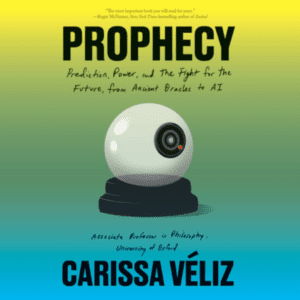
My guest today is Carissa Veliz, a philosopher and associate professor at the University of Oxford, where she also researches at the Oxford Internet Institute. Her work focuses on the ethics of technology, privacy, and artificial intelligence, and she advises companies and governments around the world on these issues. She's the author of the widely acclaimed book Privacy is Power, The Ethics of Privacy and Surveillance, and her new book, Prophecy: Prediction, Power, and the Fight for the Future, from Ancient Oracles to AI, is out now.
We talk about how the role of prophet has simply changed costumes throughout history from oracles and astrologers to economists and now tech executives and why that matters more than most people realize. Carissa explains how predictions about human beings are fundamentally different from predictions about the weather, why so many AI-driven forecasts are closer to commands than hypotheses, and what it actually looks like to take back your agency in a world increasingly shaped by algorithms.
“Predictions about people are not like predicting the weather. They can change what happens and become self-fulfilling.” - Carissa Veliz Share on XShow Notes:

- [01:13] Carissa Veliz shares her background in philosophy, ethics, and advising companies and governments on technology and data.
- [02:35] She explains how prediction has existed throughout human history, from survival instincts to ancient prophecy.
- [03:49] The role of “prophets” evolves over time—from oracles and astrologers to economists, data scientists, and tech leaders.
- [07:05] Predictions about people differ from predictions about nature because they can influence outcomes and become self-fulfilling.
- [07:55] Many modern predictions, especially from tech leaders, function more like commands than neutral observations.
- [10:13] Carissa outlines key questions to ask when evaluating any prediction, including who benefits if it comes true.
- [10:13] She argues society has been overly naive about predictions, often mistaking power plays for objective knowledge.
- [14:18] AI systems are designed to please users, which can conflict with truth-seeking and scientific rigor.
- [14:54] Growing superstitions around AI include attributing agency, intention, or even spirituality to algorithms.
- [15:47] People begin trying to “please the algorithm,” creating a modern version of superstition in digital systems.
- [19:55] The lack of regulation in AI places the burden of understanding risks entirely on individuals.
- [19:55] Carissa argues the real issue isn’t just bias, but whether predictions about people should be used at all.
- [24:49] Insurance shifts from pooling risk across populations to targeting individuals, increasing inequality and personal burden.
- [27:02] Self-fulfilling prophecies in medicine and decision-making can hide their own failures by erasing alternative outcomes.
- [30:25] Predictive systems risk limiting human potential by filtering out those who don’t fit expected patterns.
- [30:25] Society thrives when individuals can defy expectations, something prediction-heavy systems may suppress.
- [35:21] Algorithms reduce exposure to randomness, while real-world interactions create unexpected opportunities and insight.
- [36:11] Over-reliance on AI can replace human relationships and narrow life experiences.
- [36:11] Carissa reframes uncertainty as a positive force that enables freedom, choice, and democratic possibility.
- [36:11] She encourages treating predictions as possibilities to question—not instructions to follow.
Thanks for joining us on Easy Prey. Be sure to subscribe to our podcast on iTunes and leave a nice review.
Links and Resources:
- Podcast Web Page
- Facebook Page
- whatismyipaddress.com
- Easy Prey on Instagram
- Easy Prey on Twitter
- Easy Prey on LinkedIn
- Easy Prey on YouTube
- Easy Prey on Pinterest
- Carissa Veliz
- Carissa Veliz – LinkedIn
- How Privacy Can Save Your Life | Carissa Véliz | TEDxPorto
- Prophecy: Prediction, Power, and the Fight for the Future, from Ancient Oracles to AI
- Oxford Handbook of Digital Ethics
- Privacy is Power: Why and How You Should Take Back Control of Your Data
- The Ethics of Privacy and Surveillance
Transcript:
Carissa, thank you so much for coming on the podcast today.
Thank you so much for having me, Chris.
Can you give myself and the audience a little background about who you are and what you do?
I'm a writer by night, and the day job is associate professor at the University of Oxford.
What do you teach at Oxford?
I teach philosophy and ethics.
Oh, it's an interesting combination. Is that your kind of pathway for writing your books about privacy and prophecy?
Yes, although I think I've always been a bit of an unusual philosopher in the sense that I care a lot about practical applications, and I advise companies around the world. Sometimes they're very small startups. Sometimes its Fortune 500 companies. I advise governments and policymaking as well.

I'm a member of the board of The Proton Foundation, which is the majority stockholder of Proton. I come from a background of a family that is in business. I have thought a lot about how businesses use forecasting and data collection and all these topics much more than I think the average philosopher would.
I like that. Can you give us a brief, if there is such a thing, a brief history of prophecy?
Of prediction itself or of the book?
Of the concept of prophecy. Yes, I guess we have to have that distinction there—the history of prophecy as a mechanism before casting.
We've been using prophecy for as long as we've been human beings. In some ways, it is part of what gives us a competitive advantage. If you can predict how animals will behave, it's easier to hunt them. If you can predict the location of the stars, you can use the sky as a map and as a clock. If you can predict what the next season is going to be like, it's easier to farm and survive better.
But there is a very fine line between reasonable prediction and guessing what the future holds based on the past with high confidence that the future will resemble the past and getting into essentially the supernatural. Our anxiety to know what the future holds is so prominent that it makes us very vulnerable to charlatans of all kinds. In that sense, prediction has always been a very big business. Profits are merchants of prediction.
Our anxiety to know what the future holds is so prominent that it makes us very vulnerable to charlatans of all kinds. In that sense, prediction has always been a very big business. -Carissa Véliz Share on XOne of the most important figures in the history of prediction was, of course, the Oracle of Delphi. Ancient Greece in general was a culture that was obsessed by divination. There were not only oracles, there were seers. Then those became astrologers in the medieval ages. Astrologers became social scientists in the 19th century who became part of public policy and introduced forecasting in a quantitative way to make decisions about the population.
For a very short period, became economists. The role of profit, the ones that sit next to power, has been filled by computer scientists and data analysts and tech executives today.
The role of profit, the ones that sit next to power, has been filled by computer scientists and data analysts and tech executives today. -Carissa Véliz Share on XHave the Oracles always been a position of power because they have the secret knowledge, so to speak?
Exactly. We crave for certainty about the future so much that we give them a lot of power. We ask them to tell us what the future holds. That makes them very coveted, very powerful. That also makes them sit in halls of power and exchange money with power. In the courts of kings and queens, there have always been prophets, astrologers, or seers. Even today, in a sense, one way to put it is that we are seeing the latest iteration of something like the figure of Rasputin.
Looking backwards in the history, we see kind of the forecasting, the prophecy, looking towards seasons. OK, we've determined a pattern, and that is relatively repeatable. We call that a year, and we have seasons. Obviously, there's variability from year to year. At what point does prophecy kind of switch from rough forecasting to, I don't know if I want to say make-believe, but something other than rough forecasting?
Mostly in two ways. The first one is when we predict not about next hour or next week or next month or even next year, but 10,000 years. The further away in time the prediction, the more untrustworthy it is. It's much safer to predict what's going to happen the next minute than what's going to happen in 10,000 years. The second line to cross is whether we're predicting natural phenomena or whether we're making predictions about the social world.
The difference there is if I predict what the weather is going to be like tomorrow, not much of what I say, the weather is not going to be influenced by what I say. If it rains, it's going to rain, and it was going to rain anyway whether I forecasted it or not. But when I predict a human being, a particular human being, that will influence the expectations that that person has, the expectations that others have of them.

Those kinds of predictions have a tendency to become self-fulfilling prophecies. For example, if a student asked me for a letter of recommendation, and in the letter of recommendation I write that I don't foresee that person staying in academia and having a job, they won't have a job. But it won't be because of anything having to do with them necessarily, but because of the prediction that I make. That will become true. In that sense, every time we hear a prediction that has to do with social realities, we should be very, very skeptical and very wary of it.
When a tech executive says that tomorrow we're going to be using AI for everything everywhere, that is not like predicting the weather. It is predicting a kind of future that happens to line their pockets. What they're doing actually is issuing something closer to a command than a description of the world. I'm going to get a bit philosophical. But in philosophical jargon, we call that a speech act. J.L. Austin was a philosopher who wrote a book called How to Do Things with Words. He made the point that not every sentence is descriptive about the world.
Some sentences do things. When you tell your child that they have to clean up their room, you are issuing an order. You're not describing the world. When a priest pronounces a couple husband and wife, he's marrying them; it's not a description. When somebody makes a prediction about the social world, what they're actually doing is saying, go out there, fulfill my vision of the world. It's a kind of order. When we believe them uncritically, what we're doing is essentially obeying.
When a priest pronounces a couple husband and wife, he's marrying them; it's not a description. When somebody makes a prediction about the social world, what they're actually doing is saying, go out there, fulfill my vision of the… Share on XInteresting. How do we understand the differences and the nuances between forecasting the weather and forecasting societal changes? Where does that line become a change from a forecast to a command?
The most important red flag is whether it's about human beings, because human beings are agents. We have a say in our future, unlike clouds, which don't have a say in their future and are not agents. When you listen to somebody say something, the first thing to do is ask yourself, “Is this a prediction or is it a description about the world?” Sometimes it's not that straightforward to tell them apart.
When you listen to somebody say something, the first thing to do is ask yourself, “Is this a prediction or is it a description about the world?” Sometimes it's not that straightforward to tell them apart. -Carissa Véliz Share on XWhen you identify a prediction as such, the next question to ask is, “OK, who's making this prediction? Why are they making this prediction? Are they out for knowledge, or are they out for power or money? If their prediction becomes true, who's going to benefit from it? What would need to happen for the prediction to come true?” The answers to all of these questions give us more information to determine on which side of the divide that is.
But the general argument of the book is that we have been incredibly naive about predictions in the recent past and in history more generally. We tend to interpret predictions as quest for knowledge or hypotheses about the world when more often than not, they’re power plays in disguise. When you listen to our prediction, instead of obeying what we ought to do, is to take it as an invitation for defiance.
I think if we look back at it, at some point, there was this transition from prediction being spiritual or, let's call it spiritual positioning. It seems like now, if you're talking, like, economics, it's like, “Oh, well, the stock market's going to go up. The stock market's going to go down.” It's now started to become more technical in nature that it's not so much that we have priests predicting the future but people coming out of some aspect of academia or science that are ones that are making the predictions now. Is that kind of why we maybe feel more inclined to trust them?
Yes, but we're wrong. Part of what Professor Argus is very involved. But just bear with me. We tend to think about AI as cutting-edge technology and science, right?
Yeah.
But if you were to ask an ancient Greek what the cutting-edge methodology for decision making is, they would have said, “Go to the Oracle of Delphi.” It was not that different for them. When you think about astrology, it was very technical. In fact, it was too technical in many ways. People complained that they didn't have access to that. You needed to know numbers and know how to measure the distance between stars and so on.
To be fair, it wasn't all questionable. Some advancements in astrology led to advancements in astronomy, really. For example, astronomy was the first science which got close to having something like big data, like vast amounts of data. And on the other side of the coin, we are seeing some trends when it comes to AI that are very superstitious, unbelievably superstitious, and not only have to do with religion, as in people starting to have some attitudes that would be more associated with religion, like God works in mysterious ways and algorithms seem to work in mysterious ways.

Some people are even making the argument that God is just acting through algorithms right now. But also in the social connections that we see and the assumptions that people make. There are certain tribes in Silicon Valley that are obsessed with longevity or obsessed with general artificial intelligence. In some ways, from a sociological perspective, they quite resemble some religious sects.
Part of what I would like us to question is whether that divide is justified. One reason why you might think maybe we should have more doubts is it's unclear to me, and I think it's unclear to most academics, whether AI is improving science or making it worse. More academics are using AI to come up with papers. More academics are using AI to review papers. AI makes very important mistakes, and some of those mistakes are hard to recognize and to pick out. The jury is still out as to whether AI is improving science or not.
AI makes very important mistakes, and some of those mistakes are hard to recognize and to pick out. The jury is still out as to whether AI is improving science or not. -Carissa Véliz Share on XI've seen cases where AI and big data can find a pattern and say, “Hey, this might be worth looking into.” It's like, “OK, that's interesting. Let's look into it and see if we see something.” But we also see AI just hallucinating, and I want you to be happy, so therefore I'm just going to create something that supports your own hypothesis.
Exactly. AI is designed to be very sycophantic, to give in to our desires and our views, because people like to be validated and like to be told that they're brilliant and that they're right. But that doesn't align particularly well with science or the pursuit of truth.
AI is designed to be very sycophantic, to give in to our desires and our views, because people like to be validated and like to be told that they're brilliant and that they're right. But that doesn't align particularly well with… Share on XYeah, because the pursuit of truth, we want to know when we're wrong, and AI doesn't seem to want to tell us when we're wrong.
Exactly.
You talked about AI superstitions. What are some of the superstitions or assumptions that we have about AI?
Well, it depends, because there is no “we” that everybody agrees on these things or everybody feels a tendency, but the kinds of phenomena and patterns that we're seeing are AI becoming prominent within religion. Religious people refer to AI as a conduit for the expression of God or some supernatural intervention. In general, this feeling of, we don't know how the algorithm works, and so we start making hypotheses.
The way we make hypotheses very often attributes to the AI some kind of agency. Maybe it wants this, maybe it's picking out this. Hannah Arendt had this very insightful point about how when bureaucracy becomes arbitrary and it becomes impossible to rationally navigate the bureaucratic system, it's so anguishing that people naturally start coming up with hypotheses, with supernatural hypotheses, or, “Maybe this is happening, and maybe this is happening.”
That's exactly what Kafka was trying to convey with his novel The Trial. One way to describe what is happening is that we are building a very Kafkaist system in which we know we are ruled by algorithms, but there are no rules as such because it's just pattern matching. We are always trying to figure out what pattern is being recognized and how we might adapt to it. That creates a kind of naturally superstitious mentality of trying to please the algorithm when you don't know what it wants and what it's looking for and what is on the other side of the screen.
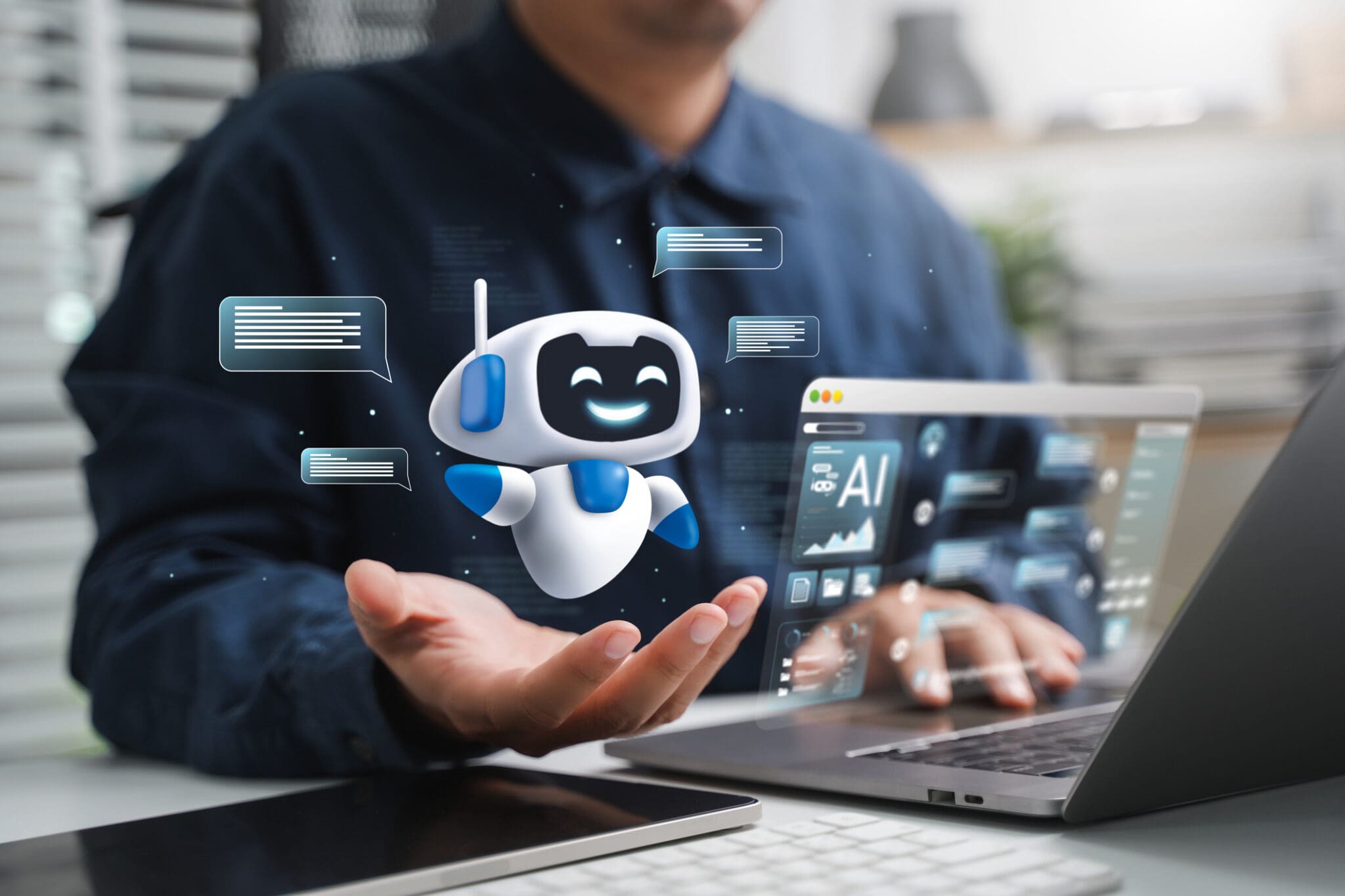
Another thing that doesn't help is that chatbots are designed to be impersonators. It sounds like there's someone on the other side of the screen. They use, for example, the first-person pronoun. That hijacks some of our emotional responses as if we were not talking to another creature when in fact there's no one there. It's just statistical analysis. Then you have these other tendencies to think about whether AI might be sentient.
Of course, I think we're very, very, very far away from that. There's no reason to think a chatbot is sentient in the slightest. But this is not the first time we've heard it. The first time that it got reported wildly in the press was with Lemoine, the engineer from Google, who thought that Lambda was conscious. But since then, there have been other people.
Now we have a term, some people call it chatbot delusion or chatbot psychosis, about how people who start having conversations with a chatbot, very often about conversations about whether they're alive or they're conscious, end up spiraling into delusion.

Yeah. Probably people do the same thing in a way. Right now they're in the production of large language models and their implementation. There aren't a lot of guardrails in place, and generally not guardrails that everybody agrees on. Everybody agrees that these are the guardrails we have to work with either. That isn't really the case. Some people like these guardrails.
Some people like those guardrails, no guardrails. Where does that kind of leave us as consumers that are interacting with this tech, since, it's not like a whole lot of people really understand how internal combustion engines work. We get in our cars and we drive. But how does our misunderstanding of the tech lead us to maybe, like, an over-reliance or giving up agency to AI?
That's a very rich question because there's so many elements to it. With a car, even if you don't understand the engine, the engine is not made to be misguided or deceitful or an impersonator in a way that a chatbot is. There's that element that is not only about us not understanding, it’s that we are being presented with a product that is designed to seem like something it's not.
The second aspect is that you're right. In most industries, in fact, every industry out there. There is regulation except for AI. That puts a very heavy burden on the shoulders of individuals to try to figure out how these systems are failing, what is safe, what is not safe, and what are some better products than others when you don't have official guidelines and supervision and so on.
The third element that I think is very important in this conversation is that in many ways, I think that we are misdiagnosing the problem. If we don't have a good diagnosis of the problem, it's going to be a lot harder to reach any kind of consensus and solutions. For example, we hear a lot about AI bias. Of course, AI bias is a huge problem. But I haven't seen this conversation on the table about what makes us think that it's OK to allow anyone, including a chatbot, to make predictions about other human beings and act in accordance with those predictions without asking for the input of the person involved, without informing the person that such predictions are happening, and without any kind of guardrails.
Even in ancient Rome, predictions were regulated. It was illegal to predict the death of the emperor for obvious reasons, because it tended to create a self-fulfilling prophecy once you predicted the death of the emperor. Very often, the emperor would show up dead. And yet, thousands of years later, we haven't caught up with those lessons.
We're using prediction much more than ever in every sphere of life, including spheres that are supposed to be about facts, like the justice system. Any sphere in which we're talking about what people deserve is not remembering that predictions are never facts. At best, they're educated guesses. At best, but often not even that.
Yeah, just for clarification. I will show one of my off-tension backgrounds. In life insurance, they have people that are called actuaries that look at the statistics of a myriad of health conditions and the average life expectancies of people with these health conditions. They make a guess that statistically, someone with these conditions is going to live to be 75, so we're going to base a life insurance policy payout on the over and under of whether the person's going to make it to 75.
What's the likelihood that they will or that they won't die? I don't think there's any prediction. They're not predicting that you, I guess, in some cases, maybe they are making a prediction. But where does it cross over from that, which is, in my mind, a little bit more analytical versus now we're going to decide whether or not someone gets an organ transplant or something like that, or what's going to happen to them after they get out of jail? How are those different? Or maybe they're not. Maybe I've got it wrong and they're not different.
That's an excellent question. In the book, there's a lot about insurance and about these tables and where they come from. The first person who did one of these tables was Halley, the same guy that predicted the comet. Anyway, one difference is that traditionally, at least, insurance was about pooling risk. You have statistics about how many people, and a million people will get this kind of disease and what that means for life expectancy.
On the basis of that, you roughly know how many people are going to be unlucky within that million population, how many people are going to be lucky, and the lucky people essentially fund the unlucky ones. But because nobody knows whether they're going to be lucky or unlucky, we all benefit from it because it's essentially reaping the benefit of the law of large numbers and statistics while being an individual. That's the luxury because if you're an individual and if you're unlucky and you don't have insurance, it'll crush you.
That's the theory of it. Now, in practice, one of the tendencies we were seeing that is very concerning is for insurance to go from being very high-level about large populations to increasingly being a prediction about a particular human being. Now an insurance company can have access to your data about what you buy, how much you earn, where you live, how fast you drive, your genes, and they can predict your life expectancy.


Based on that, your fee, your insurance premium might be a lot higher or a lot lower. That is hugely different because it means that we're pushing risk onto the shoulders of individuals rather than pooling risk, which is a whole kind of raison d'être of insurance. What that means is that the unlucky people have to pay their way. You might have bad genes and if the insurance company thinks that you have bad genes, you might get charged a lot of money, even though there was nothing you could have done differently, and you're not to blame for it.
In that case, in a sense, when you push it to the kind of last consequences, what that means is that we shouldn't even have insurance. We should pay for our own way because insurance is just paying a middleman to essentially do nothing. Their job is to pool risk and if they're not doing that, then what are we doing?
It's not only bad for individuals because if you're unlucky, but you're in a very bad position, it’s bad for society because society depends on the robustness of individuals. For example, in the 2008 financial crisis, what happened was that banks were giving very risky loans to people. They knew we're not going to be able to pay the loan back or we're going to struggle. When too many people can't shoulder the risk that is on them, they break and society breaks with them.
Is that where it kind of crosses the line where it now starts to become self-fulfilling in a sense of if I don't think that you're going to be an economically sound investment, then the person is going to go, “Oh, well, I guess I don't make good decisions,” and now that starts filtering their choices?
That too. Not too long ago, a supervisor of the UK insurance industry said that he was worried that AI was going to make some people uninsurable. Once you deem someone uninsurable, they become a lot more risky because they don't have—it’s kind of a vicious cycle. This is particularly evident when it comes to medicine. If in the process of triage somebody is deemed to be beyond all help and doesn't get the necessary care, then they will likely die.
What's interesting about self-fulfilling prophecies is that they're the perfect crime because they erase all track records because we never get the data of what would have happened had we given medical care to that person. That data doesn't exist. It's like a murderer who covers their own tracks. It doesn't give any error signals.
Maybe this is not a good analogy. It reminds me of—probably wasn't really a case study. The occurrence that happened during World War II is when the planes left England, they did their bombing and they came back. They looked at the bullet holes in the plane and said, “Oh, well, everywhere there's bullet holes, we need to put more armor on the plane.” Because they were trying to protect where the, well, these were where all the bullet holes were. Well, they weren't accounting for all the planes that didn't come back.
The answer was actually, “Well, you need to put more armor everywhere you don't see a bullet hole because that's what caused the plane not to come back.” Is a little bit of that kind of in what we're talking about, being this, like, self-fulfilling…. If we're not triaging the person, like, “Well, of course they're not going to recover because we didn't actually provide any medical care for them. Of course they're not going to get better.”
Exactly. And one of the things it points towards is this: the deception of thinking that anything can be data driven, right? Because if we are making algorithms to decide whether people are going to be employed, we're not getting the data of the people we don't give jobs to. Everybody, more and more, everybody's using the same kind of algorithm. If you don't get one job, you're likely not to get any job.
We might not be giving jobs, not because those people don't deserve a job, but because they're unusual in some way. The algorithm tends to be good at identifying patterns in the normal curve. If you fall out of the normal curve, either because you're worse than the normal curve, but maybe because you're extraordinary in some way, in some way that makes you better, or just in some way that makes you just old-fashioned and weird, then we might be discriminating against you, and we will never know what we missed out on.
Yeah, it makes me think of…I feel like many people never find out, or never have the opportunity to find out interesting things about them where they excel immensely. Let's say if you have a kid who's musically inclined, but they never have an opportunity to play an instrument, they will never get to experience that. If you're only measuring them by, “Well, did they get an A in math, and did they get an A in science?”
We're not looking at, “Oh my gosh. They have this amazing talent with music that we missed.” Like, you've missed a way that someone can contribute immensely to society because, well, we want to look at 90% of the people that fall into the, “Well, as long as you're good in English and math, you're going to make it.”
Exactly. As a society, when we think about how do we build society in order to better thrive, we should build society in a way that allows individuals to defy the odds. Our biggest heroes in history are people who have done so much better than expectations. I mean, you name it, but Martin Luther King or Rosa Parks or Marie Curie or Nelson Mandela, these are all people who defied the odds.
But if we have a system that makes predictions about them, even before they try to defy those odds, then we are narrowing human agency. It's not only that we're shackling the feet of extraordinary individuals, it's that we're shackling our own feet as a society because each one of those people could come up with solutions to the greatest challenges that humanity faces.
Given all of that, what do we do to change the circumstances, particularly if we're looking at AI? What are the decisions that I can make today, this week, this month, this year, that allow me to kind of not get caught up in the prediction cycle, the prediction wheel?
Well, a lot of it is in the book, of course, but it partly has to do with culture, with interpreting uncertainty as good news. When we look at how uncertain the world is, I think it's natural, and I feel it too, to feel anxious about it. But that anxiety pushes us to ask somebody, an expert, “Tell me what the future holds.” And nobody knows. No expert, and especially experts, don't know.
Instead of having that kind of new reaction, what we should reflect on is it's great that we don't know what the future holds, because if we did, it would mean that we were in a police state. It's only when we don't know what the future holds that we have a democracy. That's because we don't know who's going to win an election, for starters. That means that you can have leeway intervening in the future.
Instead of wanting to know what the future holds as if it was a script to discover, we should ask ourselves, “What future are we going to build? What future do we want to see, and how do we get there? How do we write that script?” What that means is many things. But just to give it a taste, it means not giving too much credence to profits. Next time you hear a tech executive say, “This is inevitable, this is progress, this is what tomorrow looks like.” Say, “Maybe, that's one future. Is it the future I want? And if not, what am I going to do to make sure that that's not the future we choose?”
It also has to do with reaping the opportunities and benefits of uncertainty and making the most of it. It has to do with increasing your exposure to serendipity. You never know what the tide is going to bring. Sometimes if you think about the best things that have happened to you in your life, they're probably quite hard to predict—meeting the most important person in your life or getting a job that you would have never imagined getting.
How do we increase the chances of that serendipity happening? One way is to just give a metaphor, but it has a lot of applications in life. I love going to bookshops because I come across books I would have never read otherwise. I particularly love, for example, a bookshop in Oxford called Blackwell’s in which people who work there recommend their favorite books and sometimes they recommend quite quirky things. Whereas if I just look online for books, I don't get that kind of serendipity.
I'm usually looking for a particular book, and yeah, I find it, but I don't find the book next to it. It has to do in general with being more critical about predictions, having a public conversation about what kinds of predictions should we be making, what kinds of predictions we shouldn't be making, even if we could predict something, and where do those lines lie, choosing better products. It's not a one thing, it's a particular take on life.
Yeah, I think the thing with the books, that resonates with me, because if I go on Amazon or whatever online reseller, they're going to look at my history of books and say, “Well, people who bought these books also bought these other books.” That is not necessarily about me finding things that are going to be interesting to Chris.
It's about what's going to result in the most books being sold, not what is Chris going to find valuable. And that's kind of, I like that analogy of going to a real bookstore because you don't have—there are different algorithms, but less chance of being more exposure to things that we're not expecting.
Another example that I've been thinking about recently is one of my favorite cities in the world. My favorite city in the world is Madrid. It's a very friendly city, and it's very normal to stop someone on the street and just ask them for directions. I find myself doing that instead of looking at my maps on my phone. More and more, when I do that with young people, they stare at me like, “You have a phone. Why are you asking me?” But when I ask someone who's over 30, they will be very friendly and will often tell me a piece of information that I would have never known to ask.
So, “Oh, yeah, the library is there, and you should definitely try that coffee shop because it's the best in the neighborhood,” or whatever. That's how you get to meet people that you wouldn't have met otherwise, have conversations that you wouldn't have had. We shouldn't allow predictive algorithms to determine who we meet, what we do, where we end up, what we see.
We shouldn't allow predictive algorithms to determine who we meet, what we do, where we end up, what we see. -Carissa Véliz Share on XWe shouldn't substitute those for relationships either.
Exactly. Yeah, very true.
I'd unfortunately hear more and more news about people feeling like they're in a relationship with AI, and less and less so with people. As we wrap up here, any additional parting advice for people?
Interestingly, my first book, Privacy is Power, was interpreted to be quite a gloomy book, even though it ends up with, I think, cause for optimism. Maybe it's because I enjoy being a little bit contrarian, but the more I encounter a very gloomy interpretation of the present, the more I just naturally try to look for sun rays, sometimes in corners that are very well-known but are neglected.
Uncertainty is a good thing, that this is exciting, that this is an opportunity to intervene in your future, that you have much more agency and power than you possibly imagine. This is a good thing. -Carissa Véliz Share on XOne thing I would like to maybe end on is that uncertainty is a good thing, that this is exciting, that this is an opportunity to intervene in your future, that you have much more agency and power than you possibly imagine. This is a good thing. That there are a lot of resources around us that we are forgetting because we are so worried about and so dazzled, and our attention is so caught up on the digital.
But the analog world is all around us, the world of relationships, of people of flesh and blood, of coffee shops and bars and bookshops and libraries, of a natural world, of streets, of other countries to visit. The world is incredibly rich. If you can ground yourselves in the analog, because everything virtual depends on the analog. If we lose the analog, we don't only lose the analog, we also lose the virtual. I think it's a good place to start thinking about what a good life is and how to make sure that we take care of the basics.
The world is incredibly rich. If you can ground yourselves in the analog, because everything virtual depends on the analog. If we lose the analog, we don't only lose the analog, we also lose the virtual. -Carissa Véliz Share on XI like that. When is Prophecy going to be available, and where can they find it?
The book is available everywhere where books are available. Your local bookshop should have it, of course, online retailers as well. And I hope that you enjoy reading it and that it inspires you to interpret predictions not as orders to obey or kind of false facts to believe, but as invitations for defiance.
I like that. And if people want to try to find you online, where can they find you?
I'm on Bluesky. I'm on LinkedIn. My website. Yes, I have a website. It's www.carissaveliz.com.
Awesome. We will make sure to link to all of those in the show notes. I really appreciate you coming on the podcast today.
Thank you so much, Chris. It's been a pleasure.