







The fight against scams and fraud is constantly evolving along with criminals’ tactics. As criminals use more manipulation and tricky tactics, an emphasis on fraud psychology, education, and proactive measures is an important approach. Efforts driven by a community of passionate fraud fighters will help protect people and organizations in our complex digital world.
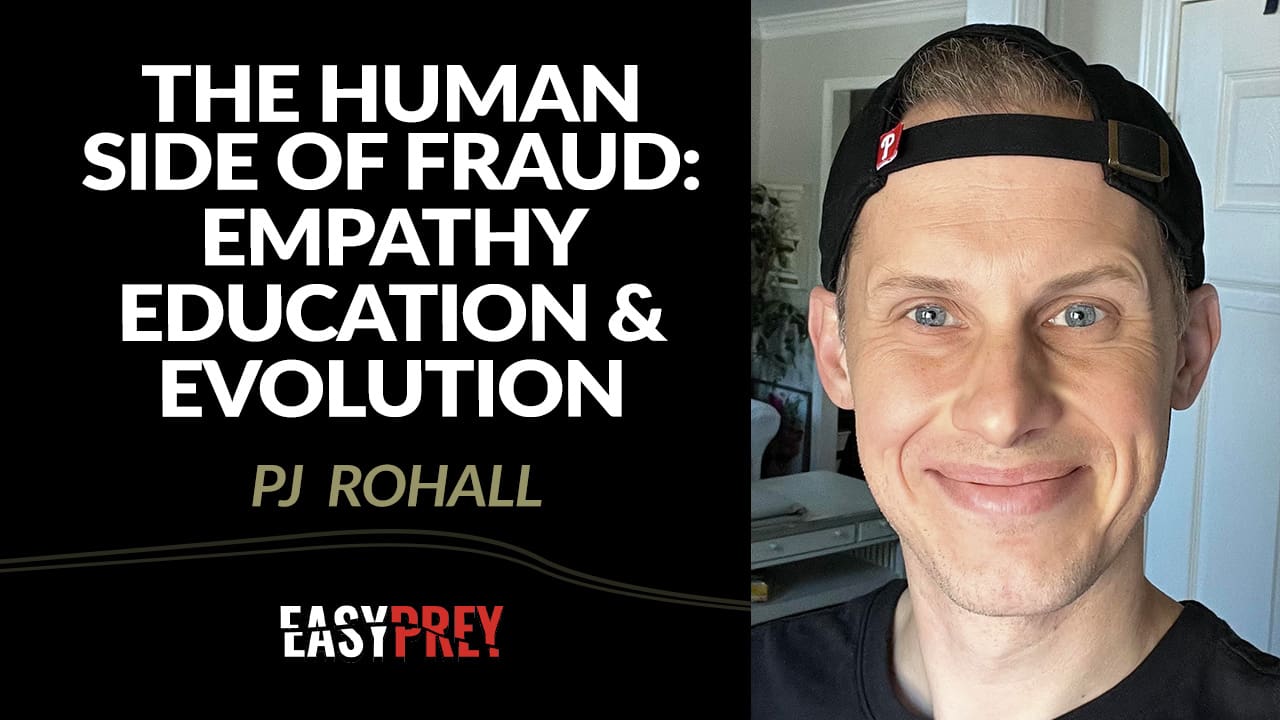
See The Human Side of Fraud: Empathy, Education, Evolution with PJ Rohall for a complete transcript of the Easy Prey podcast episode.
PJ Rohall is the co-founder of About Fraud, a global community built by fraud fighters, for fraud fighters. But he started his career in finance, because it sounded cool and it paid well. But he struggles with anxiety and OCD, and his Manhattan finance job drove him to a nervous breakdown. He moved home to take care of his mental health, and he realized he didn’t actually like what he was doing in finance. Then he saw a job listing for a fraud analyst position. If nothing else, it sounded like good job security, since it didn’t look like fraud was going away. His job was to review orders for a huge variety of merchants and determine if they were fraud or not. It wasn’t a glamorous job, but he became interested in fraud operations and learning how fraud works and the psychology of it.
After working in fraud operations for about eight years, PJ co-founded About Fraud in 2017. It was a passion project on the side, with the goal of aggregating fraud education resources to help people in the fraud-fighting field learn from each other. Along the way, that became his full-time job.
The Art of Spotting Fraud
At his first fraud analyst job, PJ was lucky to have a good mentor and team who could help him learn. Fraud is still a growing industry, and a lot of the tools are piecemeal. He failed a lot and learned a lot along the way. Eventually, he got to the point where he could look at an order and it just didn’t feel right. It wasn’t the dollar amount or anything easy to spot, just something in the back of his mind.
All fraud fighting teams have different things that show red flags and risk scores. The team always checks these scores, but sometimes it’s easy to see that something doesn’t look good. Buying five PlayStations at a time just doesn’t look great. There’s always a story. Once they get the fraudster on the phone, it’s often an elaborate or unbelievable story, like buying a PlayStation for each of their five grandkids.

The hardest part was the edge cases. There are plenty of good orders, and companies want to make good customers happy. They don’t want genuine orders cancelled for fraud. The challenging part of fighting fraud is that nobody remembers all the fraud you stopped – just the one fraud you didn’t, or the legitimate order you cancelled for fraud.
Collaboration to Fight Fraud
There’s fraud in every industry, and fraud prevention people can connect the dots to real impact. If anything, fraud prevention people need to collaborate more. Everyone says we need to collaborate like fraudsters – they’re on the dark web, on Telegram, and more. But they have no rules and not many morals. That’s not realistic. The key is doing better.
Fraud happens in every industry. – PJ Rohall
About Fraud, and their in-person conference experience Fraud Fight Club, is trying to help with that. Conferences, communities, certifications, education, and other things are all taking their own unique approach. More collaboration is always better. PJ’s job with About Fraud is equipping people whose job is fighting fraud. He enables relationships, connects people to resources, and provides information about fraud psychology, tactics, and tools. If you’re working full-time fighting fraud for a company, you may not have a lot of time to research things, network, or go to conferences. About Fraud aggregates information, resources, and connections. You don’t have to find every expert you need inside your company. And this not only benefits the experts, but also the companies they’re protecting.
Anyone Can Be a Victim
So far, PJ has only been a victim of the “vanilla” version of fraud. He’s had traditional unauthorized payment activity on his credit cards, and he was able to get that money back because of consumer protections around unauthorized transactions. Thankfully, he’s never been psychologically or emotionally manipulated with a scam. But anybody is vulnerable to it. One of the most important things we can do to increase awareness is breaking the stigma.
People who get scammed experience trauma and shame. The word “scam” isn’t strong enough. They ruin lives. Some lives are even being lost, especially with scams like sextortion. Older adults and teens are especially vulnerable, but everybody can be a victim. PJ is somewhat tech-savvy and definitely fraud-savvy. He’s seen people like him or even more tech-savvy tell stories of being scammed. Even fraud experts get caught sometimes. It’s powerful to read those stories – it normalizes having a human brain and emotions.
We just need to be realistic about who the actual scam victims could be, which is everybody. – PJ Rohall
When PJ looks back at decisions he made when flooded by emotions and urgency, it almost feels like he wasn’t the same person. Scams and fraud use similar psychology and manipulation tactics to get our emotions raised and reduce critical thinking. It’s strategic, and in some cases organized crime with big business models. They put a lot of effort into defrauding even the most savvy people.
The Right Scam can Catch Anyone
You’ve probably received a lot of scam messages not relevant to your life. It’s easy to dismiss them if they’re not relevant. But if the right message hits when you’re expecting something similar, we often don’t think to doubt. Say you get an email about a package for you being stuck in customs. Most of the time, you’d know it’s fake and delete it. But if you recently ordered something you know is shipping from overseas, you’re expecting a package that would have to go through customs. It fits our expectations, so we don’t think to check.
PJ gets a lot of spam texts about unpaid tolls for toll roads or turnpikes. He just deletes them. But if you’ve recently gone on a road trip or done a lot of driving and didn’t know this was a common scam tactic, it would look plausible. The larger issue is that it’s easier for us as a society to assume other people are stupid than to look at the actual causes and face the reality that we’re not immune to being scammed. It’s a tricky balance. But we get nowhere throwing people under the bus, and we get lots of places with empathy, understanding, asking questions, and figuring out how to educate people in the future.
Education and Detection
PJ’s scam education dream is to get outside of the bubble. It’s great to talk about your inner bubble – educating your family members, schools, and communities. But when fraud is applying psychology tricks and manipulating people, we really need everyone who can getting on their loudest microphone. Streaming platforms, influencers, and PSA campaigns are way overdue.
Many banks send out emails about fraud, and that’s great. Part of banks’ jobs is to educate consumers. But they often send their fraud education just like they would a notice that your credit card APR is changing. Advancements in education are great, but advancements in detection are just as important. And all of this shouldn’t be on banks, either.
Could there be advancements in education? Sure. Could there be advancements in the way that they detect fraud? Absolutely. – PJ Rohall
What are we doing from a societal and government standpoint? What steps are we taking to inform people about the devastating effects of fraud? It’s not just losing money, sometimes devastating amounts of money – it’s massive psychological trauma and suffering, too. We’re outside of the awareness and education curve because most of the people talking about this have an audience that’s already in the fraud fighting space. Singapore is full of billboards with fraud-related PSAs. The UAE has videos on YouTube about scams. Australia is on the forefront of regulations. We might not want to learn everything we need to know from influencers, athletes, and celebrities, but talking about this more will be a benefit.
Victim-Blaming and the Evolution of Scam Psychology
If you get randomly beat up on the street, nobody blames you. Maybe you could have been a little safer, and maybe some people will think that you made some bad decisions. But everyone acknowledges that you were the victim, that shouldn’t have happened, and we should take steps to catch the attacker or let people know this area isn’t safe. Nobody responds by saying, “You’re an idiot, I wouldn’t do that.” But we treat scam victims like it’s their fault.
When PJ was younger, he used a dial-up connection to get on AOL Instant Messenger. Social media is very new in the grand scheme of life. Even online shopping isn’t that old. It’s a convergence of a lot of things. There are new ways to connect with people, manipulate them, and get their money digitally. From a security standpoint, we’re still catching up. Fraud looks for opportunities with a good return – it’s a business to them. Using psychology to manipulate people is just the next evolution in fraud.
You have all these ways to connect with people. You have all these ways to digitally get their money. You have all these ways to digitally manipulate them. – PJ Rohall
It’s also a problem across all industries. That’s part of the challenge. If fraud starts in one company and goes to another company in a different industry, who owns the problem? And every country has a million problems, so it can be challenging to get fraud to be a major news issue. That’s where celebrities could be a huge benefit. (If you are or know a celebrity who would want to do this, PJ would be happy to facilitate a discussion!)
Using Psychology to Fight Fraud
Imagine you’re at a bank, and someone calls to tell you they lost $200,000 to a scam. They’re in a state of panic that you as a bank employee aren’t equipped to handle. PJ has seen a trend lately of companies employing psychologists to help develop or revamp their customer journey for what happens if a customer was caught in a scam. From a psychology perspective, the best advice for fraud is counterintuitive. You want to tell people it’s a scam. But that’s not the best approach and can be harmful. There are better ways of helping them.
It’s not easy to design a whole customer journey, and it’s not feasible for every company to have armies of psychologists on hand. But for organizations that can, it’s a forward-thinking move. To fight fraud, we need to think differently. Banks and merchants that are able to invest in tech to protect their customers should. We’re getting to a point where customers are prioritizing companies that will protect them. If your competitors are doing that, they’re going to go there instead.
We are reaching an inflection point where customers are going to look at institutions to prioritize their wellbeing from a scam perspective. – PJ Rohall
It’s unlikely that we’ll see legal liability for companies anytime soon, but that’s not the only reason organizations should do this. Spin it not as cost savings, but as a customer experience improvement. And you’re also at a disadvantage if you’re waiting for the government to require a change. You want to be headed towards that goalpost before it’s required.
You can find PJ Rohall on LinkedIn or email him at [email protected]. Learn more about About Fraud on their website about-fraud.com, and check out Fraud Fight Club at fraudfightclub.com.