
Every year, millions of people lose billions of dollars to fraud and scams. And the con artists won’t be going anywhere soon. New scams are created every day. For instance, this year in the U.S. one in ten people will fall victim to a scam.
Know how scams works, and you can work your way out of one.
Research and surveys clearly show that knowledge and awareness regarding scams can reduce the chance of being a victim. The more we know how scams work, therefore, the less likely we are to become victims of them.
Knowledge is power. The power to stay safe.
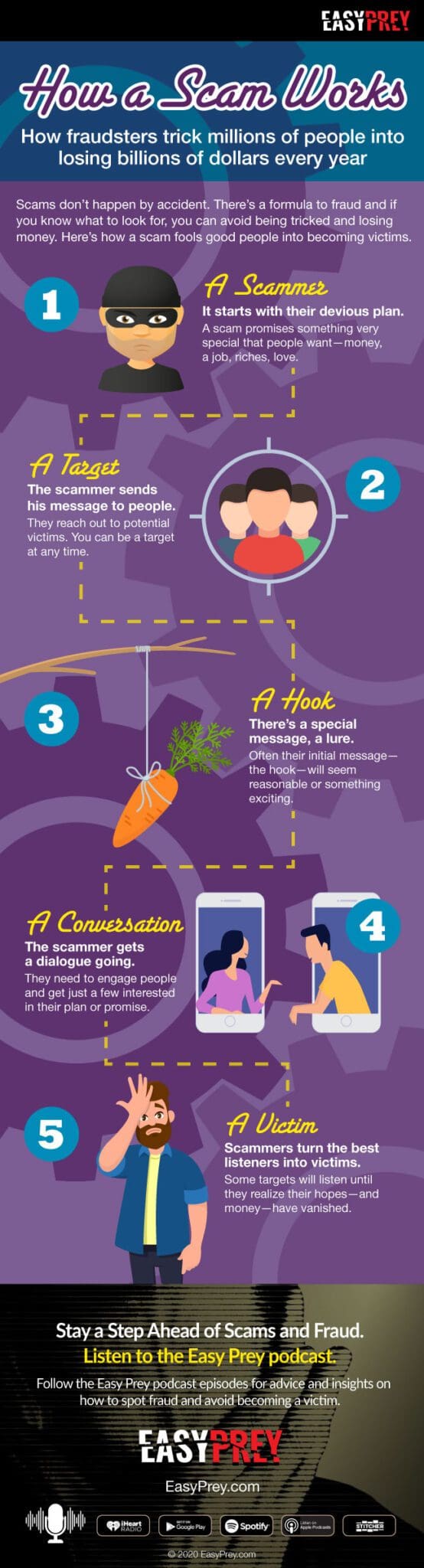
From start to finish, here is what makes a “successful” scam work.
A successful scam by a con artist happens only when they get what they were out for—usually someone’s money.
It doesn’t happen by accident. They’re not waiting for people to drop their wallets, leave their purse or backpack unattended, or leave their front door unlocked. Scammers create their fraud with precision.
A scam is a plan that a con artist rolls-out hundreds of times a day. And even though the scammer knows their schemes won’t work 80%-90% of the time, that doesn’t matter. The payoff they get from their victims is worth it.
Here’s a breakdown of how 5 components of a scam turn a target into a victim.
1. It starts with a devious plan.
 A scammer is a liar and a thief, make no mistake about it.
The scammers “tool” is trickery, deceit, lies, and a plan (a scheme). It takes the form of a message, with the promise of something very special that people want—money, a job, riches, love. Once he or she has a scheme, they're ready to launch their fraud on the world.
Scammers are devious. They often prey on innocent, vulnerable, and desperate people, often taking advantage of their kind-hearted nature.
Scammer are liars and impersonators—you won’t always see them coming.
2. Add targets (potential victims).
 A scam involves two people—the scammer and a target, a potential victim. Almost anyone can be a target at any time for fraud of some kind.
Consider yourself a target for a scammer right now. One day and maybe soon, you’ll likely be talking to a scammer, getting a message from one, or reading a fraudulent email or letter.
Just remember that being a target is not the same as being a victim. If you can sniff out the scam while it’s unfolding, you can bring the con’s plan to a quick halt.
That’s why it’s important to be aware of the different kinds of scams out there today. A believable yet devious scheme has the power to fool.
Consider yourself a target at any time. If you do, your eyes will be open and your radar will be up.
Scams and Fraud: How They Trick Millions into Losing Billions: #HowScamsWork Share on X3. There’s the sales pitch, the hook.
 Fraudsters must initiate a conversation to the target, to get their scheme underway. They contact people through phone calls, emails and texts. They’ll sometimes post ads on websites or on social media. To them, it’s a numbers game to them. That's why they’ll keep sending out messages, because they know a percentage of people will respond.
The scammer’s message usually isn’t personalized. They typically don’t know your name or much about you. They simply have a sales pitch or an opportunity they hope will catch your attention.
Often their message—the hook—will seem reasonable or even interesting: they may pose as a buyer interested in what you’re selling online, or they want to hire you for the professional services you provide, such as photography. Scams work because they’re well thought out.
Scammers know some people will listen to their sales pitch, and that’s all they’re hoping for.
A scammer’s “hook” is a lie that will sound a lot like the truth.
4. The potential victims listen—they “engage” with the scammer.
 Scammers need the attention of their targets to get their deceptive story going.
They don’t always get it. Research shows, for instance, that almost 50% of people who get an unwanted message don’t waste a second listening. They instantly reject the message and move on. (Think of it like getting a sales call and just hanging up.)
The other 50%? They’ll keep listening…at least initially. That’s what scammers need: the ears and attention of their targets, so the con artist can tell their whole message and hook people.
The research shows as many as 85% of people who were listening (initially engaged) will eventually—it could be after a few minutes, or it could be just before losing money. Good for them.
Those who keep on listening and talking to the scammer, however, aren’t so lucky.
Scammers need only a small percentage of people to stay engaged in the conversation.
5. Scammers turn fully engaged listeners into victims.
 The targets who eventually become victims fall into a wide variety of scams, but they all share one thing in common:
They kept listening the scammers lie, believing it and hoping for the best. They do it right up to the point when they realize their hopes—and money—have vanished, and there is nothing to show for it. For victims, it goes something like this:
- The victim got a new job and had to pay for supplies and training: they sent their money and received nothing for it.
- The victim accepted a check for a professional service and agreed to send some cash to someone else as part of the deal. The check bounced and their cash disappeared.
- They paid for merchandise online that never arrived or came damaged, and the seller disappeared with their money.
- The victim won a sweepstakes prize that never arrived—even after they paid a fee to get it.
If you willingly give a scammer your full attention, they will happily take your money.
Knowledge is your best defense. Listen to the Easy Prey podcast.
Here’s what we know. The more information someone knows about scams and how they work, the less likely they are to become a victim of one. There are hundreds of scams and millions of victims every year.
The best defense isn’t the police or the FBI—they get involved after people become victims of a scam—it’s knowledge and awareness that can keep you out of scammers’ grip.
That’s why you need to learn about scams, how they work, what they sound and look like—so you can avoid being a victim. For instance, in this article you learned that hanging up on an unwanted call is a sure-fire way to avoid a potential scammer. You need to find information resources you can trust.
The Easy Prey podcast is devoted to helping listeners avoid scams by providing insights, information and advice, in a friendly, easy-listening format.
You can find the Easy Prey podcast on iTunes, Google Play and other media player platforms.
Listen to the Easy Prey podcasts.
The more you know, the safer you are.