







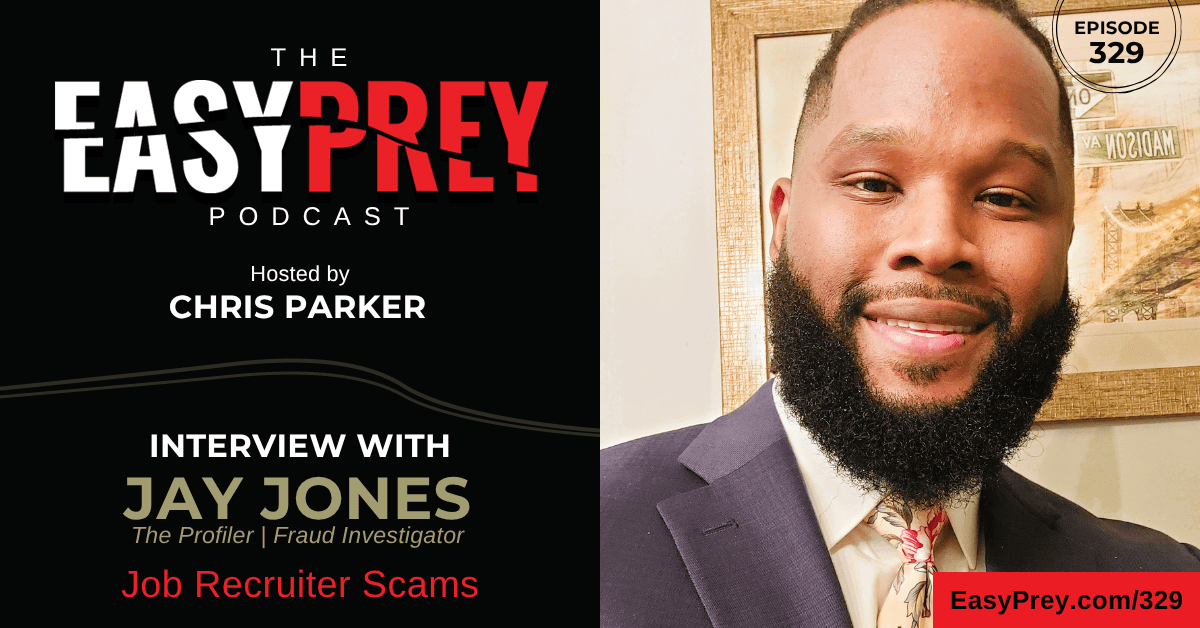

Job hunting is hard enough without having to stop and ask whether the recruiter in your inbox is even real. My guest today, Jay Jones, ran into that problem firsthand after being laid off in December 2023. With his daughter due to be born just weeks later, Jay began receiving messages from recruiters that looked promising at first, but quickly turned out to be fake.
Jay, also known as The Profiler, decided not to ignore what was happening. He started investigating the patterns behind these scams and has since identified and helped remove thousands of fake profiles, fraudulent companies, and deceptive job postings from LinkedIn. His work now helps job seekers, businesses, and executives understand how fake recruiters operate and how much damage these scams can do.
In this episode, we discuss how fake recruiting scams work, why public resumes and the “Open to Work” banner can make job seekers easier targets, and what red flags to watch for before responding. We also talk about fake background checks, resume-writing scams, equipment-check schemes, one-way interview risks, fake applicants, and practical ways to verify opportunities before sharing personal information.
“Look at everything like it could potentially be harmful, and then prove it not to be before you interact.” - Jay Jones Share on XShow Notes:

- [0055] Jay Jones introduces his work as The Profiler and explains how he helps companies and job seekers protect themselves from fake recruiters, fake jobs, impersonation, and online risk.
- [01:23] Jay shares how being laid off in December 2023 led him to LinkedIn, where he quickly realized many of the recruiters contacting him were not real.
- [02:20] Fake recruiters often outnumber legitimate outreach because scam operations have dedicated teams sending generic messages around the clock.
- [03:23] The goal behind many fake recruiter messages is to collect personal data, steal money, or gather enough information to impersonate someone.
- [06:00] Scammers layer different tactics together, including fake background checks, resume-writing referrals, equipment-check scams, and fraudulent vendors.
- [07:40] The “Open to Work” banner can make job seekers easier targets because it signals vulnerability and invites unsolicited outreach.
- [08:36] Checking your inbox can quickly expose a fake recruiter who claims to have received an application you never actually submitted.
- [10:16] Job seekers need to stay vigilant by treating each opportunity as potentially risky until they can verify the recruiter, company, and posting.
- [11:06] Red flags include minimal connections, no company-related posts, no digital footprint, and recruiter profiles that only seem to exist on LinkedIn.
- [12:01] Email domains matter, especially when someone claims to work for a major company but contacts you from Gmail, Outlook, AOL, or another unrelated address.
- [13:26] Scam operations can involve people and organizations across multiple countries, with different levels of sophistication depending on the type of scheme.
- [14:44] Legitimate recruiters are paid by companies to find candidates, not by job seekers through resume-writing side businesses or upfront fees.
- [16:09] Engagement pods and fake online credibility can make scammers look more legitimate than they are by inflating likes, comments, and followers.
- [17:16] Fake job postings often include copied descriptions, formatting errors, unrealistic salaries, conflicting remote-work details, or buried instructions to email outside the platform.
- [18:42] Requests for credit checks or background checks before an interview or offer are major warning signs, even though some legitimate jobs may require checks later in the process.
- [19:21] Fake interviews can be used to collect personal information, record a candidate’s face or voice, or gather intelligence about a previous employer.
- [20:53] Fake job offers often move unusually fast, rely only on email or chat, and may include equipment-check schemes designed to steal money and card information.
- [22:14] Asking detailed questions about benefits, recent hires, or company procedures can disrupt scammers because they often rely on prepared scripts.
- [23:36] Companies also face fake applicants, especially in technical and engineering roles where scammers may be trying to gain access to systems or data.
- [25:13] Anyone who has shared sensitive information with a fake employer should freeze their credit, set up alerts, and consider whether their phone number or personal data has been compromised.
- [26:18] Using a dedicated job-search email and a separate phone number can create a safer barrier between recruiting activity and personal information.
- [27:17] Jay describes why he began reporting fake profiles and job postings, and why he expected platforms to take the problem more seriously.
- [29:25] Jay discusses his ongoing friction with LinkedIn over fake job postings, scraped positions, and shell operations that insert themselves into the application process.
- [31:33] Jay shares his own experience with identity theft after discovering that a credit card had been opened in his name when he was young.
Thanks for joining us on Easy Prey. Be sure to subscribe to our podcast on iTunes and leave a nice review.
Links and Resources:
- Podcast Web Page
- Facebook Page
- whatismyipaddress.com
- Easy Prey on Instagram
- Easy Prey on Twitter
- Easy Prey on LinkedIn
- Easy Prey on YouTube
- Easy Prey on Pinterest
- The Profiler
- Jay Jones – LinkedIn
- Jones, do you copy?
Transcript:
Jay, thank you so much for coming on the podcast today.
Thank you for having me, Chris. It's an honor. I appreciate it.
You're welcome. Can you give myself and the audience a little bit of background about who you are and what you do?
I'm Jay Jones, and I'm known as the profiler, and what I do is I help companies and job seekers be safer while doing business online by protecting them from impersonation, risk, and then taking down fake companies, fake jobs, and fake recruiters that want to do harm to them.

How did you get started doing that? Because it's a very unique talent.
I got laid off. That's what actually kicked it off. I was laid off in December of 2023, and from there, people are told that you should go to LinkedIn, put up the open-to-work banner, post your resume, and then you'll have all these opportunities come to you. And immediately, I was contacted by a bunch of recruiters, but then what I quickly realized is that these recruiters were not real.
With my daughter set to be born two weeks later, I'm dealing with all of these competing responsibilities and stressors. It angered me to see that in the midst of such a challenging and traumatic time, that here they come trying to steal from you at the same time. That's what kicked it off because I got angry that they would do that. Then I was like, “If they're trying to get me, they're trying to get millions of other people.”
I looked around at the landscape and I didn't see anybody actually attacking them directly. It's more of general awareness, which is fine, but it's different when you're actually naming the who, the what, the when, the where, the why, the how, and what they actually intend to do with this stuff. That's what kicked it off.
When you first started doing this and you first started dealing with fake recruiters, was it just one here, one there, or was it actually more fake recruiters than real recruiters?
It's more fake than real because the real recruiters are busy working. They don't have the extensive outreach. The reason they don't is because these are dedicated teams that are impersonating recruiters that are impersonating entire companies. There'll be, like, in different countries, like India, Pakistan, Nigeria, have entire floors dedicated to scamming 24/7. They'll send out these generic messages. They'll try to reach you in various means and methods.
What actually raises your hand to be targeted is the open-to-work banner itself. The minute you put that banner up, you're targeted immediately. The platform, LinkedIn, won't actually tell you this because they've leaned into it. They've invested millions of dollars into it. They recently wrote a book about it. It doesn't behoove them to actually tell you, “Hey, this thing we're telling you to do is the very thing that's compromising.”
What actually raises your hand to be targeted is the open-to-work banner itself. The minute you put that banner up, you're targeted immediately. The platform, LinkedIn, won't actually tell you this because they've leaned into it.… Share on XThat's awful. Please follow the conventional wisdom and your life will be worse off.
That's how it goes.
What is the ultimate goal of the fake recruiters? Because if they don't have a real company that they're trying to hire people for, why are they reaching out?
They're reaching out to steal as much money as they can from you in the process. Because what they do is they steal your information, and I tell people that you should never post your resume publicly online because you're just… Share on XThey're reaching out to collect your data. They're reaching out to steal as much money as they can from you in the process. Because what they do is they steal your information, and I tell people that you should never post your resume publicly online because you're just freely giving your information out to these scammers.
They can, from there, place you throughout your life. For example, if you just put your resume out public-facing, people can cross-reference that with different websites like whitepages.com or BeenVerified. A few of these background-checking websites like that, it's just a nominal fee. With the money that they steal from people, that nominal fee is just part of doing this, part of doing this bad business.
They'll pay for that. They'll get all of your history. They'll track you, place you, find out who your relatives are. From there, they can impersonate you and apply to jobs as you. The big thing there is, I believe, and I've seen this happen before, and it's a major issue now, where they're taking people's information and then applying to jobs as those people and trying to infiltrate U.S. companies.
Is this kind of the classic North Korean spy game, that sort of thing?
It's a blend of things, like the North Koreans; they're more patient. It's what I call bait-and-wait. They'll either use mules here or people stateside who have a financial interest in cooperating with them and infiltrating these companies. Then they give them access to the laptops and whatnot. But they're different tiers of scammers.
There are the basic ones that reach out to you immediately with the quick-hitting, “Let me get your background check done for you before you even apply for a job for a dollar,” which is fake. Or they'll say, “Hey, you're a perfect fit for this job, but your resume isn't. If you talk to my expert, then this expert will get you in good positions to actually make this job your next opportunity,” even though the job doesn't exist.
There're the basic ones that reach out to you immediately with the quick-hitting, “Let me get your background check done for you before you even apply for a job for a dollar,” which is fake. -Jay Jones Share on XThat fee is typically $300 to $500. And then from there, they'll scam you by doing the home desktop scam. That's where they send you a check. I've actually stopped somebody from depositing a check for $3,450. That check process and that fake process in and of itself is you get the check, you buy equipment from their approved vendor, which is them or a co-conspirator.
When you're buying it from that website, they capture your card information and then they can run up charges on that card until it's stopped. And then three-to-five business days later, depending on your bank, that check bounces and then you're out thousands of dollars.
Yeah. They're really layering a whole bunch of different scams together.
Yeah, and they try different things. Before we talked, you said you got the different levels of outreach and joked about, like, the hair stuff since you are balding, but they'll just send these different targeted outreaches because they don't actually care about being targeted. They care about phishing to see what level of victim they have in front of them.
While you won't fall for the basic stuff, somebody who has no previous experience with the job market being this infested with scamming, they'll fall for it. Then they know that, “OK, this person will fall for the base-level scamming.” They'll do that. Then, if you're more elite in your vigilance, then they'll try more elite things towards you.
Oh, that's crazy. Are there particular, like to me, kind of any unsolicited communication is always a red flag. But when you're intentionally throwing out the open-to-work, you're kind of inviting the unsolicited communication. At least from that initial communication, how can you determine, are they a legitimate recruiter or a scammer? Like how can you get rid of 90% of the scammers?
By checking your inbox, because what they'll typically say, and they know that a ton of job seekers apply to a ton of jobs and they don't actually keep track of the companies that they've applied to. They'll say, “Hey, we received your application and we'd like to move you forward for an interview.”
The quick way to stop that is to check your inbox, put that company's name in your search field, and see if you ever got an “application received” email. Because if you didn't, that means you never applied to them, which means that… Share on XThe quick way to stop that is to check your inbox, put that company's name in your search field, and see if you ever got an “application received” email. Because if you didn't, that means you never applied to them, which means that this outreach is entirely fraudulent from that point. Because they know since you don't keep track, how would you know that you actually applied to this company?
The other thing is generic, what I call recruiter, but what I call recruiting love-bombing language. Basically, they'll say you're exceptional, you're wonderful, you're the best thing since sliced bread, we can't believe you're in the job market. It counters what you hear constantly, the constant rejections, the ghosting, the lack of substantive feedback so you can actually improve going forward and land a job.
When you hear this complimentary language, you jump to it because there's this thing that happens when you're constantly under pressure to your amygdala. I'll be nerdy for a bit. When you're constantly under pressure, it makes sure critical thinking and logic skills diminish because you're in the survival mode. When you're in survival mode, you don't make the best decisions.
When you hear this complimentary language, you jump to it because there's this thing that happens when you're constantly under pressure to your amygdala. When you're constantly under pressure, it makes sure critical thinking and… Share on XThis is why people, when they step out of the actual survival mode and look at the interaction, and hear from other people, they feel stupid because they're like, “How did I fall for this?” But you shouldn't feel stupid. It’s just the situation that you're in because you have these competing motivations. You're trying to provide for your family, you're trying not to lose everything. And in that desperation, that's when they jump in.
We'll come back to the process, because I think this is interesting. Is there a particular mindset that we should have when we're job hunting? I know that, I think you're talking about, like, when you’re—I can think of situations, like, if I'm really tired, I'm not gonna make good decisions. I probably shouldn't be job hunting at midnight or one o'clock in the morning or late, kind of weird hours. But what kind of headspace should we be in when we're job hunting?
It's difficult to answer because like I said, it's a constant weight in your mind of, will you be evicted? Will you have these different things that are life-altering happen? At the same time, you're trying to present yourself as this best version of yourself because it's not professional to speak about what you're going through and whatnot.
But the mindset is vigilance because that's why I say stay vigilant, because there's a difference between being paranoid and being vigilant. Vigilant is look at everything like it could potentially be harmful and then prove it not to be before you even interact. I hate to say it because that means it's much more work on behalf of the job seeker, the HR people that are fielding these candidates, the companies that are posting their roles and things like that.
But the mindset is vigilance because that's why I say stay vigilant, because there's a difference between being paranoid and being vigilant. Vigilant is look at everything like it could potentially be harmful and then prove it not… Share on XYou can't just go forward like everybody is legitimate anymore. You have to actually look at every single thing critically and be very shrewd. Because if you go out here and you think that anything is just on the up-and-up with every interaction, you're likely going to get burned.
Gotcha. Are there ways that we can look at if they claim to be representing a company? How can we verify if it's a legitimate company? If they're a legitimate representative of that company, are there particular giveaways that they aren't?
The giveaways, if you're looking at the profile and they have minimal connections or no connections at all, they have no posts in relation to that company, no photos at public events with that company. Now they're caveats, like maybe they're a remote worker, they've never been on site. That's something that can actually be real even though you don't see any pictures.
Message recruiters. I know it's a lot of work and it requires you waiting on the response and things like that, but the quickest thing to do is search their names, search the company, see if there's any cross-reference. -Jay Jones Share on XBut the biggest thing is call the company itself. Call and try to reach out to them. Message recruiters. I know it's a lot of work and it requires you waiting on the response and things like that, but the quickest thing to do is search their names, search the company, see if there's any cross-reference.
If the only thing you see is the LinkedIn profile, then that's a red flag that they really are not affiliated because any recruiter that's claiming they have 10-plus years of experience, or they have all of this track record of success under their belt, they would have a digital footprint.
If the only thing you see is the LinkedIn profile, then that's a red flag that they really are not affiliated because any recruiter that's claiming they have 10-plus years of experience, or they have all of this track record of… Share on XI know I also get these, you own a company, you get emails from all sorts of people like, “Oh, hey. I'm the CEO of this amazing company.” It's coming from a Gmail address. I'm like, “No, I don't think so.” Outlook.com, AOL.
Real-time mail.
That would be one of the things to look for. Are they, is the email coming from?
A corporate address. That reminds me of another thing, even if it's not a Gmail, because I'd say, like, Gmail itself is not scammy, but when you see a recruiter from a Gmail address stating that they work for, let's say, Microsoft, like no, they don't use Gmail addresses to do outreach. But the domain of the email, which is the content after the @ symbol, when you put that into the URL of Google and search it, typically it'll lead you nowhere because that means that it's a fake domain.

They either didn't register it because it'll typically be on websites, like Hostinger or Hostinger or GoDaddy or different other websites that allow you to establish domains, and they have no reason to build a page because the whole purpose is stealing information and money.
I know one of the things that I do when I'm researching a company is I look at how long the domain name has existed for.
Who that is, yeah.
Doing a Whois lookup at the domain, it's like, “Oh, they claim to have been a business for 20 years, but the domain name was registered last week.”
Yeah, of course, yeah. And they have all these thousands of employees, but on LinkedIn, it's only, like, either LinkedIn member or zero employees.
Yeah, that's crazy. Who are the entities that are running these scams? It seems like an awful lot of work to run them and to maintain them. Are they US-based, non-US-based, a mix of people, individuals, organizations?
It's a complicated answer because it involves different nations. There are some people stateside to participate in this because they get money for allowing it. You get website traffic. I often relate it to the medical industry. It's like, what behooves the medical industry most? Somebody that gets cured and goes on or somebody that's pain managing?
Obviously, you get more money out of a person that's pain managing. For these different entities, you're looking at Cambodia, you're looking at Nigeria, Pakistan, India, North Korea. And like I said, with the different tiers, you get the different levels of infiltration attempts. The base-level ones, they're the ones that send you those initial outreaches like, “Hey, I need your resume, and I can't move you forward unless you do this background check. And hey, you need to pay this to do this.”
They're trying to get as much money as possible. The higher tier of the North Korean ones, they'll go through all the processes. They'll quietly answer questions. They've made it through several rounds of interview processes with companies and then get the job offer. And then something later on down the line is triggering that they're not who they say they were, but they've already extracted that at that point to an unknown number.
But those are the main organizations and nations that I've seen.
With any kind of legitimate recording organization, how do they get paid?
They get paid to source you. They get paid to find a real candidate, put you in front of the people that are hiring for this role. You get hired, and then they get paid after you typically are there for a certain amount of time. Or if they've negotiated it, they get paid on the front end. But that's how a real recruiting process works.
And the other thing you just reminded me of is no real recruiter is also gonna run a resume-writing side business and then charge at the same time because they're paid to recruit. Because there was this one guy I dealt with where he was scamming people doing that same thing, pretending that he worked for Adobe and he had 25,000 followers on LinkedIn.
Then he would message people and say, “Hey, I'm affiliated with these companies. I can get you in front of these decision makers, but I run a resume-writing side business. Once I get your resume into a good spot, I'll then put you forward.” But he would take their money and ghost them.
Yeah, Because it was just about, “What are all the different ways that I can get money out of an individual?”
Correct. Playing on their desperation. We're trained to look at numbers and followings and engagement on posts and think that is a sign of authenticity. But you know what engagement pods are?
But tell the audience.
An engagement pod is a clandestine agreement between people that have a large following and they'll agree that any time a person in this group of individuals in this pod posts something, they'll all go and like it. They'll employ bot farms overseas to go and like it. A good example in a signal that somebody is in an engagement pod is where it's a nothing burger post.
It doesn't offer anything substantive and yet it has thousands and thousands of likes, a bunch of, “This is a great post, this is very insightful,” blah, blah, blah. But when you look at it, you're like, “What did it actually leave you with? What did it actually contribute to you as a professional?”
They do that. Then the difference between liking and supporting someone's posts in an engagement pod is typically these members will sell you something and say like, “Hey, I can get you this kind of engagement if you follow my points, if you purchase this course,” and whatnot, but they're not telling you that they paid for it. They're not telling you that it's entirely fake.
Yeah, typical kind of, “We'll make you look good online, but you're actually—but you don't really actually have that real engagement.”
Fake it til you make it.
If people are looking at job postings, what kind of things should they be critical about in reviewing a job posting?
The structure of the posting, because scammers, they'll typically just copy-paste, or they'll use web scrapers to steal job descriptions from real companies and put them on the pages of their fake ones, because there's no legislation in place. Even though there should be to stop job scraping, because what they'll do is they'll steal a posting. You'll see formatting errors, you'll see things that don't make much sense.
Exorbitant salaries for roles that don't actually require it, or the sign of a posting that is nonsense is, like, I saw a post where it said head of IT and cybersecurity, and the salary was $160,000 to $200,000. These are two individual jobs, not one, and that salary is too low for either one of them. It's that kind of stuff.
Then when you see embedded in the job description, games that are played. Like, it'll say remote, but then in the bottom of the description, buried, it'll say onsite three times a week. And it's like, “Which is it?” The other thing is it'll direct to an email, like one was talent source site at online.io, something like that. There's no barrier fake email within the posting.
And from there it says, “You can only qualify to apply for this job if you submit to this $1 TransUnion credit check.” Anytime you're doing a credit check to apply to a job, you're being scammed. No, don't do it.
Anytime you're doing a credit check to apply to a job, you're being scammed. No, don't do it. -Jay Jones Share on XAt least until you've met them in person, because if you are going to, if you're working for a bank, they probably will do a credit check.
Yeah, because I used to work for a credit card processing company, and there were two levels of roles. It was one that was a basic customer service role, and then there was one in the bank card department where you dealt with higher credit card levels and whatnot that you had to submit to a credit check. That actually came after you had the offer. There are exceptions to it.
Yeah, but you definitely wouldn't see that. “Hey, we needed to do this before we even set up interviews and offers and things like that.” Interviews, do these fake recruiters actually do interviews with people?
All the time, and they're abusing the desperation, as I mentioned earlier, of the candidates because they're so willing to jump through any hoop to avoid the catastrophic event that they see in their mind, the homelessness and whatnot. They'll submit to these one-way interviews whether they're the only one on camera.
It's like if we were talking and your camera was off, it's like you don't know if they're secretly recording you, recording your face, your biometrics and whatnot, recording your voice and then using your voice with an AI model to then string along different words you never said. And then, also, they'll do things like abusing the process in another self, asking for information that should never be asked at that certain stage of the interview process.
They'll be like, “What's your Social Security number and what did you do at the last company?” Because this is a cybersecurity buddy of mine, he went through this where it was supposed to be an interview but what they were actually doing is trying to assess the security vulnerabilities of his last company. They were like, “Well, what threats actually worked in? What did you specifically work on? And what specific software did they use?”
And it's like, “Yeah, I know I need to demonstrate that I'm a cybersecurity professional, but now you're trying to get intel to infiltrate.” Those are the different things you should watch out for.
That's crazy. Are there, let's say if you go through these fake interviews and they, at some point, they seem reasonable and a job offer is made. Is there any telltale signs of fake job offers?
There are two companies, major ones, that had 70% of their candidates be fake and another had 80% of their candidates be fake. I believe these roles were for engineering roles and the reason they target those is so they can get… Share on XThe telltale sign of the fake job offer is the equipment check that I mentioned beforehand. Then there's also the rush of the process because as we've seen in this job market, the timeline to hire is much, much longer. When you're the one that suddenly has an offer within a week or within a few days or if you've never actually spoken to anybody, that he offers entirely over meetings, chat or over email, that's a red flag.
If you start to ask different questions and their responses get more delayed, when prior to that, they were just rapid fire, it's because they're using templated responses to you. From there, if you deviate in the conversation then they have to jump and pivot and try to figure out a way to answer this professionally, because in the foreign countries, they don't have English as their first language. There's that barrier and they can't communicate coherently. When you throw a question that they're not prepared for then that's when they start to fumble.
What would be some of the questions that they're not prepared for? Like in my mind, I think, “Hey, I would like to speak to the benefits manager because I have this particular health need and I'd like to talk to the benefits manager to see if it's covered,” like with something like that be.
Yeah, because you can't fake that off. You can't make that up on the fly. That's something where you have to pull documentation to show what your benefits policy is, what the actual, like, leave is and whatnot. Like these are different things that you get when you have an official offer, you get the layout of the benefits package, points of contact, how to file a claim, all these things.
These are like 40-, 50-page-plus documents that you can't just rapidly make up. The other thing is like, “Who have you hired recently? Can I reach out to them, see what their experience is being with the company?” Questions like, “Are you a scammer?” Just ask that. They'll be like, “No, I'm not a scammer,” because you'll start to see, like, when they're pressed, they have to rapidly respond to you as themselves.
Before that, it's like, “Oh, this and this and this.” It's all coherent. It's all these great blocks because I've seen them go as far as send 70- to 80-plus emails and have entire long, drawn out conversations for the goal of stealing information and money. But then the minute you start to say, “Am I a scammer,” or, “Are you a scammer to them,” then they'll start to fumble. They'll start to, like, get insulting and then they'll quickly block you because they know they're burned.
That's crazy. On the flip side of it, if you are a company that's hiring people, I assume the fake employee submission, the fake applicant, is also just as much of an issue.
Yeah, all the time. There are two companies, major ones, that had 70% of their candidates be fake and another had 80% of their candidates be fake. I believe these roles were for engineering roles and the reason they target those is so they can get access to all of the information, all of the data that these roles have.
It's something that I'm working on, getting into companies and establishing a model and a framework that shows them how to avoid these candidates before they even get to them to streamline the timeline of hiring and streamline the costs associated with hiring. It's a major thing. They're attacking every single company they can. The more prominent you are, the more you are a victim. The more reputable you are, the more you are likely to be a victim, and it goes on and on.
Gotcha. If you are the job seeker and you think you've been scammed, you provided—maybe you didn't send any money, but you provided Social Security number, you provided some bank account information or something to get, quote unquote, payroll set up, and then it turns out to be a fake job, what should you do to protect yourself?
Immediately freeze your credit through all three credit bureaus and also lock down any type of potential alerts that you have. I mean, you can actually go as far as changing your phone number because that's something that is compromised too. Like, it's unfortunate, it's inconvenient, but it's something that's necessary because you've already been flagged as somebody who will fall for this and somebody who will give this amount of information.
They sell it to data brokers and then you'll start to receive text messages randomly from people pretending to be with the businesses you do business with already because they do their research on you. If you think you've been compromised, I actually created a guide for that. I have a free guide, a guide that's $27.99 and you know, it goes on from there, but it lays out what you should do at each stage to protect yourself and insulate yourself from that.
Would you recommend people, like, set up a burner email address and kind of get a burner telephone number? “This is the email address and this is the phone number I'm gonna use for all my recruiting stuff. And then once I get a job, I'll give them my real—if they need the real—like, I'll give them real information when I get it.” But then once you're done with the hiring process, you just burn both of them and you don't have to deal with it.
Correct. Set up a VoIP number through Google. You can create a dedicated email solely for recruiting or your job application process. You have that barrier between you and your actual personal email. Those are a few of the stop gaps you can put into place.
Set up a VoIP number through Google. You can create a dedicated email solely for recruiting or your job application process. You have that barrier between you and your actual personal email. Those are a few of the stop gaps you can… Share on XWhen you originally started this process of seeing all these fake job posts and trying to take them down, like, what did you expect to come from that? What was your reasoning behind it?
The reasoning is, as I said before, it pissed me off and I wanted it to stop. I wanted these corporations and entities that are seeing this to know the scale of the problem and to address it substantively. I wanted people not to be defrauded. I wanted them to be able to just look for work, find it, get hired and get out of this market.
That's how it should go. But instead what happens is they're looking for work. It's fake work, it's fake this, it's fake that. They're losing time, money, resources, hope, and then in some cases, their lives when they take them because they just give up. The goal is always to make this be what it should be: an honest process.
I expected, at the time, for primarily LinkedIn to be like, “Hey, thank you for identifying this. Let's work together to actually stop this.” But behind the scenes, it's just constant friction. Looking the other way until I actually force the issue and then the things come down.
How many kind of fake accounts, fake job postings, have you run across and been able to get taken down on LinkedIn?
Seven thousand-plus fake profiles. Three thousand of them were for this fake resume-writing company at the time I started called Ten Star Resume Limited. What they did, the anatomy of the fake resume writing or a fake recruiting company is they'll steal pictures from real people on LinkedIn or throughout like realtor websites and whatnot, put them on a fake profile, steal content from real profiles that are in the actual spaces they're pretending to be in.
Then from there, they'll make these random connection requests to the people that work in the industry to make this profile look like it's actually in that industry. This is why every connection request you get, you need to vet, you need to make sure it's actually somebody that's not just trying to build credibility off of yours. And then from there, they will send outreach.
They will, like I said before, love bomb you with the recruiting messages. And then regarding the other work that I've done, it's been hundreds of fake companies I've taken down. I just took down this company, quote unquote, it's called, what's the name of it? Give me a second, I'm trying to remember. They had 681 fake jobs. But basically, it's a fake recruiting company and they were scraping positions and acting like they were hiring for them, but there was no website.
There were no actual employees, the two employees that were listed on the page said LinkedIn member. And it's like, there's no barrier to adding company information. There's no barrier to adding education to your profile. Anybody can claim they work anywhere and this is where we're led to.
How have your interactions been with LinkedIn corporate about addressing the issue and reporting these things?
Like I said, it's been friction. It's like, for example, Delintify.io is an organization that is running a shell operation on LinkedIn. They have eight different pages. One is Carestream Advisor Group; the other is Timeline Optimization Group. There's another one called Agile Grid Solutions. Another one, I forget the name of it, but it's eight of them and then they all ladder up to Delintify because when you click apply to each of these jobs that they scrape, at least it's Delintify.io's website.
Behind the scenes, I've been like, “Hey, this is a problem I laid out.” I show that they took the job from here. They stole it from this company. They all lead to this website that interspersed, I mean, that puts itself in the middle of the job application process by saying, “Hey, in order to apply to this job, we need your email,” and then they collect that data, but they actually have no business with this position that they posted.
Behind the scenes, they'll close the cases. I'm on my fourth case number with them now about this and the most recent interaction was for me to send them screenshots about what I see. If you know my work, then that's what I do from the very beginning. I show, “This is the date, this is the time, this is the who, this is the where, the why,” because there's no conjecture or speculation. It's like, “This is what they're doing, and this is why it needs to stop.” But I'm working on it now, but it's a major, major problem.
It's a slow process, I'm sure. One of the questions I'd like to ask my guests in the counter scam and the counter fraud space is if you've ever been a victim of a scam or fraud, because if you and I can't get it right 100% of the time, the audience shouldn't feel like that they're a bad human being, that they're stupid, they shouldn't feel humiliated, they shouldn't feel afraid to share what's happened to them, because this is something that really does impact everybody. Have you ever been a victim of a scam or fraud?
Yeah, my brother, he stole my identity when I was 19. I was in college, and I woke up to a phone call from Capital One and they said I owed over $6,000 on a credit card I never opened. I'm like, “Wait a minute. What are you talking about?” I go through the process of trying to figure out who actually did it.
I'm like, “Hey, can you send me statements? Can you help me figure this out?” At the time, they didn't cooperate with me because they thought I was the one just trying to get out of the bill I owed. But I'm like, “No, this is actually not me.” I went to the police department, had to file a police report, wanted to pursue criminal charges.
This is before I found out that it was him. They said in order to even file criminal charges, it has to be $10,000. As I tracked it down, I had to look back and I was like, “Well, how did he do it?” I remember my sister, she took us on a vacation one time to Vegas and we were sitting in Johnny Rockets at the Pittsburgh airport.
As he was paying for the meal, some cards fell out and one of them had my name on it. I was 17 at the time. He said that he was just using it to build my credit. I'm thinking the best because I looked up to him like a father figure since I didn't have my father. I'm like, “OK, that's nice he did that for me.” But then as I'm doing this research about the credit card and how he possibly could have done it, I'm like, “Well, how did he get my Social?”
And then I remember because I had to leave my mother's home when I was 15, and I stayed with him for about two months until I moved into a group home. At the time, in order to claim somebody on your taxes, you had to live with them for an entire calendar year. But then I remember that he had asked for my Social because I stayed with him.
But again, I only stayed with him for two months. There was no need to have my Social. Then I put it together. I still didn't want to believe it until Capital One finally sent me a statement that had his address on it. I called him and I said, “Hey, did you do this?” And he said, “No,” and I haven't spoken to him since. That was, I was 19, 39 now.
Unfortunately, I've heard of way too many cases of familial identity theft where it's a parent, it's a grandparent, an aunt, or an uncle that just steals the identity. I'm sorry that's happened to you. That's an awful introduction to credit and adulthood.
Before we started talking, like, all these things that work together because the most common question I'm asked is after why doesn't LinkedIn hire me is because they're like, “How is it you're able to do all this?” It's because I've lived it before, because I've seen the pain of it.
I've lived that, I've lived the sadness, the fear currently on a precarious situation but focusing on doing this work because it will work. But I know what it's like to be defrauded. I know what it's like to lose hope and go through it and still persist. It is possible. It is hard, but it is possible.
Jay, I super appreciate you coming on the podcast today. If people want to connect, if legitimate people want to connect with you on LinkedIn and they want to find you online, where can they connect with you and find you? I know I'm creating more work for your filtering process, but…
No, no, you're fine. It's cool. It's linkedin.com/in/jonesdoyoucopy. My website is theprofiler.org. My email is [email protected]. If you want to work with me, you can reach me at those avenues. Have examples of previous cases that I'm working on, that I worked on, my case studies, my different offerings to businesses and business owners and job seekers. Those are the places you can find me.
Awesome. And we'll make sure to link to those in the show notes that way people can find them easily. Jay, thank you again so much for coming on the podcast today.
Thank you for having me. I appreciate you, Chris.