






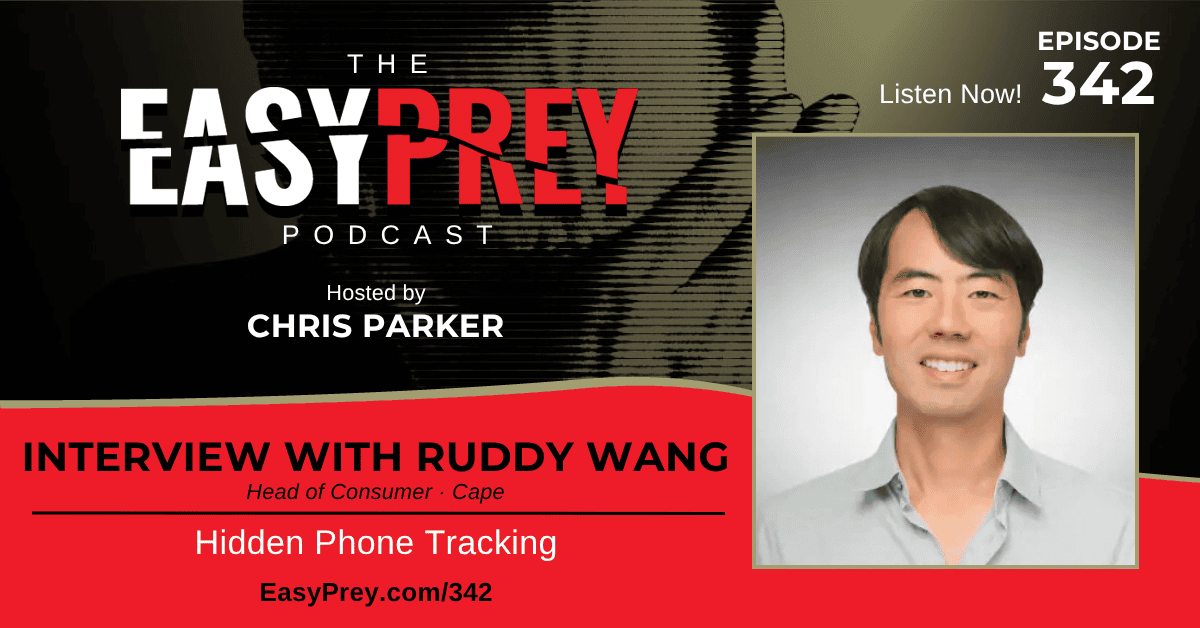
Hidden Phone Tracking

Hosted By Chris Parker

342
Click Below to Subscribe
“Cell phone service should, by default, not collect as much information about you as possible and should not be selling your information to third parties.” - Ruddy Wang Share on X

Your phone gives off a surprising amount of information just by being connected to a cellular network. Things like your location, who you communicate with, and your daily patterns can all become part of the data tied to your mobile service. While some of that information is necessary to keep a cellular network functioning, questions remain about how much data carriers really need to collect, how long they should keep it, and what happens when that information ends up in the wrong hands.

My guest today is Ruddy Wang, head of consumer growth at CAPE, a privacy-first mobile carrier designed to collect as little customer information as possible. Ruddy began his career as a U.S. diplomat before moving into the technology world, including roles at Facebook and Uber, where he helped launch more than 100 cities across Brazil. His experience in government and technology gave him an early look at how much information our phones can reveal and how that data can be used, which eventually led him to CAPE and its effort to rethink mobile service with privacy and security built in from the start.

In our conversation, we discuss how cellular networks track phones, why identifiers such as IMSI and IMEI numbers matter, and how signaling attacks can potentially intercept calls or text messages without the user realizing anything has happened. We also get into SIM swaps, some of the weaknesses in traditional carrier security, and what CAPE is doing differently to make mobile service more private. We also talk about practical steps people can take to reduce unnecessary data sharing and strengthen the security of their accounts, even if they have no plans to change mobile carriers.

“With a signaling attack, you actually wouldn’t see anything at all. In that respect, it’s a particularly invisible kind of attack.” - Ruddy Wang Share on X

Show Notes:

  • [01:02] Ruddy Wang shares his background and how his work as a diplomat and in technology shaped his interest in mobile privacy.
  • [04:36] We discuss why cellular carriers retain customer data and how that information can be monetized or shared.
  • [07:19] We break down IMSI and IMEI numbers and how these identifiers can be used to recognize and track phones.
  • [10:13] We explore signaling attacks and how someone may be able to track a phone or intercept communications through the global telecom system.
  • [12:22] We compare signaling attacks with SIM swaps and explain why some attacks can happen without the phone owner noticing anything unusual.
  • [14:42] We discuss why vulnerabilities built into the global telecommunications system can be difficult to prevent and what users can do to reduce their exposure.
  • [18:56] We look at the differences between traditional mobile network operators and MVNOs and how those relationships affect service and security.
  • [20:26] We discuss how CAPE uses its own mobile core and SIM technology to add privacy protections while still relying on other carriers' towers.
  • [23:19] We explore the limits of cellular privacy, including why traditional phone calls cannot offer the same end-to-end encryption as some messaging apps.
  • [26:32] We discuss how CAPE approaches SIM swap protection by giving customers control through a recovery phrase rather than relying on customer support.
  • [28:35] We talk about who is most interested in privacy-focused mobile service and why demand has expanded beyond people with high-risk security concerns.
  • [32:55] We discuss how much personal information mobile carriers actually need from customers and CAPE's approach to collecting less data.
  • [36:18] We look at the cost of privacy-focused mobile service and how CAPE's pricing and referral model compares with traditional carriers.
  • [40:20] We discuss Ruddy's experience with a convincing fake crowdfunding site and how the scam managed to fool him.
  • [43:10] We share practical ways to improve mobile privacy and account security, including opting out of data sharing and moving away from SMS authentication.
“There is no technical reason for collecting as much data as the main carriers collect unless there’s some other purpose for that.” - Ruddy Wang Share on X

Thanks for joining us on Easy Prey. Be sure to subscribe to our podcast on iTunes and leave a nice review. 

Links and Resources:

Transcript:

About Your Host

Chris Parker

Chris Parker is the founder of WhatIsMyIPAddress.com, a tech-friendly website attracting a remarkable 13,000,000 visitors a month. In 2000, Chris created WhatIsMyIPAddress.com as a solution to finding his employer’s office IP address. Today, WhatIsMyIPAddress.com is among the top 3,000 websites in the U.S. 

Share Post:

COULD YOU BE EASY PREY?

Take the Easy Prey
 Self-Assessment.

YOU MAY ALSO LIKE

Allan
Liska

Ransomware Evolution

Kari
Kammel

The Counterfeit Economy

Nina
Jankowicz

The Internet is Playing You

Vanessa
Bohns

The Psychology of Yes

Dawn
Dines

Drink Spiking

PODCAST reviews

Excellent Podcast

Chris Parker has such a calm and soothing voice, which is a wonderful accompaniment for the kinds of serious topics that he covers. You want a soothing voice as you’re learning about all the ways the bad guys out there are desperately trying to take advantage of us, and how they do cleverly find new and more devious ways each day! It’s a weird world out there! Don’t let your guard down, this podcast will give you some explicit directions!

MTracey141

Required Listening

Somethings are required reading – this podcast should be required listening for anyone using anything connected in the current world.

Apple Podcasts User

Fascinating stuff!

I’ve listened to quite of few of these podcasts now. Some of the topics I wouldn’t have given a second look, but the interviewees have always been very interesting and knowledgeable. Fascinating stuff!

Apple Podcasts User

Excellent Show

Excellent interview. Don’t give personal information over the phone … it can be abused in countless ways

George Jenson

Interesting

I’ve listened to quite of few of these podcasts now. Some of the topics I wouldn’t have given a second look, but the interviewees have always been very interesting and knowledgeable. Fascinating stuff!

User22

Content, content, content!

Chris provides amazing content that everyone needs to hear to better protect themselves and learn from other’s mistakes to stay safe!

CaigJ3189

New Favorite Podcast!

Entertaining, educational and I cannot 
get enough! I am excited for more phenomenal content to come and this is sthe only podcast I check frequently to see if a new episode has rolled out.

brandooj

Big BIG ups!

What Chris is doing with this podcast is something that isn’t just desirable, but needed – everyone using the internet should be listening to this! Our naivete is constantly being used against us when we’re online; the best way to combat this is by arming the masses with the information we need to stay wary and keep ourselves safe. Big, BIG ups to Chris for putting the work in for us.

Riley

As seen on

COULD YOU BE EASY PREY?

Take the Easy Prey Self-Assessment.
close

Copy and paste this code to display the image on your site

Privacy Policy

Your privacy is important to us. To better protect your privacy we provide this notice explaining our online information practices and the choices you can make about the way your information is collected and used. To make this notice easy to find, we make it available on every page of our site.

The Way We Use Information

We use email addresses to confirm registration upon the creation of a new account.

We use return email addresses to answer the email we receive. Such addresses are not used for any other purpose and are not shared with outside parties.

On occasion, we may send email to addresses of registered users to inform them about changes or new features added to our site.

We use non-identifying and aggregate information to better design our website and to share with advertisers. For example, we may tell an advertiser that X number of individuals visited a certain area on our website, or that Y number of men and Z number of women filled out our registration form, but we would not disclose anything that could be used to identify those individuals.

Finally, we never use or share the personally identifiable information provided to us online in ways unrelated to the ones described above.

Our Commitment To Data Security

To prevent unauthorized access, maintain data accuracy, and ensure the correct use of information, we have put in place appropriate physical, electronic, and managerial procedures to safeguard and secure the information we collect online.

Affiliated sites, linked sites, and advertisements

CGP Holdings, Inc. expects its partners, advertisers, and third-party affiliates to respect the privacy of our users. However, third parties, including our partners, advertisers, affiliates and other content providers accessible through our site, may have their own privacy and data collection policies and practices. For example, during your visit to our site you may link to, or view as part of a frame on a CGP Holdings, Inc. page, certain content that is actually created or hosted by a third party. Also, through CGP Holdings, Inc. you may be introduced to, or be able to access, information, Web sites, advertisements, features, contests or sweepstakes offered by other parties. CGP Holdings, Inc. is not responsible for the actions or policies of such third parties. You should check the applicable privacy policies of those third parties when providing information on a feature or page operated by a third party.

While on our site, our advertisers, promotional partners or other third parties may use cookies or other technology to attempt to identify some of your preferences or retrieve information about you. For example, some of our advertising is served by third parties and may include cookies that enable the advertiser to determine whether you have seen a particular advertisement before. Through features available on our site, third parties may use cookies or other technology to gather information. CGP Holdings, Inc. does not control the use of this technology or the resulting information and is not responsible for any actions or policies of such third parties.

We use third-party advertising companies to serve ads when you visit our website. These companies may use information (not including your name, address, email address, or telephone number) about your visits to this and other websites in order to provide advertisements about goods and services of interest to you. For information about their specific privacy policies please contact the advertisers directly.

Please be careful and responsible whenever you are online. Should you choose to voluntarily disclose Personally Identifiable Information on our site, such as in message boards, chat areas or in advertising or notices you post, that information can be viewed publicly and can be collected and used by third parties without our knowledge and may result in unsolicited messages from other individuals or third parties. Such activities are beyond the control of CGP Holdings, Inc. and this policy.

Changes to this policy

CGP Holdings, Inc. reserves the right to change this policy at any time. Please check this page periodically for changes. Your continued use of our site following the posting of changes to these terms will mean you accept those changes. Information collected prior to the time any change is posted will be used according to the rules and laws that applied at the time the information was collected. 

COULD YOU BE EASY PREY?

Take the Easy Prey Self-Assessment.

We will only send you awesome stuff!