



Scam calls and texts are not necessarily getting more complicated. What is changing is how much information scammers have before they ever contact us. When someone already knows your name, your bank, where you live, or other details about your life, it becomes much easier to make a fake call or message feel real.
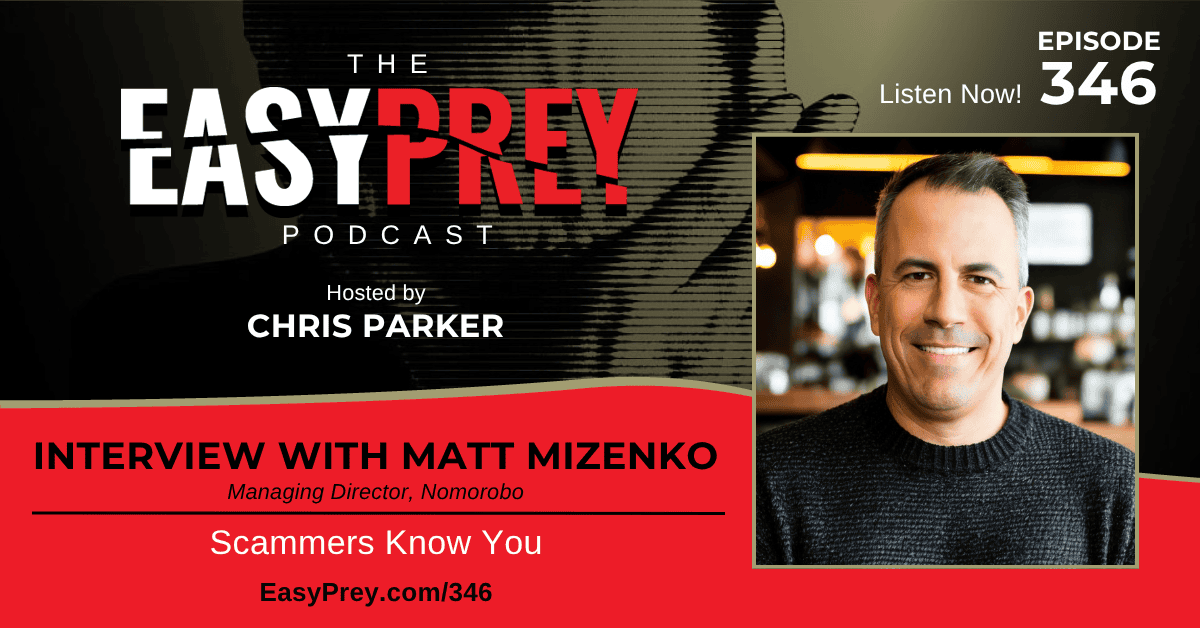
Today’s guest is Matt Mizenko, Managing Director of Nomorobo. Matt has spent more than 20 years in the telephony space and more than 12 years working specifically on call and text fraud. Before joining Nomorobo, he worked with Hiya and RoboKiller, and he regularly speaks about fraud trends in the media and at industry events.
We talk about how scammers are using personal data and AI to target people more effectively, why some old fraud prevention advice does not help much anymore, and what actually makes someone a harder target. We also get into call screening, spam labels, pig butchering texts, and why even people who work in fraud prevention can still get caught at exactly the wrong moment.
“Scams don’t only happen to older people or careless people. They can happen to anybody when they get caught in the right web.” - Matt Mizenko Share on XShow Notes:
- [00:46] Matt Mizenko shares his background in telephony and more than a decade of work fighting call and text fraud.
- [01:53] Imposter scams use familiar brands, banks, and service providers to convince people that an urgent problem needs their attention.
- [04:41] Package delivery scams become especially effective during busy shopping seasons when unexpected shipments seem believable.
- [06:24] AI and personal data are allowing scammers to target smaller groups of people with much more convincing information.
- [11:30] A personal fraud experience shows how criminals can test stolen payment information before attempting larger purchases.
- [14:08] Even fraud experts can come close to falling for a scam when the timing and details match something happening in their own lives.
- [17:05] Some traditional fraud prevention advice has become less useful as voice cloning and other AI tools improve.
- [19:11] Hanging up and refusing to engage can be one of the simplest ways to make yourself a less attractive target.
- [22:07] Sending unknown callers to voicemail or using call screening can add an effective barrier between you and unwanted callers.
- [27:29] New call authentication technologies can help identify legitimate calls, but the complexity of the phone system limits how well they work.
- [34:36] “Spam likely” labels can come from several different sources and may sometimes appear on calls you actually want to receive.
- [38:46] Call blocking services have to balance stopping scams with avoiding false positives that block legitimate callers.
- [42:08] Large honeypot networks help identify suspicious calling patterns and improve decisions about which calls should be blocked.
- [43:06] AI bots can engage with pig butchering texts to waste scammers’ time and improve future scam detection.
- [44:30] Wrong-number text scams use innocent or emotional opening messages to encourage people to respond and begin a longer manipulation.
- [46:34] Scam awareness resources can help people recognize current fraud trends and learn what real scam calls and texts sound like.
- [48:04] Reporting fraud quickly can help limit additional damage and give law enforcement a clearer picture of the problem.
Thanks for joining us on Easy Prey. Be sure to subscribe to our podcast on iTunes and leave a nice review.
Links and Resources:
- Podcast Web Page
- Facebook Page
- whatismyipaddress.com
- Easy Prey on Instagram
- Easy Prey on Twitter
- Easy Prey on LinkedIn
- Easy Prey on YouTube
- Easy Prey on Pinterest
- Nomorobo
- Matt Mizenko – LinkedIn
- Nomorobo Fraud Fighters
Transcript:
Matt, thank you so much for coming on the podcast today.
Great, thanks for having me.
Looking forward to our conversation. Can you give myself and the audience a little background about who you are and what you do?
Sure. My name is Matt Mizenko. I’m the managing director at Nomorobo, which is a company that provides call and text protection services for customers and businesses.

And how long has Nomorobo been doing that?
Nomorobo has been doing this since 2013. Nomorobo was one of a few companies that sort of sprung up around some challenges that were created by the FTC back in the early ’10s, so 2013, 2014, where they were looking for novel solutions to solving the robocall problem. Nomorobo was one of those companies that put together a novel solution in 2013. They won that robocall challenge. With the prize money that was awarded at that point in time, our founder, Aaron Foss, who’s no longer with the company, but he founded the company and it’s grown from there ever since.
Awesome, because spam calls are the bane of people’s existence.
Absolutely.
Because you guys are running this platform, what are some of the, we’ll kind of start with this, what are some of the most common scam calls, scam and fraud calls that people are currently getting?
Some of the big ones that we’re seeing right now are things like imposter scams, for example, which is a big one, where someone calls you or sends you a text claiming to be from someplace they’re not. It could be they’re calling from your bank to verify a $962 PlayStation 5 purchase that you made at Walmart. It could be Verizon calling to confirm that you really meant to quote unquote purchase that iPhone that you just purchased, things like that. That’s certainly one of the bigger ones that we’re seeing right now. As we go later into this year, as we get into the last half of this year, it’s hard to believe it’s September already.
But we’re going to start seeing midterm election scams, people calling to ask for donations. Another one we’ll see as we get toward the holidays will be open enrollment scams, especially again, with a lot of the things around the different medical programs changing and tax things, which I’m not an expert on, but expiring or whatever. There’s a lot of confusion. You can see I’m confused. There’s a lot of chaos around that. Scammers are certainly going to take advantage of that kind of confusion to try to get people to hand over money and information that they probably shouldn’t.
Because you have the opportunity to listen to calls at some aspect of it, are they mostly human callers, mostly AI callers, not sure?
It’s really kind of a mix and it depends to some degree on what the scam is. For example, with the imposter scams I mentioned before, we see that mostly what I say are pre-recorded, whether they’re an AI voice or a pre-recorded voice. At this point, the distinction kind of doesn’t matter. It’s not a human. That’s the important thing. Whereas with things like the Medicare scams or the open enrollment scams, a lot of times those are actually real people.
I think the reason for that is that it establishes more credibility. Like if you’re hearing a robot voice talk to you about signing up for a medical plan for next year, you’re not likely to give it much kind of credibility. Whereas when you’re talking to a real human, they’re able to use all of the tricks that these guys use psychologically to make a nice soothing voice, make you feel comfortable. “I’m going to help you with that, Mr. Clark. We’re going to get this taken care of for you.” That’s going to go a lot further in terms of getting you to sign up for something that you probably should not.
Do you see, like, Amazon imposter scams peak during key kind of like Prime Day and holidays, or is the Amazon imposter scam basically all year round?
It’s all year round, but it definitely pops up a lot more during the holidays, as do FedEx and UPS imposter scams as well. Again, it’s not uncommon knowledge that in the months of November and December, everybody’s really busy. There’s all sorts of stuff going on. No matter where you are in life, it’s just a very, very busy time of year. You very likely may be getting a package that you don’t know about because you think, “Oh, maybe it’s a gift somebody is sending me or it’s a corporate gift that somebody is sending me.”
Those sorts of things. There’s lots of those things coming around plus the fact that we’re already kind of out of sorts and very busy and just kind of harried means when we get a text or a call from someone saying, “I have a package for you, but it’s short $19.32 on shipping. How would you like to take care of that?” We very well may be inclined to just give them a credit card number, “Oh, it’s just 19 bucks. It’s probably legit.”
What scammer would ask for $19? Well, they’re asking 10,000 people for $19, which is still pretty profitable, but they absolutely take care of it. It’s that sense of urgency. They get us when we’re not paying attention and they have an urgent need for us. We’re like, “Oh, OK. Maybe it’s not so bad.” Then we’ve just given them 19 bucks for a package we’re never going to get.
About that, you talked about that one of the things with scams historically has been it’s just about volume. We’re going to make 50,000 calls in hopes that one person is going to respond or 10 people, whatever the metrics are that make sense for them. Was there any shift? Are you seeing call volumes dropping, but the targetedness of those calls increasing?
Absolutely. One of the things that people like to talk about a lot in the media and everywhere is the rise of AI. Of course, AI has an effect on scams. We’ve seen a fair amount of coverage in the press around what I would call generative AI scams where they’re using generative AI to sound like a grandkid or sound like a relative or something like that, where they’re trying to convince you that they are somebody else and they need you to send money to get them out of jail or to get a car repair or medical bill or whatever.
While those are out there, they’re actually not nearly as prevalent as you might think. What is far scarier is the use of what I would call just traditional AI. Much like a high school kid can go into ChatGPT or a Claude or whatever and say, “Hey, I need you to write me a five-page report about why Francis Scott Key wrote the Star-Spangled Banner. It will go and it will do a pretty good job.”
What these people are doing is they’re saying, “I want you to go out and I want you to find me a 1,000 55 to 65-year-old whose bank account information is known, who have high net worth, who have a retirement account worth at least $500,000 and are a customer of Bank of America and the last four of their Social.” It’s a little bit of a contrived example, and I’m not saying that necessarily any of the AI platforms would go through doing this.
But there are ways to make something like that happen where you will get that list, and then now you have 1,000 people that are, as you would say in the credit business, they are pre-qualified. You can call them up and you know their name and you say, “Hi, I am calling from XYZ Financial Solutions for Mr. Smith. Can you confirm the last four digits of your Social Security number are 5736?” “Yes, that’s me.” “Can you confirm you still live on 123 Main Street?”
Then they have information. They come at you immediately with the information, which kind of knocks you off guard. It sounds authoritative, it sounds urgent and, “OK, well, we need to talk to you about this specific suspicious transaction on your account.” “What transaction? I didn’t make a transaction.” “OK, that’s OK. We understand you might not have made this and that’s why we’re calling you because we care.” It just cascades from there.
Thanks to all of the many data breaches that we’ve seen and just people that tend to be way too generous with sharing information on social media and so on in general, it’s become very easy for these criminals to use new tools to go out and get all that information and you know, circling back to the point of your question, you don’t necessarily need to make 20,000 calls now at $20 each. You can make 1,000 calls and maybe get $10,000 each or $100,000 each and your return on investment is much, much better and you’re spending much less time doing it.
Much less effort. You don’t need a scam compound to do that. You could just have a couple of people doing it.
No, that’s absolutely right. I have often said, I attend a lot of events in the space around the anti-fraud space and whatnot over the course of the year and I hear some of these stories in these case studies and I have said many times if I didn’t have a moral compass and fear of prison, I could be a very rich man. It’s unfortunately not that hard.
I always find it very interesting that, you know, we were talking before we started recording that from time to time I will take calls on a particular number that I have just to kind of see what the scams are and what the pitches are and I found it interesting that in some cases, they’re incredibly vague about information. “It’s your Visa credit card. We’re calling from Visa,” and I’m like, “Well, I’m not a customer of Visa.”
The banks are, you know, the merchants are a customer of Visa, not me. “What account are you talking about?” “Well, it’s your credit card account.” Well, you start asking, like, fun questions on the fringe and, you know, they go sideways but it’s been interesting to see how some of those are. They are very specific where it’s like, “Oh, they have done some data mining and they do actually have some valid information here. I’m not just a random number that they call, but they are actually trying to get a hold of me in particular.”
Yeah, that’s absolutely right.
Which has its scariness to it. You had mentioned that you’ve been in the fraud, anti-fraud space for a while. There’s a question I want to ask you is if you have ever been a victim of a scammer fraud and if so, do you have a story that you can tell about that?
I was actually a victim of scammer fraud kind of before this particular space really became a problem. In the early 2000s, I had one of these interesting cases where I came home from work one day and found a couple of Amazon packages that were filled with, like, children’s shoes and the other one was, like, office supplies or something like this. I didn’t think anything of it really. I contacted Amazon and I’m like, “I didn’t order these things.”
I don’t know how they ended up here, and they’re like, “Well, OK, you can send them back or keep them because if you didn’t order them, you know, then, we’re not going to charge you for them.” But what I didn’t know was somewhere along the line, my American Express card had been compromised. What they used to do back then was they’d make a couple of small purchases that weren’t likely to flag the fraud sensors at the credit card company, see if it worked, see if the address worked, of course, which it all did.
Then once they see that delivery has taken place, now they go and they try and run up some much bigger charges. Fortunately for me, Amex was very much on the case. They kind of nailed it right before it became a big problem. They obviously refunded all of the charges. I had to go through what was an interesting process of working with the local sheriff’s department to file a report and all of those sorts of things because, you know, it can come back to haunt you in some cases, which is another interesting story I could tell.
But it was, in general, it was just really kind of a big pain in the butt. Having said that, I will say, again, completely honestly, I have come close in a couple of cases with a text and/or a phone call within just even the past year of going far too far down the rabbit hole with one of these things and starting to turn over information, one of which was actually the toll road scam that we saw. This is probably about 18 months ago. I moved here to Arizona from Washington State.
When I was in Washington State, I had whatever they call it, a Good to Go! account. I probably didn’t pay all of my last bill again, being very honest. If they’re listening, somebody contact me. I’ll send you 20 bucks. But I got one of these things that it was labeled from Washington. It was about some charges that I owed. I was literally on the form to start putting in information. I happened to peek at the URL and I’m like, “Well, wait a second. Something, this isn’t right.”
Like something isn’t right here. Again, the right information and they catch you at the right or wrong time, depending on how you look at it, it can happen to any of us, even I’ve been doing this for 14 years now, and it still occasionally trips me up.
I think that is the thing that most people don’t realize. When you are getting the scam kind of outside of the right scope that works for you. It’s often very obvious. But when you knew you just went through Washington, and yeah, I probably was on a toll road and yeah, I probably, maybe I had to think like, there’s a scenario in everybody’s life where one of those scams perfectly fits something that’s happened in your life.
Absolutely.
There was another interview that I was doing that he had ordered something internationally and knew it would be coming through customs. When he got this fake phishing scam about “You have a package coming through customs,” any other, one week earlier, one week later, clearly it’s a scam.
But because he has something coming through customs, he started filling it out and got, like you, partway through the form and went, “Well, that just doesn’t seem…something just seems off,” and started to look at it, was like, “You know…” and you, and he, and me are experts in these things. Gosh, it is like, at just the right time, we are all susceptible to something.
We like to say that while these are not legal businesses, they are still businesses. These are not dumb people. They have playbooks, they have tactics, they know exactly what they're doing. -Matt Mizenko Share on XThat’s absolutely right. We like to say that while these are not legal businesses, they are still businesses. These are not dumb people. They have playbooks, they have tactics, they know exactly what they’re doing. I think that kind of the thinking is changing on this, but you know, previously the thinking used to be you’d see a story about somebody losing, say, $50,000 from a retirement account or something like that. People would think, “Well, I would never be that dumb. How could somebody be that dumb?”
These things only happen to dumb people. These things only happen to older Americans and it’s, like, to your point, no, it just happens to everybody when they get caught in the right web. We have to keep that in mind and be vigilant because, you and I both know, well, it can happen to us too. I did a piece recently in Atlanta with a gentleman who’s a customer of ours who works in the AI industry and nearly got caught up in an AI scam. If that doesn’t tell you something about how good these people are at what they do, I don’t know. It does.
It’s just the right time. Early on when I started the podcast, kind of pre-generative AI, I felt very comfortable saying jump on a Zoom call, do a FaceTime with someone because the technology is just not there. If they won’t jump on a FaceTime, you know, clearly there’s something going on and you should be cautious now with generative AI and facial overlays and all that stuff. That’s crummy advice.
Not necessarily crummy advice, but it’s not as useful advice as it was even a couple of years ago. Are there things that are kind of commonly taught that people like me would probably say of kind of fraud prevention tips on incoming phone calls that aren’t worth spending our time on anymore? Or that were never real to begin with?
There was the one that goes back a long while, I think where people used to say, “Never,” when you answer the phone, “Never say yes or never say no, or never say specific things like that.” That may have been true at a given point in time, but the reality is if it’s a legitimate telemarketing call, you know, which maybe you are on the list somewhere, those people aren’t generally going to respect the rules.
They can get cloudy sometimes, but for the most part, they respect the rules because even though it’s not the best business to be in, and people don’t necessarily want calls from them, they do make money doing it, they have to stay in business and they know that the government is watching. Likewise for the bad guys, the bad guys have, like, five different telecom providers they are using who are routed through another five different telecom providers, through a shell company. Nobody knows where any of that stuff goes and you can say, “Put me on your do not call list.” You can not say the word yes or no.
Which is almost impossible to do during any real conversation, as we were kind of discussing earlier, and they’re not going to obey it anyway. There’s not really any point. Your best bet, honestly, is to just kind of hang up and show them that you’re not going to indulge them and that is probably as good a signal as anything else because now they’re like, “OK, well, this guy’s clearly not going to fall for us. Move onto the next, kind of the next victim, if you will, is probably your best bet, honestly.
If you’re in the US, does the FTC do not call list, is it worth anything? Clearly we know it’s not going to stop someone who’s doing something illegal. Outside of that, does it really do anything?
It does. If you want to keep the volume of—it’s kind of like the junk mail you get in your mailbox. If you don’t want to deal with any of that, which again, it’s perfectly legal, but if you don’t want to deal with it, putting your name on the DNC list, putting your number on the DNC list, it’s a good idea. You’ll definitely get less of the calls selling you, trying to sell you solar services or, you know, go to cleaning or what have you. It definitely helps for that sort of stuff for the people that are operating legally. For the bad actors, no, it’s not going to have any effect whatsoever.
It doesn’t stop political calls in the US because there’s an exception for them.
That’s right. The politicians did a very good job of carving themselves. Again, doesn’t matter what party you’re in. They carved themselves out wonderful loopholes that allow you to continue to call and allows them to continue to call and text you no matter what. Yes, that’s also kind of not going to do much good.
I know one of the other ones is, you know, don’t say hello when you answer the phone or another one is why is there dead air for three to five seconds after you do finally say something?
What you say on the call is sort of irrelevant. If somebody wants to clone your voice, they’re going to go to your Instagram or your Facebook or your TED Talk or wherever YouTube or wherever else, and they’re going to be able to very easily do that, if that’s something they really feel like doing. And honestly, in a lot of cases, it’s not going to be worth their time or trouble. The dead air thing is a bit more interesting. Typically what that indicates, and again, this is used both by legitimate and not legitimate callers.
Typically, what that indicates is that they’re waiting to connect you to some sort of a representative. In a lot of cases, these companies are using autodialer technology, which means it’s dialing in some cases, maybe four or five different numbers at the same time, and whichever is the first one that answers, it’s then going to connect you back to a rep that’s waiting to talk to you.
More often than not, when you hear that dead air, that’s what it’s telling you. It’s basically saying, “You’re the lucky recipient to talk to this representative,” and it’s connected your call and now it’s putting it back through its system, and you’re going to get somebody that’s going to pop on the line and, you know, go, Hello, Mr. Smith. I am wondering if you have interest in extending your car’s warranty.” Not particularly nefarious, but it’s a really good indicator that you are about to be talking to someone, and if you don’t want to, hang up the phone.
I think there’s value to it, but is a lot of the phones these days— well now there’s a couple of different options. You can have calls that aren’t in your contacts list just go straight to voicemail. Is there value to that? Does it give scammers any leg or information about you because you’ve done that?
Not really, and it’s a good thing to do. There are some that, you know, again, if it’s…I think of Apple calls. It silences unknown callers. If it’s not in the contacts, or if it’s not in your recent list, right, maybe somebody you call that you’re waiting for a call back from, it just sends it straight to voicemail, which is great because you’ll still, if it’s a legitimate person, often that they are going to leave a message.
You’ll be able to go in and take a look and see is this somebody I wanted to talk to or not. If it’s not a legitimate person, they’re probably going to hang up and they’re not going to leave a voicemail anyway, which is great. Similarly, now there are features around call screening as well. One of the features that our application Nomorobo has where, if they pass an initial check of the phone number, then you’re going to get presented with some sort of thing saying, “Hey, the person that you’re calling is screening their calls. Need to tell us who you are and why you’re calling,” and in some cases, again, depends on the technology, but press some sort of random number, which again is designed to weed out the autodialers.
We find almost always anybody who’s calling, you know, with something you don’t want is not going to bother to go through that process. The example I like to use is if you have a camera on your front door and your neighbor doesn’t, and somebody wants to steal a package, they’re probably going to your neighbor’s house because it’s just one less thing they have to worry about. With yours it’s like, “Oh, I might get busted with them.” It’s like, “Oh, sweet. I’m not going to get busted at all.” Say with phone calls, the more kind of things that you can put up between you and the bad guys, the better off you’re going to be.
I have to do my rant about porch pirates. In my alley, all but one of the houses has cameras. And a while back, someone, two people, drove up in a car, passenger got out, ran to one of the neighbor’s houses, grabbed the package off the front door, looked at their camera, turned around and looked at the next neighbor’s camera, turned around and looked at my camera, got back in the car and drove away. I’m like, “Well, clearly they don’t care about the cameras anymore.”
I guess not, no.
And it was one of those things, like, we all decided, “Hey, let’s just report it to the police. It’s not going to result in anything inherently, but it’s the right thing to do.” We all sent in pictures of, like, the guy looking right at the camera. To some extent, I think kind of that there is good advice about don’t be low-hanging fruit and leave your package sitting out front or the side of the front door, but I don’t know how well cameras work as a deterrent anymore, as much as they used to.
I’m kind of curious about the call screening. Can you guys tell if it actually blocks legitimate people who call in a sense that like, is there a way to tell whether people are just like, “I just don’t want to deal with that. I’m not willing to talk to them. I don’t even want to bother to talk to my uncle because I don’t want to go through this.”
With our technology anyway, the way it works is that ultimately that decision is made by the person being called. We get the information from the person. We show it to you. Basically it’s a transcript, you know, so it says call from this number. “Hi, I’m your Uncle Smedley calling to ask you if you’re coming to the picnic this weekend.” And at that point, it’s up to you, right? You can say yes or no.
If you have an Uncle Smedley, then you can decide if you want to talk to him or not. If it’s something that you don’t recognize, that could be a bad actor. One of the things we do in particular with Nomorobo is we are analyzing that kind of audio in real time and comparing it back to our database of known spam callers. For example, someone is deciding to go ahead and leave a message to your screener, we can see if that matches any other patterns. If so, we can actually go ahead and then terminate that call for you again, if that’s your choice as a customer, or you can choose to just, you know, have it go to voicemail, whatever you want.
It kind of depends on the solution that you’re using, but we’re trying to cover off on all the possibilities so that, you know, when we do see these audio files and these transcripts, we can pretty quickly do an analysis to determine if it’s something that we should show to you or if it’s something that seems like it’s probably not good.
I know a number of years ago, there was a lot of discussion that, like, taking the technology, taking Insta, it’s going to solve bad phone calls and bad text messages. Clearly it hasn’t. Is there technology that carriers are starting to use, whether it’s voluntary or not, which does help reduce them being a source of spam calls, kind of increase the likelihood that it’s a legitimate call coming from that platform?
Yeah, the short answer is yes and no. There are technologies out there that will solve some of these things, right? There are things like authenticated calling, which basically in a nutshell is if I’m going to call you, as I go to call you outside of the phone call using the internet, I’m sending a message across the internet to whoever is providing your phone service.
It’s basically saying, “This number I know that is on my network and belongs to this customer is making a call to your customer, and it’s going to come in the next five seconds, and it is from this number, and it is legitimate, and you should tell your customer that it is legitimate,” which is kind of the idea originally behind the stir and shaken. The difference is that it’s using kind of what we call an out-of-band communication, or it’s basically using both the phone line and the internet at the same time and that’s one of the reasons.
The problem with that is that, like many things here in the United States, with the way our telecommunications system was built, which was one company that was broken up to a million companies and now it’s consolidated back into a couple of handfuls of companies plus other smaller service providers that get in there, I like to say that if you took a pot of spaghetti and threw it on the ground, what you see there looks a lot like what the US telecom system looks like.
It’s just a literal mess in many ways and different standards that don’t talk to each other, and it’s only as strong, like any network, it’s only as strong as its weakest link. If at any point in that phone call, which could be across two communication points, it could be across 20, it really depends on who you’re calling, where they are, and what they’re on, and that sort of thing. If at any point something happens to a packet in your internet street or if it leaves the internet altogether and it goes across copper wire, all that stuff goes out the window.
That’s what makes this so hard. That’s what makes those technologies, unfortunately, not work super well. Lots of people are trying to solve this problem. Lots of people are trying to get it to work better. At the end of the day, it is going to come down to a few things. One is that we need to have technological improvements and private industry is trying to do a good job of getting that done, but there are still regulatory things that need to be faced and there are areas where the government probably needs to loosen things up a little bit to make those easier to happen.
That’s certainly one thing that we have to look at. Then it just comes down to cooperation. There needs to be, again, my personal opinion, but I feel like that there needs to be a lot more cooperation between all of the different players in the space to get this stuff to happen. But cooperation is easy to say, but in business, at some point that means maybe you’re not making as much money or you’re potentially putting yourself out of business and those sorts of things.
There are solutions out there, and I think we are making slow and steady progress toward getting there, but there are still plenty of just old-fashioned human and corporate elements that come into play that make it difficult.
I assume the fact that there’s so much of this, depending on the circumstance, runs over copper. I just got a text message from my parents saying, “Our telephone provider is no longer offering copper service anymore. Effective, like, the end of next month, we’re not going to have a home phone anymore.” I was like, “Oh, wow. I didn’t realize you could get a home phone anymore.”
Believe it or not, you can’t.
For people in California, there’s always been this in the back of everybody’s minds of why you want to have a copper phone service. Because if there was ever a major earthquake, some networks are going to go down, but the copper systems are designed to be a fair bit more resilient when the internet goes down. But apparently, they decided that they don’t want to do that anymore.
I mean, the cost of maintaining those networks is pretty high and the cost of updating them as well. When the government says, “You have to provide X, Y, and Z services,” but you have a bunch of copper lines, it’s like, “Well, do we really want to spend that money or does it make more sense to just turn them off and then it’s not a problem anymore?”
It’s not a trivial decision to make when you think about having to—when you’re talking about copper wires, you’re talking about putting guys in trucks and sending them out into the field. Again, you look at the size of California, I mean, yes, the urban areas are all very easy to get to, but there’s a lot of open space in the middle of nowhere in California. That’s not even thinking about a state, for example, like Wyoming, which is really out there and it’s, like, those things are hard to do, unfortunately.
The proverbial last mile gets extremely expensive.
Very expensive, yes.
Let alone the 10 miles to get to the last mile. We talked about a number of things that really aren’t valid advice anymore. We’ve got some good advice about just let the calls go to voicemail. It’s always like I’m one of those huge fans of the if I don’t know the number, it goes to voicemail, which is great until I’m having the plumber come over and he’s calling to let me know that he’s running 15 minutes late and that comes to voicemail.
I’m waiting for the day that the phone integrates with the calendar and knowing that I have an appointment and turning off the call screening when I’m expecting contractors to show up. That would be, “Hey, Apple, that would be a nice feature.”
Yeah, exactly right, and I think we all face those same problems because there are always those edge cases where the call that you’re expecting or the call that you maybe forgot you’re expecting but you really want gets caught by the call screener or gets sent to voicemail, or if you’re using the call blocking software and you haven’t turned on, it just blocks the call altogether. Those are the things that are problematic.
Going back to what we’re saying a couple seconds ago about the different telecom stuff, one of these things that I think is going away from old knowledge that doesn’t matter much anymore to maybe here is some new knowledge that does matter and it’s good to know is when you see “Spam Likely” or “Spam Likely” on your phone, that could be coming from 20 different places because everybody that provides telephony service is required to label calls they think may be suspicious.
But if I’m on Verizon and you’re on T-Mobile and I’m calling you, it could be that Verizon thinks it’s Spam Likely, or it could be T-Mobile thinks it’s Spam Likely, or you could have a third-party service that thinks it’s Spam Likely, and it’s like, so who is actually making that decision and where it’s coming from, and how do I know if it really is Spam Likely or it’s not Spam Likely and in some cases, that will be a call that you absolutely want to get, like I’ve had an air conditioner repairman who’s here in Phoenix.
I want that call, show up as Spam Likely, and I just looked at it trying to put it together in my head and, like, I’m going to go ahead and answer this because I think this is probably going to be the air conditioning guy that turned out I was correct, which is good. If you do miss that call and it’s potentially urgent, it’s like, “Oh, man. That’s bad.”
You talked about a fringe case there, if you’re the air conditioner repair guy and your calls are getting flagged as Spam Likely, like, what the heck can you do about it? Are you like, “Who do you call?”
It’s a great question and it’s not an easy answer. You could call one of the telephone companies. They all have what they call remediation services where if you think your number is being blocked in a way it shouldn’t be, or labeled in a way it shouldn’t be, you can request remediation. You put it in front of it and you say, “I’m from this business and we use this as part of our contract with whoever you have phone lines with,” and they’ll go through and try to fix that for you.
But because there are so many players, there are actually kind of cottage industries that have sprung up around this and what these industries do for a fee of course is they basically, they will either monitor your numbers over time, and they’re monitoring your numbers on all of the services, right? Our service, Verizon, T-Mobile, AT&T, consumers, whoever, they’re monitoring your numbers to see if and when the state changes and if it does, if suddenly they see one of your numbers is being flagged as Spam Likely, they will go on your behalf to that particular entity, whoever it is, and say, “Hey, we monitor numbers for this company. They’re making legitimate calls. Here’s their use case. Could you please unblock this or unlabel it,” or whatever. And in most cases, they will.
If you’re a huge call center making tons and tons of calls and making millions of dollars on those calls, that’s probably a service that you can pay for. But if you’re the local plumber, AC repair company, and you have 20 employees, chances that you can afford that are really slim and now you have this nuisance problem where it’s like you’re not going to have the time and patience to deal with that, but your call is being labeled so what do you do? Do you go get a new number or, like, do you…so it is a problem, and it is one that depending on your scale, can be solved for money, or if you’re a smaller player, it’s much harder to solve and it becomes increasingly annoying when you are trying to get those calls to go through this so that you can conduct business.
I suppose that’s one of the challenges that Nomorobo and other services like it is the tolerance for a false positive is really low. If your customer says, “Every time my mom calls, she can’t call me,” you’ve now created a really bad customer experience. What are some of the deliberations that go on in an organization like yours of what is the tolerance for false positives? Because the last thing you also want is customers saying, “Well, this service doesn’t work and all these calls are getting through.”
That’s exactly right. We’re in what I call a utility business. Very different in terms of what we provide. For example, I don’t think about my power company, I think about it when I have to pay the bill, but in general, like, I flip a light switch, the light comes on, I don’t think, “Wow, the power company’s doing a great job for me.” When I think of the power company is when I flip that switch and the light doesn’t come on and I’m like, “What the heck is up with my power, right?”
It’s the same, for example, with us with both false positives and, you know, and calls that we miss, right? If the call protection is working really well, you’re probably not thinking about us. But the minute you didn’t get a call that you wanted because we blocked it, or you got 10 minutes of your time taken away because you answered a call that we should have caught, now you’re thinking about us. Those are the types of things that you know, we’re thinking about daily.
We’ve done a number of consumer surveys on those very topics and found exactly what you said, right? And in fact, falsely blocking a call that somebody wanted is actually considered a bigger problem than not blocking a call that we should have because it’s like, yes, OK, a certain amount of stuff is going to slip through the net, but blocking something that I really wanted, like that’s almost unforgivable to some people. We’re constantly looking at, you know, a huge amount of signals in terms of how we do that.
For certain things, like for example, things about public service things like utilities, hospitals, schools, police departments and stuff, there are a number of providers out there that provide what I would call kind of an approved list of all of the numbers and where they’re coming from. We can ingest those and then when we see a call come in, we can compare it like we do against our database. But with that information, OK, this is coming from a school district, and we can look at the stir-shaken header, which is one good use of it and see, OK, it’s not spoofed.
We’re going to hand this off. We’re going to say this is a good call, that you want to get this. Then similarly, again, not on a personal basis, because that’s a PII problem and a privacy problem, but on an aggregate basis as we see calls through our customers and through our networks, we, in addition to seeing the calls that people are not engaging with and don’t want and maybe have weird stuff associated with them. The number is flipped from a cell phone to a landline and back to twice in two days and things like that.
We can also see the numbers that come through our network and are answered, and people spend an amount of time on the phone with them and those sorts of things. That gives us an indication as well as to, you know, whether or not a given number is worth engaging with. We’re implying it from volume, but it’s actually a really good signal and conversely, our kind of the secret sauce of what we do is we have a what we call a honeypot of 300,000 or close to 300,000 phone lines that we use that are constantly seeing phone calls from everywhere.
What comes into those and what is said or not said and the audio files and the transcripts and all of that stuff, you know, gives us amazing intelligence in terms of being able to make good decisions about what we do and don’t block.
Do you have AI that talks the answers to those phones?
We have some conversations. We have some flavor of AI that engages with those and attempts to, in some cases, attempts to keep them online, get more information and a bigger transcript in a bigger audio file, which of course improves our effectiveness over time. Another one that we have that we’ve deployed recently is on the text side. One of the really big problems with text scams right now is these so-called pig butchering scams, right?
The one where like, “Hey, are we still meeting for coffee?” Or, “Hey, I found your number on my phone, but I forgot your name.” Those sorts of things that seem very innocent at first, but you know, they’re the first step in 10 or 20 steps to get you to pop over to WhatsApp or Telegram or something like that and start giving away personal information. We developed a bot that engages with those things.
It’s absolutely fascinating to watch in real time some of these things, you know, in our little admin console. But they do a wonderful job of a couple things. First is just wasting that person’s time, which is great, because now they’re not bothering somebody else that’s legitimate. But also, again, over time, as we get more and more and more and more of these interactions, we can feed these back into our learning models and then use those to more accurately predict when something like that hits your phone as a text.
Is this something that you really need to see, or should we filter it for you so that you can check it out some other time and, of course, reduce the risk? Yes, we are definitely using some amount of that stuff to, you know, basically fight fire with fires, but we think of it.
As we start wrapping up for a landing here, the text message introductions, “Hey, you know, I found this phone number on my phone. I don’t remember who you are.” What are the most common others? Are those things just like all over the board with that first messages, or they’re very certain ones that are repeated over and over and very consistent?
They tend to be all over the board, unfortunately. They tend to be very random and kind of different. They, like the coffee one, was pretty common for a while. That stopped working or people caught on to it. They’ve moved on to other things. “Hey, are we still going shopping?” “Hey, are you still, you know….” I got one. “Hey, are you still meeting me at the airport?”
Urgency.
That’s exactly right, urgency. Unfortunately, with those, yes, they are kind of all over the map. Like everything else, I think, unfortunately, I think what will happen is after a certain amount of time, people will just stop taking any of that stuff seriously unless it comes from a number they know. But I’m sure at that point, they’ll come up with something else that they’ll use to try to get your attention and get you to engage.
The most insidious one that I saw was, “I’m checking to see how my dog surgery went.”
Wow.
I’m like, “Oh, that’s mean.” Like, anyone who’s a dog owner is going to be like, “Oh my gosh. You’ve got the wrong number. You need to get ahold of your vet to find that out.” But I was just like, “Wow, that’s gutless. That’s ruthless to just like that.”
That’s definitely below the belt.
If you’re not a dog owner, if you don’t like pets, then you probably don’t care about that one. But if you’re a pet owner, that’s really, like, there’s the emotion, there’s the urgency, all those things that will get us to engage. Are there any particular resources that we haven’t mentioned that you’d like to make sure that people are aware of?
Yeah, sure. One thing we like to talk about at Nomorobo, obviously, you know, we have our apps that we sell for iOS and Android, but we also really take our role in this kind of spam-fighting community seriously. On our website at Nomorobo.com/fraudfighters–all one word—we have a literal treasure trove of information that is all about everything phone and text scams. You can listen to actual scams that we’ve recorded, you can see transcripts of them.
You can keep up with kind of what are the latest trends, which sounds a little funny to say, but the latest trends and scam calls and kind of what’s out there and what’s being said, which, you know, is actually a really important resource. We saw, I mentioned earlier, the toll road scam. That scam actually was one of the shorter lived ones. I think it’s my hypothesis, but I think it’s because people did a great job of sharing that.
Facebook, for example, like, a lot of people were like, “Don’t fall for this. Don’t fall for this. Don’t fall for this.” It kind of nipped that in the bud pretty quickly. The more you know, the better informed you are, obviously the safer you’ll be. Of course, all that stuff is free. You can send links of those things to your friends and family, make them aware of kind of what’s going on and what to look out for and what’s real and what’s not real.
The more you know, the better informed you are, obviously the safer you'll be. -Matt Mizenko Share on XAlso, if you think you may have been the victim of the scam or fraud, there are resources there as to, you know, how to get help with that and where to go and who to turn to. I would say one of the most important things I mentioned is way back to the beginning, but I’ll go into this story very quickly, because I think it’s super important. It is very important that if you have been the victim of fraud, you need to, or even think you need to talk to law enforcement. Here is why.
Nomorobo, we work closely, we have a nice collaborative relationship with AARP and Kathy Stokes, who is director of Fraud Prevention Programs there, is a person we work very closely with. She tells this story, which is basically they had a person who they worked with in terms of telling their story, who got scammed to the tune of, I want to say it was a little bit over $100,000, something like that.
Obviously realized that after the money was gone, felt, incredible amounts of panic and shame and regret and remorse and all of those things that you naturally do as a victim of a criminal, right? But didn’t report it because of that, right? Because of kind of those feelings. Where this became a problem is that because the $100,000 came out of their retirement account, tax time came and the IRS is like, “Hey, that was an early withdrawal. You owe us a bunch of money, plus a penalty and plus this, that, and the other thing.”
And now, right after, several months down the line, after you’ve maybe started to make peace with that problem and getting back on your feet, all of a sudden, it’s like now somebody else is coming to you and saying, “Nope, you have to pay us.” Had that person addressed that at the beginning, you know, I mean, ultimately, I think it got resolved to everyone’s satisfaction, which is good, of course, but you don’t want to delay on these things.
You don’t want to wait, you want to just get out and as much as it sucks, you want to get out in front of it and try to keep all those kind of second order effects from happening later on down the road. It’s never good and it’s painful, but if that does happen, to do everything you can to kind of stop the bleeding as soon as you can.
Yep. If we have to report even like—joking about the package theft—it was, like, $20 of protein bars or something like that. Not a big deal. But if we don’t report it, then law enforcement doesn’t know what’s happening, and doesn’t understand the scope of the problem and isn’t going to apply the appropriate resources. If everybody was losing $10,000 a year to, you know, some particular scam, you bet the government is going to have, all levels of government are going to take action on it. But if no one reports it, they’re not going to do anything.
Absolutely right.
Matt, thank you so much for coming on the podcast. We will make sure to include all those resources in the show notes. If people want to connect with you, how can they find you?
Nomorobo.com is the best place. Head to the website. We have links to all of our stuff there.
Awesome. Thank you so much for coming on the podcast today.
All right. Thanks for having me.