







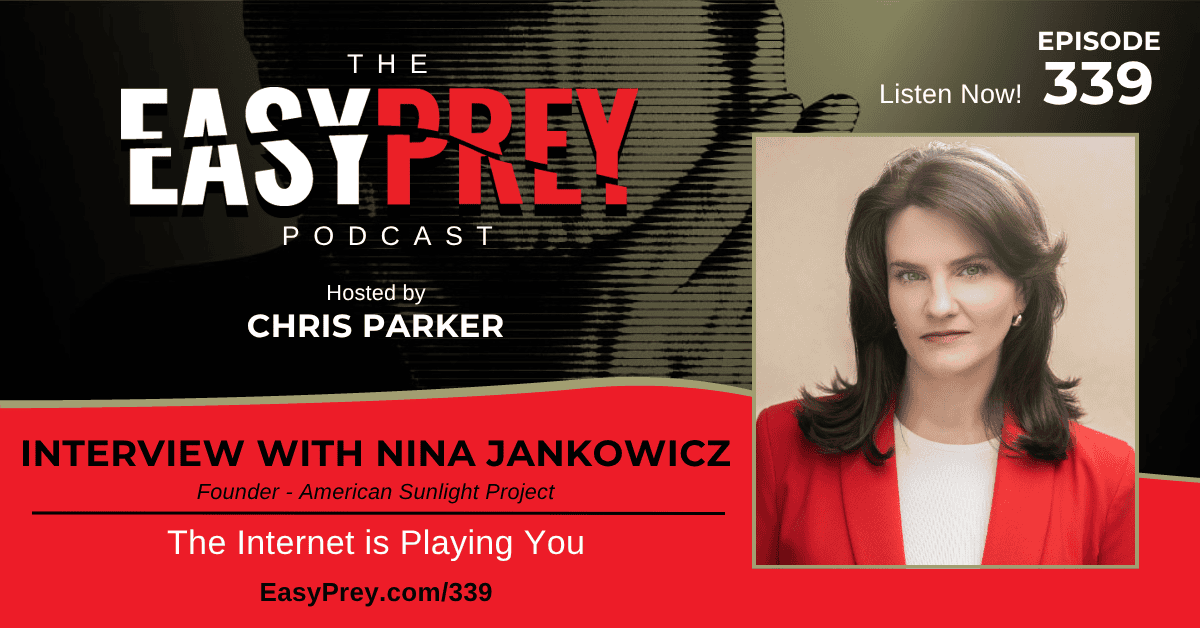
A convincing lie no longer needs to look suspicious. It can appear in a familiar social media feed, come from someone who seems real, or arrive as a video that looks almost impossible to fake. By the time doubt sets in, the post may already have been shared thousands of times.
Few people understand that online environment better than today’s guest. Nina Jankowicz has spent more than a decade studying what she calls the bad things that happen on the internet. She is an internationally recognized expert on disinformation and online harassment. She was also named one of Time magazine’s 100 most influential people in AI.
Nina explains how disinformation spreads and why emotional content travels so quickly. She talks about online harassment, doxxing, romance scams, and AI-generated impersonation. The conversation also covers ways to check questionable information and protect your personal data. Just as important, Nina shares how to step away from trolls before they take over your time and attention.
“If you’re getting emotional about something you see online, take five seconds and think it through. You might be being manipulated.” - Nina Jankowicz Share on XShow Notes:
- [01:00] Nina Jankowicz describes her work studying disinformation, online harassment, and AI-generated harm.
- [03:50] The important difference between misinformation and deliberate disinformation.
- [05:09] Why an emotional reaction may be a sign that someone is trying to manipulate you.
- [07:09] How social media platforms monetize attention and reward harmful engagement.
- [10:05] Using lateral reading and multiple sources to evaluate questionable online content.
- [12:27] Why slowing down matters when an image or video may have been generated by AI.
- [14:04] How algorithmic feeds have made information consumption increasingly passive.
- [17:01] When an aggressive disagreement crosses the line into harassment.
- [19:34] Threats, doxxing, and the limits of platforms and law enforcement.
- [22:18] Nina’s one-reply rule and how blocking trolls removes the attention they want.
- [24:07] Why laws and law enforcement training have not kept pace with cyberstalking.
- [26:06] Preserving screenshots, documenting abuse, and asking employers for support.
- [29:23] Password managers, two-factor authentication, and the personal details hidden in photos.
- [32:34] Removing information from data brokers and making online safety more manageable.
- [34:40] A romance scam involving stolen images and real-time AI impersonation.
- [37:35] Why older adults need digital literacy training as much as children do.
- [39:44] Addressing disinformation without suppressing speech or telling people what to believe.
- [42:12] How social media incentives favor profitable engagement over trustworthy information.
Thanks for joining us on Easy Prey. Be sure to subscribe to our podcast on iTunes and leave a nice review.
Links and Resources:
- Podcast Web Page
- Facebook Page
- whatismyipaddress.com
- Easy Prey on Instagram
- Easy Prey on Twitter
- Easy Prey on LinkedIn
- Easy Prey on YouTube
- Easy Prey on Pinterest
- Nina Jankowicz
- Nina Jankowicz – LinkedIn
- How to Lose the Information War: Russia, Fake News, and the Future of Conflict
- How to Be a Woman Online: Surviving Abuse and Harassment, and How to Fight Back
Transcript:
Nina, thank you so much for coming on the podcast today.
Thanks for having me, Chris. Great to be with you.
Looking forward to our conversation. Can you give the audience and myself a little bit of background about who you are and what you do?
Yeah, my name is Nina Jankowicz. I have for the past 10-plus years been in the space that I would broadly describe as bad things that happen on the internet, inclusive of disinformation, both from nation-states and domestic disinformation, as well as online harassment, and more recently, AI-generated harms, including deepfake notification. When I talk to my chiropractor about what I do, it’s bad stuff that happens online.
And your chiropractor says, “I know why you have back problems.”
Yes, yes. “Stop sitting at your computer so much.”
Let’s talk a little bit through kind of the online harassment and the various forms that works, that happens through, and how that kind of ties in with disinformation and how those things overlap.
I would say where there's disinformation campaigns, there's almost always online harassment. -Nina Jankowicz Share on XYeah, so I see those as two sides of the same coin, really. Where there is online harassment, frequently there’s disinformation. I would say where there’s disinformation campaigns, there’s almost always online harassment. Very frequently, the target of a disinformation campaign, if it is a person, will also be experiencing various online forms of trolling, sometimes of doxing, sometimes of deepfake nudes or deepfake pornography, as it’s more commonly called, especially if that person is a woman or a person of color.
The data show very starkly, including in research that I’ve done, that women of color or women of intersectional identities are much more likely to be targeted with online harassment and threats than their kind of white, cis-gendered counterparts. That’s something I’ve looked at a lot. And then on the disinformation side of things, whether it’s coming from a nation-state or whether it’s something that is being generated for political gain or for profit here at home, typically the stickiest disinformation has a main character, right? Something that pulls the story together, that animates it, that gives it life.
And when that main character happens to be an unwitting person who’s just been roped into the whole thing, sometimes they might be a political figure. Still, frequently I’m thinking about subjects of conspiracy theories like Ray Epps, for instance, who was a guy who I think was at the January 6th protests and has repented. Still, Tucker Carlson said that he was a Fed who was there and he was subject to all sorts of conspiracy theories.
He had to leave his home. That’s the sort of thing that I’m talking about where frequently when disinformation comes to people, these false or misleading stories spread with malign intent, that often has really material impacts on people’s lives. I’ve experienced that myself, of course, as well.
We’ll get to that. What is the difference between misinformation and disinformation?
Disinformation is false or misleading information that's spread with malign intent. -Nina Jankowicz Share on XYeah, one of my favorite questions and one that still to this day, a lot of folks in mainstream media get wrong. Disinformation is false or misleading information that’s spread with malign intent. It is your nation-states like Russia, China, Iran. It is political campaigns. It is snake oil salesmen on the internet who are trying to pull a fast one on whatever their target audience is.
Misinformation is different. That doesn’t have the intent. It’s still false or misleading information, but it’s spread without that malign intent. So the way I often describe this to people is it’s Aunt Sally or Uncle Bob at your Thanksgiving dinner table. They think the moon is made out of cheese or styrofoam or whatever. It’s a conspiracy theory. And they’re trafficking in it not because they want to pull a fast one on you, but because they believe or because they think it’s interesting.
Because they think people should investigate it more because there’s some deep-seated distrust that misinformation speaks to. That’s the big difference. And they’re really not interchangeable. And so when people say, “We have to fight misinformation,” I have a lot of qualms with that, actually, because I don’t think we need to fight misinformation. We need to get the problem at the source, the disinformers.
When people say, “We have to fight misinformation,” I have a lot of qualms with that, actually, because I don't think we need to fight misinformation. We need to get the problem at the source, the disinformers. -Nina Jankowicz Share on XDoes it in some sense potentially switch from disinformation to misinformation? Because once you’ve gone through, “OK, I put it out here for malicious purposes and it’s working. It’s spread to my Aunt Sally and my Aunt Sally now sees it and she thinks it’s true, but she doesn’t necessarily have malicious intent at that point.” It’s just, “Oh, my goodness, you know, I’ve made my three-second reaction to it and I’m going to pass it along.”
Yeah, or shared it. If we all stopped and thought a little bit about the disinformation that we encounter or, more frequently, the stuff that gets us really worked up on social media, that’s the biggest heuristic that I give to people. If you’re getting emotional about something you see online, like, take five seconds. Think it through. You might be being manipulated. That is exactly right, Chris.
If you're getting emotional about something you see online, like, take five seconds. Think it through. You might be being manipulated. -Nina Jankowicz Share on XThat’s where it kind of crosses that line from dis to misinformation. And I think people who have concerns about fighting disinformation as potentially being an impingement of freedom of expression, what they’re envisioning is that everyone who shares the article that the moon is made out of cheese will be punished. No, that’s not what anyone who studies this wants.
What we would like is that, you know, the platforms, for instance, put some friction on stories that are gaining a strange amount of virality because they’ve been juiced up by the algorithms that reward that sort of emotional engagement. Or that the people who are selling fraudulent products or scamming people online, those snake oil salesmen, or defrauding them of their vote, disenfranchising them, that those people will face some sorts of consequences, the disinformers.
What we would like is that, you know, the platforms, for instance, put some friction on stories that are gaining a strange amount of virality because they've been juiced up by the algorithms that reward that sort of emotional… Share on XAnd I don’t mean jail time or anything like that. I mean, like, account suspension, things that are a little bit different. But I don’t want to answer your Uncle Bob to do anything, but maybe be a little bit more educated about the ways that our information environment today is designed to manipulate them and steal their money and attention.
Is that one of the challenges? It feels like it’s been for maybe an inevitable end to the way the algorithms work is like, are we kind of victims of the algorithm to some extent?
Oh, absolutely. And when you talk to a lot of my colleagues in this space who study online hate, or who are in, like, the news industry, for instance, I mean, one of the things that we all agree on is that the United States in particular has been really derelict in its duty to regulate this space where other countries, like Australia, the UK, the European Union more broadly, South Korea also has some laws on the books where those jurisdictions have tried to stop the platforms from monetizing access to our attention, which is exactly what they’re doing.
The United States has said, “The door is open. Do whatever you want,” basically. And despite suicides happening on these platforms, despite the radicalization, despite the disenfranchisement, as I talked about before, we have not done anything to add any friction, let alone oversight of the platforms. And if there were any other industry that were operating this way, take the car industry, the airplane industry, even, at-home face creams, the beauty products, stuff like that, they’d all be regulated, right? We haven’t done that yet here. The result is that folks like Elon Musk, Mark Zuckerberg, executives at other platforms are making billions of dollars.
In fact, before we recorded today, you and I were talking about scams online. There was a great story that Reuters did last year. Again, this is tied in with the bad stuff on the internet frame that showed how many millions, if I’m not mistaken, billions of dollars Facebook made on fraudulent and scam ads just last year that are stealing Americans’ hard-earned money, the same sorts of skills that would be able to empower users to recognize those scams are the skills that we want people to have to recognize disinformation. Both of those are things that the platforms can see from the back end as well, right? They’re in it for the money.

Let’s take the platform out of the conversation at the moment, because the listener, other than talking to their legislator, elected officials, the listener can’t do anything themselves to, “How do I keep from seeing this content?” How does the listener differentiate misinformation, disinformation from information?
Well, particularly in the AI age, that is getting increasingly difficult, right? Because we’re at the point, and many AI experts agree with this, where you no longer can trust the evidence of your eyes and ears to mangle an Orwell quote. We have seen so much AI-generated content. In fact, the platforms, again, are incentivizing that because it promotes good engagement for them. But leaving them aside, again, I think that emotion heuristic is the most important one.
The most engaging content online is the most enraging content. If you feel yourself getting mad, anxious, scared, even elation, like, there's a reason animal videos are so popular. It's because they give us a hit of dopamine. -Nina… Share on XThe most engaging content online is the most enraging content. If you feel yourself getting mad, anxious, scared, even elation, like, there’s a reason animal videos are so popular. It’s because they give us a hit of dopamine. And we keep scrolling. That is just something to be aware of. If you, before you’re sharing that content, before you’re sending it to Aunt Sally or Uncle Bob or sharing it on whatever platform you use these days, thinking through doing a little bit of research, particularly if it’s about breaking news.
Like a school shooting or a natural disaster, something like that, where the facts are few, but a lot of content is flying early on. That’s where you want to go and do what we call lateral reading. Just look at how a bunch of different outlets or a bunch of different content creators are covering the same topic. I would really encourage people to go outside of their filter bubbles there. If you don’t typically read Fox News or The Wall Street Journal, when some major news happens, go look and see how they’re covering it, because it gives clues into who is manipulating the platforms and how and what the kind of prevailing narrative that they want to get out is.
That's where you want to go and do what we call lateral reading. Just look at how a bunch of different outlets or a bunch of different content creators are covering the same topic. I would really encourage people to go outside of… Share on XAnd that’s on both sides of the spectrum, I would say. Then particularly when we’re thinking about visual content these days, I had a pretty compelling example of this in my own life back in January, not long after the killing of Alex Pretti. We all remember the second video of him a few weeks before his killing came out of him in an altercation with some officers in Minneapolis.
The prevailing narrative among many people on the left immediately was this is AI. They’ve created this. They, the Republicans, the Trump Administration, have created this to make him look like a bad guy. And my father-in-law said, “Well, how do you know, Nina, that this is an AI?” And at this point, the AP and a couple of other experts had done a fact check. But I said to him, “Dave, I actually don’t think that we can know.”
And nobody like you, no layman, should put that pressure on themselves. What we need to do is slow down. And in a moment like that, say, “Let’s wait for the Associated Press to confirm this or deny it. Let’s wait for an expert like Hany Farid, who’s one of the best deepfake experts in the country, to say whether this is real or not, because it’s past the point where we can know.”
Until then, it’s sort of a—I guess now I’m quoting Reagan after Orwell—trust but verify situation. Or is that, which president? It was Reagan, right? Trust but verify. That’s where we are right now. And putting the brakes on slowing down is one of the most important things that we can do.
Trust but verify. That's where we are right now. And putting the brakes on slowing down is one of the most important things that we can do. -Nina Jankowicz Share on XAnd I guess that’s the unfortunate thing that maybe it’s not unfortunate. It’s the right thing to do. But when we get worked up, that is so not what we’re wired to do.
Well, and it’s what the platforms want us to do, right? They want us to keep sharing, to keep doom scrolling, to keep rage commenting and getting in flame wars. Like, one of the most interesting things about understanding the mechanics of online abuse is that it’s so good for the platforms, like, on both sides, right? The abuser leaves a comment and says some horrible thing. The target responds to it, amplifying that comment to his or her whole audience. And back and forth it goes, and you know, virtual arrows are being slung left and right.
That’s why often what I do is I just mute the person. I let them shout into a void. But what we need to recognize, and this is something I tell my graduate students as well, I make them track their news consumption for 24 hours. It’s always pretty eye opening to them, not just news, but information broadly.
What they always come back to me saying is, “Professor, we didn’t realize how passive our information consumption is becoming.” Very, very rarely in today’s day and age are we actively going out and either opening a newspaper, turning on the radio. Even then that’s curated, seeking out a piece of news from a specific platform or outlet, it’s just sent to us in an algorithm in a feed. Taking a little more control over that can be really empowering and can also slow you down and add that friction back into your daily information consumption.
Is this kind of one of the victims of personalization?
Yeah, I mean, absolutely. I recently adopted a puppy, and I was doing a little research ahead of time, started following some dog trainers. I had learned from having a baby a couple of years ago that there’s a lot of great information on the internet, a lot of terrible information, but it’s, you learn a lot of cool tips and tricks. Now my feed is primarily dog trainers. It was Broadway musicals for a while because I couldn’t get that anywhere else and it was Tony season, but now it’s dog trainers.
I hardly see anything else. You can train it to go the other way, but how many people are actively sitting at the wheel saying, “OK, now I want my feed to be something else,” right? And sometimes the algorithm knows something before you do. Another great example of that to bring my baby up again was after I gave birth, I was in the recovery room for a couple of hours when I think I got my first Facebook ad about weight loss after pregnancy, postpartum weight loss, because it knew I had been pregnant. It probably saw my IP address was pinging to a hospital and it was like, “Well, she had the baby. Congratulations. Time to lose that baby weight.” Crazy.
I’ve seen stories of, and again, maybe I haven’t fact checked this well enough, that department stores and big box stores are often able to, they know more about their customers than the customers do because they see the aggregate. Like, they know when someone shops for this week. In two weeks, they’re likely to shop for the next thing. And, “Oh, well, that means maybe she’s pregnant because of this string of events.” She knows it or not. The store knows it.
Yes. And they can purchase big data packs on you, not just based on what they’ve got, but based on the data brokers and all the information that they have, which I know is of interest to your audience as well. Whatever it is, thousands of points of data that every data broker owns on all of us. I mean, it’s a scary picture and it really is like an episode of Black Mirror.
It’s crazy. You talked about the, when we get in, when we see the viral content, there starts to be these flame wars and people going back and forth. I’ve personally never understood why people do it. I don’t know anyone who’s ever had their opinion changed because of a Facebook comment.
But I’ve seen lots of people leave, like, uncharacteristically aggressive comments that I would like, “Oh, my goodness. I would never expect this person to say that in real life or in person.” Yet the things that people say in comments are over the top. Like, at what point does that switch from, “I’m just venting” to, “This is harassment. This is a problem.” And what should the recipients of that or the targets of that do about it?
The way I describe this in my book, How to Be a Woman Online, which despite its title, I think has good tips for everybody who’s engaging, you know, in ideally a civil discourse on the internet. If somebody’s not engaging in good faith, that’s when I mute and move on, or sometimes block, right? You can, if they’re saying something really horrible, you should feel empowered to use the block button early and often.
I think we're all kind of conditioned to believe that these social media profiles, these feeds that we curate for ourselves are some sort of utopia, but actually it's like the Wild West of all rules are off and there's no… Share on XI think we’re all kind of conditioned to believe that these social media profiles, these feeds that we curate for ourselves are some sort of utopia, but actually it’s like the Wild West of all rules are off and there’s no consequences. You should not force yourself to endure that just out of some kind of democratic ideal that doesn’t exist. But if you do want to try to engage people and get them to see your side of things.
That’s when I’ll give them one reply, and I say something nice and polite and measured. And if they then come back and they’ve doubled down or say something even crazier, that’s where I mute. I love the image of them just, like, shouting into the void and not having the satisfaction of my reply. One of my friends, the Australian columnist for The Guardian, Van Badham likes to remind everyone that the problem of online abuse is something to be managed, not something to be solved, at least until the platforms give us better tools.
And I don’t see that happening anytime soon. So using the tools that are at your disposal—muting, blocking a couple of platforms, including Instagram, and I believe TikTok—have certain keywords that you can mute. Twitter might do that now too. I think they have something called safety mode, but I have a lot of, not to get too political, but I have a lot of misgivings about the way that that platform has evolved over the past couple of years.
But using those tools, again, I think is really important to preserve your sanity when you’re online. And in terms of, like, when it crosses the line from—what’s the word I want to use—vociferous disagreement to threats and harassment. I mean, when you’re going after somebody’s, race, gender, age, religion, those sorts of things, when it’s getting into ad hominem attacks, when it’s going into violent threats.
I’ve had people threaten to dox me. I’ve had doxing happen to me. I’ve had people say things about my family, my unborn child, my son who now exists in the world. That’s where things are crossing a line. I think the sad truth is not only are the platforms really ill-equipped to deal with that stuff and increasingly relying on AI, which is woefully inadequate at identifying these sorts of threats, the law enforcement are also really ill-equipped to deal with it. I can speak from experience on that, but there’s also troves of data of people who have gone to law enforcement with things that have happened online and essentially been laughed out of the room.
One of my favorite quotes about that from, unfortunately, not my book, although I did quote this quote in my book is a victim told the sociologist Sarah Sobieraj that she was either Sarah or Danielle Citron. I might be misquoting the quote, but she said, “It was like I was drowning and law enforcement didn’t know what water was.” It’s a bleak scenario out there.
And that’s why, again, I think you have to put your own life vest on first and not worry that you’re hurting somebody’s feelings by muting or blocking, but just making the platform usable for you so you can keep using your voice because a lot of people right now are self-selecting out of public discourse. That’s not good for anybody, in my opinion.
Yeah. I know that I will have conversations with people in person about things that we disagree about. I very seldom have those conversations online because when you’re face to face and you can see someone and you can sit down and have a meal together, it’s a much different experience than the emotion of the moment and the keyboard. They’re not going to come across the table at you.
Absolutely.
But there is something when you’re there with someone in person that they will function significantly different than they do online. The old phrase, “Don’t feed the trolls,” is effective.
Well, I think there’s a time and a place to have those discussions. Again, I give people one reply, usually, unless I’m in a cheeky mood and I often regret that if I go back and forth with them more than once. The other thing that I do frequently is I will take a screenshot of the offensive or threatening or harassing piece of content and I will redact the username and then I’ll share it to my followers because often it is educating to people that don’t know this stuff is happening or the extent to which it happens.
But it also doesn’t perpetuate the harassment. I don’t want to play a role on Bluesky, 60,000 followers going after somebody else. I’m really not into that. Although, Bluesky is an interesting platform because they have something called the nuclear block where if you block somebody in your replies, nobody else gets to see that reply, which is a great way. I think that sort of effect, that network effect, that really takes the oxygen out of that flame war that’s going back and forth.
Another Van Badham quote, the Australian Guardian columnist, she talks about how the reply guys, the trolls, they’re often after the oxygen or the clout that the person they’re harassing has and by blocking them, you’re removing that. I think that’s really smart advice. But again, I try not to perpetuate that harassment, and I know there are people who disagree with it and believe they deserve it, but as somebody who’s been on the other side of it, I just, I don’t think anybody does.
Is there a way to have a more effective discourse with law enforcement if you are a target of online harassment?
This is something that I think is going to take systemic change. And in fact, California is one of the states in the US that has better laws on the books for people who are experiencing different forms of online threats and harassment. But even there, I have heard some sad stories about the ways that law enforcement and judges are ill equipped. And again, I think that’s just going to take training.
It’s going to take some investments from states and other government infrastructure to bring cops, detectives, up to speed. Judges also need to be brought up to speed. And the way that one of my lawyers talked to me about this—you know, I’m not a lawyer; I just play one on TV—is the law in the United States is inherently backward looking. When you’re applying laws that were written in the 80s about telecommunications in the 80s to cyberstalking today, it’s not going to fit the right way.
When you're applying laws that were written in the 80s about telecommunications in the 80s to cyberstalking today, it's not going to fit the right way. It's going to be a square peg in a round hole. -Nina Jankowicz Share on XIt’s going to be a square peg in a round hole. I try to do a little bit of that education wherever I go. And when I have been, for instance, to events in places like California, I’m encouraging legislators and the governor’s office there and others to make investments into training and, frankly, acquiring talent that understands the internet because cops do a lot of great work. Not everybody is meant to do kind of cyber investigations. The FBI has got that, but sometimes we have it on a state level. Again, it’s a systemic thing that we need to start investing in.
Yeah, I’ve definitely heard the advice of take screenshots and document everything because depending on the platform, if someone deletes their comment, it’s gone. The police are like, “Well, we don’t see anything. There’s no evidence there.” I know that there’s a knee-jerk reaction of people, like I want to, I just want to delete everything to make it go away.” But unfortunately, people are also deleting evidence of abuse, unfortunately, in some cases.
Yeah, preserving screenshots is really important. I think it can be something that is really weighty for victims of abuse too, because not only do you have to go and you have to see the stuff, but then you have to preserve it and catalog it somewhere. That can be difficult. And what I recommend to people, especially if this is happening to you in kind of the line of duty, so to speak, is encouraging or asking employers for some support there, and there’s some ethical issues around this as well.
Like, do you want to expose an intern to the stuff that you’re seeing? But that can be helpful. Sometimes HR can help with that. There’s also different softwares that work with that. One that is used frequently in the open-source investigation world is called Hunchly, which basically takes screenshots of every page that you visit. Like, you tell it, “OK, start taking screenshots.” It does it and catalogs it for you automatically. They’re not court admissible.
There’s another one in my book that I’m forgetting the name of right now that will document things that would be in a way that is admissible to court, like, in terms of the forensics of the file, it saves all the metadata and things like that. I think unless you’re dealing with something that is, like, a very serious level of abuse, then you should think about something like that. If it’s one-off, yeah, take some screenshots, put them in a folder you don’t have to look at, preserve them in some way.
I think a lot of people make a mistake of suffering in silence and suffering alone when they’re subject to this stuff. Even I made that mistake early on, and often employers don’t know what to do. One thing that I’ve done even before my own experience with online abuse was trying to educate different groups that I’ve worked with about putting a policy in place for their employees. Because very ironically, most organizations these days have policies about all sorts of stuff you can’t say online, but they want you to be online representing the company, right?
And then when the shit hits the fan, they don’t do anything about it. And so that’s something that I’m trying to change culture-wise too, but to get a company to say, “OK, we’ll put you up in a hotel if you get doxxed for a week or two,” that’s a big investment to make, especially if you’re at a larger place. Not to mention the mental health implications, et cetera, et cetera. But it’s something that everybody, I think, unfortunately needs to think about these days. It’s a reality of doing business in the digital world.
Yeah. And I think if you’re a journalist, it’s particularly more challenging. If you’re a, “I’m a mechanic working on cars,” I’ve got a less likely, I should say, very less likely that I’m going to be doxxed. But if I’m a journalist talking about touchy social topics, there’s just going to be more attention to that, I suspect. And not that it’s an excuse for it, but I would expect employers in the journalism realm to see that as a much larger possibility than an auto body shop.
Yes, yes. Unless you’re an auto body mechanic who does cool videos on TikTok or something like that.
Which is about half of them now. What should individuals be doing, then, to, like, “How can I mitigate some of the trolls? How can I mitigate some of the doxxing? How can I minimize the impact of some of these things?”
In my book, my book is definitely geared more toward people who are in the public eye. Journalists, et cetera, people putting their voice out there, or people who want to, you want to be doing that more regularly. I’ve also got on my Substack the Wayfinder attendee online safety tuneup. That’s just, like, the very basics of what I recommend so that if you get hit with the worst, you will be a step ahead.

And this includes things like very basic stuff: having a complex password, using a password manager. I mean, some of them, seem silly. When I say this to audiences, they groan. I’m like, “OK, but how many of you still have a list of passwords that are either in your phone in an unprotected document in your notes, or, like, on a Post-it note? Because all that stuff is bad.”
Everybody has done password with a capital P 123 exclamation point at some point in their life or a variation of that.
Exactly, yeah. And so from moving from there, you know, two-factor authentication and it talks about something that I think a lot of people do not pay enough attention to at all because people don’t know how geolocation works, but talking about thinking through when you’re posting pictures online, whether that’s of your cute puppy or your kid, how much personal information you’re giving away there.
Talking about thinking through when you're posting pictures online, whether that's of your cute puppy or your kid, how much personal information you're giving away there. It could be your pet’s tags. It could be the park that you… Share on XIt could be your pet’s tags. It could be the park that you go to with your son or daughter every day. I mean, that you can pretty easily geolocate that, which will bring you in close proximity to your house or, especially if you’ve got a, “Oh, we rode our bikes here today.” OK, well, it’s in bike-riding distance of, et cetera.” Thinking through some of that stuff, thinking through some of the strategies for dealing with trolls, if you’re going to be out there and engaging, publicly.
But I chunked it out into really easy, manageable steps you can do over the course of 10 days or 10 weekends. I just think it’s something that everybody needs to think through. It’s not a nice-to-have anymore. It’s a, “Let’s do this preparation so that, again, if the worst happens, we’re not going to be in a bad situation.” I will share my impetus for doing this was that when I was doxxed and had a nationwide harassment campaign against me.
A security consultant that I hired, because I was extremely pregnant at the time, and I wanted to make sure that the worst of the stuff that was online, that somebody was looking at it, but I wasn’t looking at it. He helped me and he said to me, “If you weren’t you…” having the Russian government has been trying to get in my email for more than a decade now. If I hadn’t taken the precautions that I take regularly, things would have been much worse. Like, my private documents probably would be out there, pictures, et cetera.
All of that stuff, it doesn’t take that long. It’s kind of a set-it-and-forget-it sort of enterprise. The toolkit also goes through preventing doxxing. Personally, I am in the throw-money-at-it camp. I think there is a lot of good services these days that will do all this work for you. But the toolkit also includes resources for people who want a DIY data removal. If you have that time, I love that for you. With a four-year-old and a puppy, I do not.
I subscribe to actually two different services to keep me and my family’s information off the internet. But yeah, it shouldn’t be scary. And I think that’s the important thing that people need to realize that like, it’s just a couple hours of work. If you set that aside over summer, while you have a little bit more flexible time and your kids are rotting their brains in front of a screen somewhere.
Yeah. And I think that’s one of the challenges people think that there’s, “Oh, my gosh. In order to do anything, I have to do everything.” That like, “No, do what you can today, to future-proof yourself today. And then tomorrow, we’ll look at it again, or look at it again in a week.”
Absolutely. That’s the approach I take. And I’m still trying to get my sister-in-law to get her passwords out of a Word document, but I’ll let you know when I win that battle.
I know a few people that still carry around password books with them. But maybe safer than an Excel spreadsheet.
I’m not sure. It depends if your threats are more online or offline, I suppose. There’s operational security threats out there too.
I suspect the loss of a paper notebook with your passwords is also just, “I lost it.” It’s probably much higher than, “I accidentally emailed my spreadsheet to everybody.” Do you see kind of an intersection with all this stuff and scams?
Oh, absolutely. Gosh. So, I actually had a loved one who fell victim to romance scams, two of them in one year recently, and she has learning disabilities. She’s a little bit older. I would say that, like, she just wasn’t super savvy about the sorts of things that can happen to people online, the bad stuff, again. She was going through a divorce and was really vulnerable. When I found out about this, we kind of had a little argument because she didn’t believe me that the men she thought she was talking to weren’t real.
And it was, I mean, just extremely basic reverse image search that showed her that they weren’t because they were using the same pictures. I was able to show her other women who had been scammed by a guy that looked exactly the same with a different name tag. He, of course, pretended to be a service member, armed service member. So, it was just like a little bit of AI. I think the other thing was she didn’t realize—this was just in 2025—didn’t realize that it was possible to fake your appearance in real time.
She thought she had been Facetiming with somebody who was a love interest. And actually, this was a scammer sitting who knows where. The biggest thing that really hit me was, well, actually there were two lessons. One, I was able to help her because I have a couple contacts still at some of the platforms who took pity on my loved one who had just been scammed, right? And she was able to get her account access back.
But if I hadn’t been me, I wouldn’t have been able to do anything for her. And that two-tiered system of access to justice, if that’s even justice, is really miserable, again, because the platforms are making money off of all of this. If I can see that those people are scammers, imagine the information that the platforms have to stop it. The second thing is just that the basic skills that anybody who’s using the internet should have today from learning how to do reverse image search to recognizing just that this real-time, AI-generated content can and does exist now.
It’s a dereliction of duty that people do not have those skills. I think that the government, which talking about this government seems crazy, but a government that cares about its citizens should be investing in helping the citizens navigate a very polluted, complex information environment. That doesn’t mean saying these are sources of information that are good and these are sources of information that are bad or trustworthy and untrustworthy. It’s literally just skills building. And we spend some time doing that with children.
And for all the talk about getting kids ready for the AI revolution, like, what about grandma and grandpa who are getting scammed out of their 401(k)s? How are we making sure that they can navigate all of this stuff? And the conclusion I’ve come to is that there just isn’t political will to do that because it actually benefits all that same class of people, the political power, the tech power, and they’re all making money off of it or staying in power with it.
If people had those skills, I don’t think we’d be seeing the outcomes that we’re seeing. And that feels really grim to admit, but there is a connection, absolutely. And I hope that we start to see this tackled more—both scams, disinformation, harassment—see that tackled more on the state and local level. Because frankly, a lot of these scams and falsehoods and things like that are very locally targeted these days.
Yeah, I think one of the challenges we as a society, and this is probably more of a human being thing, is we have a challenge doing things that don’t have, like, we can’t necessarily calculate the ROI on it.
Yes, we can see that scams maybe are overall decreasing, but it’s difficult to draw the line and say, “Well, this is why they decreased, or this particular training course stopped this one individual from becoming a victim of a scam.” It’s the insurance, it’s compliance, it’s if everybody’s doing your job, the bad things happen less. And it’s hard to say, “Well, it happened because we were doing the education.”
Yeah, nobody ever wants to invest in education, unfortunately. That’s been the story of information literacy and media literacy of the past more than a decade, I would say.
It’s a challenging thing when, so much of these sort of things also get politicized, that if I’m trying to, I want to help prevent disinformation, the viewpoint is, “Well, you’re just trying to prevent different disinformation that you don’t want out there, but you’re going to put the conspiracy theories behind when you’re fighting disinformation. Are you being altruistic about it, or do you have an incentive behind how you’re fighting disinformation?”
Yeah, I mean, that has been a whole kind of can of worms over the past four years. And part of the reason that I dealt with so much harassment, because I was in the center of those conspiracy theories, people saying that I was going to be censoring the internet because of work that I did in the Biden Administration very briefly. And it wasn’t true. We weren’t doing any censoring.
My job was coordinating among different entities within the Department of Homeland Security, and ironically, making sure they were preserving civil rights, civil liberties and privacy. But leaving that to one side, I mean, I think the idea that any work to counter disinformation is inherently sensorial. It’s—how do I want to say this—it is predicated on an idea that fighting disinformation means suppressing speech in some way.
You want to make sure that people have the tools they need to navigate this environment, to make informed decisions, whatever that decision may be, whichever conclusion they come to. -Nina Jankowicz Share on XThat is not ever what I’ve believed. I have always criticized what I call playing whack-a-troll and, like, just taking down offending accounts, whether they’re Russian or Chinese or American or otherwise. What we need to be doing is building that understanding, that literacy from the ground up to empower people. You can lead a horse to water, but you can’t make them drink. You want to make sure that people have the tools they need to navigate this environment, to make informed decisions, whatever that decision may be, whichever conclusion they come to.
Generally, the research says people don’t want to be wrong. If they have an abiding interest in ending child trafficking, that’s great. But when they find out that they’re being lied to by a conspiracy theory like QAnon, that has predictions that don’t come true ever, right? We’ve seen a real move away from QAnon and there is a reason. That’s just one example. So that’s what I want to do. I want to give people those tools. And I also think we need platforms that are promoting information that is more truthful, more trustworthy, rather than people who are making them the most money, which is what we’re seeing right now. Those incentives are all out of whack.
Yeah. And that’s the challenge with any social media platform, I think, is you’re incentivizing interactions and keeping people on the platform. If I yell and scream at you, you’re more likely to yell and scream back at me and everybody. And even if we’re the ones not being civil, there’s a dozen more people on the side going, “Oh, my goodness. This is entertaining, watching these two yell at each other.”
Yes, refresh, refresh, like, share, subscribe.
Yeah, it’s crazy. Nina, I appreciate your time coming on the podcast today. If people want to connect with what you’re doing, where can you have a sub stack? What is the Substack?
Yeah, the Substack is called the Wayfinder. It’s at thewayfinder.net. I’m also on LinkedIn and Bluesky and Instagram these days. I think I’m also on Threads, although to be honest, I don’t go on there very frequently, but those are the big three for me right now.
And your latest book is How to Be a Woman Online, and that specifically discusses online harassment and what to do about it.
Yes, that one is basically a manual for anybody who wants to deal with trolls and harassment online. And then before that, although still unfortunately very relevant to information and disinformation today, is How to Lose the Information War. That one is all about Russia and Eastern Europe and the countries that dealt with disinformation before we even recognized it as a threat.
Awesome. Nina, thank you so much for coming on the podcast today.
Been a pleasure. Thank you, Chris.