







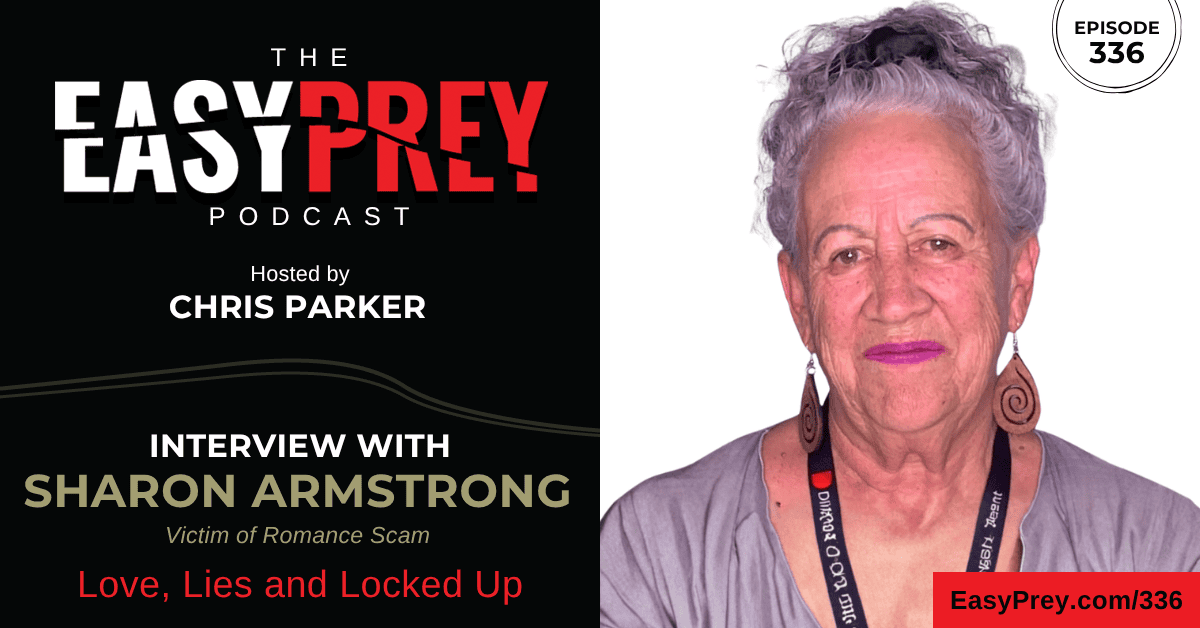

What sounds like the plot of a crime thriller was Sharon Armstrong’s real life. An online romance drew her into an elaborate web of lies involving overseas contracts, invented emergencies, and several people playing carefully planned roles. By the time she arrived at an airport in Argentina with five kilograms of cocaine hidden inside her suitcase, she still believed she was carrying business documents for the man she loved.
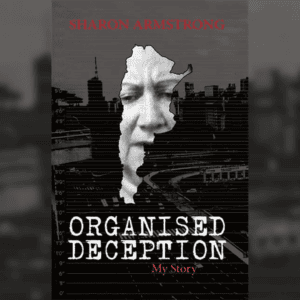
Sharon was arrested and spent more than two years in an Argentinian prison before returning home without a conviction. During that time, she had to confront the truth of what had happened and find a way to forgive herself. She later wrote about the experience in her book, *Organized Deception*. Today, she is an author and international scam awareness advocate who works to educate the public, support survivors, and challenge the shame that often keeps victims silent.
In this episode, we talk about how the criminals built trust so quickly, why warnings from loved ones can be difficult to hear, and how organized scam networks use kindness and personal values against the people they target. Sharon also explains why she no longer says she “fell for” a romance scam. She was deliberately targeted by sophisticated criminals, and she believes the attention belongs on those who planned the deception rather than on the person they harmed.
“I didn’t fall for a romance scam. I was targeted by a sophisticated group of criminals who deliberately set out to deceive and exploit me.” - Sharon Armstrong Share on XShow Notes:
- [01:12] Sharon begins the story of moving to Australia and unexpectedly being signed up for an online dating site.
- [03:36] A convincing introduction quickly develops into an intense romance with someone claiming to be an engineer.
- [04:52] The first request for money tests the trust that had already been built through a carefully fabricated story.
- [06:18] The scammers introduce new characters and create a plan for Sharon to travel to London through Argentina.
- [09:07] Family concerns grow as the relationship begins to take priority over the people who had always mattered most to her.
- [11:34] A suitcase supposedly carrying business documents arrives after Sharon has spent a confusing week alone in Argentina.
- [13:21] Airport officials discover five kilograms of cocaine hidden beneath the lining of the suitcase.
- [15:46] Sharon describes surviving the first days minute by minute before spending two and a half years in prison.
- [18:09] Criminals study a target’s values, kindness, history, and online presence to create a story that feels deeply personal.
- [20:58] A dramatization of Sharon’s story shows how organized manipulation can gradually change someone’s behavior and relationships.
- [23:16] Her experience as a probation officer did not protect her from grooming that closely resembled techniques she already understood.
- [25:07] More than 7,000 messages over five months reveal the intensity of the communication and how difficult it was to recognize from inside the relationship.
- [28:13] Healing begins when Sharon decides to forgive herself rather than continue carrying shame for what the criminals did.
- [30:04] Denial can become a safe place when accepting the truth feels more painful than continuing to believe the story.
- [32:08] Public humiliation adds another layer of trauma after details of Sharon’s arrest are released to the media.
- [34:27] Each day in prison begins with a choice to move toward happiness rather than allow the experience to make her bitter.
- [37:52] Writing, speaking publicly, and sharing her story become important parts of rebuilding her life.
- [40:09] Sharon rejects the phrase “fell for a scam” and explains why victims should be described as people deliberately targeted by organized criminals.
- [42:18] The title Organised Deception shifts attention toward the people who intentionally planned and carried out the crime.
- [43:17] Victim blaming can make people feel safer because it allows them to believe the same thing could never happen to them.
- [46:02] Sharon believes being arrested may have saved her life and kept her from being trafficked through an even more dangerous country.
- [48:34] Families increasingly reach out for help as they recognize the seriousness of romance scams and look for ways to support someone they love.
- [50:01] Sharon shares how listeners can connect with her through Stand Up 2 Scams and learn more about Organised Deception.
- [51:37] A reminder that scam victims are not alone and that the shame belongs with the ruthless criminals who targeted them.
Thanks for joining us on Easy Prey. Be sure to subscribe to our podcast on iTunes and leave a nice review.
Links and Resources:
- Podcast Web Page
- Facebook Page
- whatismyipaddress.com
- Easy Prey on Instagram
- Easy Prey on Twitter
- Easy Prey on LinkedIn
- Easy Prey on YouTube
- Easy Prey on Pinterest
- Sharon Armstrong
- Organised Deception
- Stand Up 2 Scams – Facebook
Transcript:
Sharon, thank you so much for coming on the podcast today.
Thank you. Thank you for having me, Chris.
You're very welcome. I look forward to hearing your story in more detail. So rather than the normal who you are and what you do type of question, let's just jump in right into your story.
OK, cool. Well, as your listeners may or may not know, I live in New Zealand. I was born in New Zealand a number of years ago. In terms of my story, I've got to go back 15 years now, actually just over 15 years. Towards the end of 2010, I had moved from New Zealand. I'd been living in New Zealand. I moved across to Australia to join family that lived over there. I thought it was time for a bit of a change.
I had spent the previous sort of 20 years working in different roles within the public sector. Felt like it was time for a change. Headed off overseas and over to Brisbane. Found it really difficult to pick up work, which was a new experience for me. And towards the end of 2010, well-meaning cousin of mine signed me up to a dating site unbeknownst to me, initially. I was on that for maybe three weeks. Wasn't really my cup of tea.
I had been approached by a couple of different ones and I just thought, “Nah, this really isn't me.” Anyway, to get off it, you had to de-register or however that goes. I did, went in and did that, but it was like another three days that the profile remained alive. And it was in that time that I was contacted by what I thought at the time was a very handsome, in my eyes, man who wrote a really great sort of introduction email saying, “Want to get to know me.”
I shared it with my family, with my sister, with my daughter. And we're all like, “Oh yeah, no, he sounds pretty interesting.” And supposedly lived quite close. Well, like 40 minutes, I think it was, away from me. Anyway, to just trim the story down, because it is pretty involved and intense, we continued to communicate. We moved off the dating site, which is probably one of the first little signs I have learnt subsequently. Over the next three weeks, things were intense.
By intense, I mean real intense. Confessions of love were made from his side. There was a story, and it's hard to tell the story now without the benefit of hindsight, of course. At the time, I believed he was an engineer. We were supposed to meet up one Sunday, but unfortunately got called to Sydney for an interview, for a contract in England. The drama went on. And again, emphasize the word drama. He flew directly from Sydney to London.
He was an engineer and he was supposedly in some factory undertaking some contract. I could hear machinery in the background when I would be talking to him, all of those things. Very clever. -Sharon Armstrong Share on XThen we continued to talk once he arrived. Interestingly, when I look back in the background, I could hear, so as I said, he was an engineer and he was supposedly in some factory undertaking some contract. I could hear machinery in the background when I would be talking to him, all of those things. Very clever. My situation is very stereotypical because it wasn't long before the first request for money came. Initially, I shut down and thought, “No…something. Why is this happening?”
But it was a very good fabrication of a story, which you can easily search and find out what happened around that. But my point in that is that I passed the first test. So yep, I sent not a large amount of money, but a bit of money. Remember, I'm unemployed at this point too. So from there, one thing after another happened, one other issue arose. If it wasn't to do with family, all of those things, suddenly he got on well.
We're now in January, and this had started at the end of November. We're now in January. I'm deep in it. I end up moving back to New Zealand to pick up some work. I'd sent more money by this stage. I was ticking all of those boxes. The trust was building all of that stuff, or the trust had been built very early. Again, with the benefit of hindsight, was I having any concerns? It was the odd little bit, but everything else was so convincing.
I now talk in the they, because it's very hard to talk about a singular person. I'm well aware that it wasn't a singular person nor the person that I fell in love with, in quotation marks. -Sharon Armstrong Share on XI moved back to New Zealand. I now talk in the they, because it's very hard to talk about a singular person. I'm well aware that it wasn't a singular person nor the person that I fell in love with, in quotation marks. They rarely began to dig in deep with concern around health and all of those things and wanting me to borrow money. I couldn't. I wasn't going to go that far. And I also was, and I didn't borrow money off my family. I went back to New Zealand. I was earning money again.
Then they set up the scenario for me to fly to London. I'd been romanced all of this time, I just want to add that. Very, very good at the romance script. The scheme is incredible. Often, at times, when I've given presentations or spoken at events, the challenge is being, “Come on, you guys, you need to step up your game,” because their romancing is very good. I just want to put that little plug in there. Things started to pick up in pace, and then they wanted me to fly to London.
Then they set up the scenario for me to fly to London. I'd been romanced all of this time, I just want to add that. Very, very good at the romance script. The scheme is incredible. -Sharon Armstrong Share on XHe had a new contract with some company in Spain. I checked that out. Yes, there was a company online, as they do. They set their scenarios very well. By this stage, there were other players in the game as well. I was dealing with secretary that worked for the new company he was going to work with, and a few other people had been brought into the game.
We're now moving in March, and they started talking about flying to London, and all of these wonderful things were going to happen, and we're going to live happily ever after. Then the scene was set about flying to London via Argentina. Now, I was so deep by this stage that my family had probably been raising concerns for about maybe six to eight weeks prior to this happening. Mid-January, they were getting concerned.
Then the scene was set about flying to London via Argentina. Now, I was so deep by this stage that my family had probably been raising concerns for about maybe six to eight weeks prior to this happening. -Sharon Armstrong Share on XOf course, I was in the state of denial, so it wasn't breaking through. That's what I mean in terms of I ticked all of those boxes. I just want to preface that by my daughter, my grandson, my family have always been the most important things in my life. To actually have that focus shift for me shows the power of the scammers, of those that are intentionally doing this. The scenario unraveled. I told my daughter only basically hours before I was ready to fly from New Zealand over to Argentina.
I just want to preface that by my daughter, my grandson, my family have always been the most important things in my life. To actually have that focus shift for me shows the power of the scammers, of those that are intentionally… Share on XAnd of course, you can imagine the worry that I put my family through. That's probably one of the hardest things that I've had to come to terms with is what my family went through. Anyway, I get on the plane, turn up in Argentina, thinking I'm transiting overnight, and that they were going to bring some documents to me. Well, yeah, no, that didn't happen. As part of it, I was there for a week. By this stage, I'm confused. I'm upset on all of these things, which is all part of the setting it all up.
In a country far away from home.
Absolutely. Don't speak the language, didn't know the people, was in a not-fabulous hotel, all of those things, you know, again. The day arrives, and the suitcase arrives, and I ring him saying, “There's nothing in the suitcase. Why do I have to swap?” All of this had been set up, in over a few days or over that week. And he's saying, “Oh, they've hidden it because it's a multi-million dollar con,” you know, they fabricated this massive story.
Again, recognizing the state of mind that I'm in by this stage. At the end, I kept challenging, saying, “Well, how come I can't see these documents, you know, and you want me to bring this suitcase?” In the end, he said to me, “Honey, he said, lift up the lining and have a look. I'm OK if you need to check those documents out.” That was the, that was the turning point for them and for me.
I've subsequently learned about the cost sunk fallacy. And that's exactly, I think, at that point that some of this really began to happen. So no, did I lift that lining up? No, I didn't. Why not? Because I wanted to trust this man. I wanted to believe that I was going to be with this person. So no, I didn't. So I walk up to the airport the next morning, and I'm actually OK, because I'm thinking, “Nah, this is all good. I'm good.”
So no, did I lift that lining up? No, I didn't. Why not? Because I wanted to trust this man. I wanted to believe that I was going to be with this person. So no, I didn't. So I walk up to the airport the next morning, and I'm… Share on XI drop through and all the rest and go through customs. And yeah, and then I'm sitting in the waiting lounge and they call out my name. I still wasn't concerned. Again, to cut a very long story short, they said there's something in my bag and I'm thinking, “Yes, that's OK.” They get me in a room for some time—about an hour and a half. I knew I'd missed my flight. I'm thinking, “Well, they're going to have to put me on the next flight once they discover that in my bag are these contracts.”
At this stage, I'm still fully invested in believing in the story. And I could see that Frank was trying to ring me, but they weren't letting me answer my phone, of course. Then came the time when they took me into a room and they went through my suitcase, and that seemed to take hours. Then they lifted up the lining. There was nothing in my bag, of course, they went through everything, though. I mean everything.
And then they lifted up the lining and I saw three—and if you Google on the internet, I think there's photos of it—three packages, flat packages in the bottom of the suitcase that were wrapped in masking tape. As soon as I saw that, I thought, I'm avoiding using the words I really thought, but I thought, “Oh, my God. Is this really happening?” And then they picked the first package up and they sliced into it with a nice, thin, sharp knife, and I could see white powder.
At that point, yeah, I completely lost it. And like the only other time I remember losing it was when I found out suddenly my mother had passed. It was almost a drop-to-the-floor moment where it's just all too much to handle type of stuff. As you can see, I'm dealing with it because the emotion doesn't sit here now. There are the odd little triggers that I sometimes have, but, I'm 15 years down the track.
I can remember them saying, “Are you OK?” And I can remember thinking, “Oh, my God. I'm never going to be OK again for the rest of my life.” -Sharon Armstrong Share on XAnyone listening, I just want to let them know that I am a long time down that track and I've had a lot of time to heal, which is why I think I can tell my story in a less emotional-type way, if that makes any sense. Once that happened, I guess important things for me at that point was it was so overwhelming. I can remember them saying, “Are you OK?” And I can remember thinking, “Oh, my God. I'm never going to be OK again for the rest of my life.”
How do I explain that, here I am in a foreign country with, at that point, I didn't know, but it was five kilos of cocaine concealed in a suitcase? How do I live with that? How do I go back to my country? How do I tell my family?… Share on XHow do I explain that, here I am in a foreign country with, at that point, I didn't know, but it was five kilos of cocaine concealed in a suitcase? How do I live with that? How do I go back to my country? How do I tell my family? All of those things. That was so overwhelming that the strategy I implored at that time was minute by minute. That's all I could cope with. Just what was going to happen in the next minute, in the next minute, in the next minute. And that probably lasted for maybe three days, almost. That's about all I could really cope with was what was happening in the immediate and what the next thing was that was required of me.
That was so overwhelming that the strategy I implored at that time was minute by minute. That's all I could cope with. Just what was going to happen in the next minute, in the next minute, in the next minute. -Sharon Armstrong Share on XThat's the lead-up to the scam. I then subsequently spent two-and-a-half years locked up in a prison in Argentina. I left without conviction. For that, I'm grateful for because my family, not that I was acquitted, I was initially charged, but my family insisted that I go, that I'm innocent, that I was an unwitting drug mule. I was probably the only one in my two-and-a-half years that challenged the assumption that I had knowingly trafficked drugs.
I believe there were maybe two or three others in there at the time that had also been set up in a similar way to myself. I'm grateful to my family. I ended up being deported because there were three appeals. One, two, the third appeal would have gone up to the Supreme Court. I'd already been locked up for over two years by this stage. The lawyers that my family had engaged decided to go down the route of seeing if they could get me deported, which they did, which we paid for because, it's a, yeah, that's another story. But that's the basis of it, Chris.
Wow. I'm going to kind of talk, ask a couple questions based off of some interviews I've had wit other people, some patterns that I've seen, that often it seems to—when people become victims of particularly romance scams, that there was sort of a life circumstance shift. I think you alluded to it with the job, having difficulty finding a job. Were there other kind of life circumstances that had you looking for a relationship or that were challenging, that were part of your life at that time?
I think if you'd asked me this question a couple of weeks ago, my answer would be different. I've just recently read an article by a woman called Emma Irvine. I don't know if you've come across her. I have been following her on LinkedIn now. And I thought, “Yes, this makes sense to me,” because we've always talked about vulnerabilities, that there's a level of vulnerability.
I can remember a number of years ago going, “Anyone who has a presence on the internet, there's a level of vulnerability, if you think about a continuum.” So yes, I still believe that there's an element of vulnerability in terms of when they target victims. Now, what Emma talks about is kindness and people who care and that they do their homework. They check you out on social media. I'm maybe not recalling her discussion correct, you know, 100%.
But what I took from it was, you're absolutely right, because they do their homework. I think that's important. They look for people. Part of the scenario that I was given was that Frank's mother worked for the United Nations. Now, I've worked in, you know, my career has involved standing up for injustices and those sorts of things. So, hello, and so when I read that piece from Emma, I thought it's not exclusively around vulnerabilities around people who are kind, who care, who have some awesome qualities that now these criminals turn around and use against a victim. Hence, I feel like I've answered that differently to what I probably would have a couple of weeks ago.
I definitely think there’s—everybody has a set of vulnerabilities at any given time and they shift over time. But it's interesting that you mentioned, like, he claimed that his mom had worked for the UN. Were there other kind of parallels that tied in with your life and tied in with your values, that would be unique to you and not just, “Well, everybody cares about their family, or everybody cares about their kids” or whatever, like, those should be kind of consistent exploitations. But to say you have a vein in your life that was seeking justice, and here's this little piece here that that resonates with that.
I think—so some of the rest of his scenario, and I haven't thought about this in a number of years, really, but we're along with his mother—she was a single mother. I was a single mother, most of it, from about the age of eight, my daughter was, and that traveled around the different countries. I think he'd been born in England. I really have to stop and think now.
That's how good I've gotten it, just pushing stuff away. He had been engaged, his fiancé had been killed in a car crash. I can't remember how many years early. I can't remember whether his mother had died eight years earlier. There was tragedy in his life. I'm trying to think what else. There were a couple of other sort of similarities that, at the time, you just don't realize, but that wonderful hindsight. You think, that's how you know, and when you pull it all together, it just—you see how organized they are and what they do.
There were a couple of other sort of similarities that, at the time, you just don't realize, but that wonderful hindsight. You think, that's how you know, and when you pull it all together, it just—you see how organized they are… Share on XYeah. Early on, you talked about that one of your relatives got you on the dating app, and that when you showed him to other people, they were very supportive, they were initially very supportive of it. At what point did that change, because you talked about your family started to have concerns. At what point did they shift from, “Hey, we think this is great to we think something's up here”?
I would say probably within maybe the first four weeks or so. I think they probably were concerned when he went to London from Australia and we didn't actually meet. The concerns probably started, but I think it was probably the intensity, the continuous phone calls, me on the computer, you know, all of that in my room. I'm not sure if you're aware, but off the back of me writing my book, one of our production houses here in New Zealand bought the film rights to my book and produced a drama, and that sort of weaves, I think, a very good story around how a lot of this happened. They told my story dramatized in some ways, of course, but what I loved was that it showed that it was organized. It showed that it was bigger than me. It showed arguments between my family, which actually didn't happen, but they could have.
There's a scene in it where it shows I've taken my grandson who was eight at the time to the movies, and I get a phone call, and I leave him in the movie theater and go out and talk to Frank. That didn't happen, but could it have happened? Absolutely. So for me, they did a really good job in showing just how this comes about. Yeah, I probably went off on a tangent.
No, I think that was really good. Did Frank try—or the multiple—did Frank in parentheses, “they,” did they try to distance you from your family? Because that's also one of the common themes I see is that slowly, “Well, they don't know how much I love you. They just don't want us to be together.”
Not quite to that extreme, because I'd like to think I would have pushed back on that. I don't know that I would have, again, because I didn't ever think that this would happen. I can't remember in my book—it’s a long time since I've read it—but I think I talk about my background as a probation officer in the '90s, and I trained to work with sex offenders, with pedophiles. I knew how they groomed their victims.
This isn't a lot different. Sometimes they groom fast, and sometimes they groom over years. I think I might have gone off on a tangent then, Chris, sorry.
Tangents are what make podcasts fun.
Oh, that's good. Well, I'm good at that.
So, when your family started expressing some reservations, what was your response to that?
I minimized. Well, moving back to New Zealand helped. So, they probably thought that things—and I didn't disillusion them—they thought that maybe I wasn't in contact as much, that I was back working, and that those things were happening, and I didn't tell them differently, if that makes any sense. I just didn't talk about them with them. That was part of me withdrawing, really.
Yeah. Do you note, subsequently in the conversations with Finn, did they see you withdrawing, or did they not kind of—was that just kind of the normal ebb and flow of life?
Yeah, I think they suspected. It's hard to remember now, But they did, at that time, think that I was busy again, back working, those things. Not spending as much time as I had been. And I possibly wasn't, but I was still spending a lot of time. I think it talks about it in one of the chapters in my book, as written by—I always call him a white hat hacker—but John, and he talks in there something about he went through my computer hard drive, and there's something like over 7,000 messages over a five-month period. Wow. That's over 1,000 a month. That's over 250 a week of some description, chats, the messages. That's the intensity. I had no idea it was that intense. Lots of people probably don't, because when you're in it, you're in it.
I think that's one of the challenges is that when you're the target, and when you're in it, you don't see how potentially outside of the norm this is.
Absolutely. And that's where they're really good. And that's for me, being… For any of the listeners that may be experiencing this, please don't get me wrong. It took me a while to. The first couple of months inside were very hard, and I was hard on myself. Harder than the public were being. I was vilified—shocking. It was terrible. My family wouldn't tell me headlines and stuff like that because it was that bad. But I was doing all that to myself. I didn't need anybody else to do that to me.
I think, again, I'm going back a number of years, but it was around that couple-of-months mark where I actually started to get unwell. I thought, “What are you doing? Your family are worried sick about you, and the last thing they need to be worrying about is your health.” At that point, I confronted myself to a degree, and it was like, “OK, so you have a choice here. You can either set about healing yourself and accepting what's happened, and look at how, the why and everything else, and you can make a choice to not become bitter and twisted, to actually rise above this.”
It was terrible. My family wouldn't tell me headlines and stuff like that because it was that bad. But I was doing all that to myself. I didn't need anybody else to do that to me. -Sharon Armstrong Share on XI knew that that healing had to begin with forgiving myself. That was the hardest thing. It's hard. It's hard to forgive yourself when you feel foolish, when you feel ashamed, when you feel all of those negative things to actually reach down deep and think, “Well, did I set about this intentionally? Did I hurt my family?” Hell no. That would be the last thing from my mind. So bear in mind also, I did not have to carry on with a normal life.
Despite the fact that I was locked up, I had a lot of time to think, and I really want to stress that point. I also, because I know that denial, because of the victims I've worked with subsequently, denial is our greatest enemy. And to come out of that denial is hard. My denial basically shattered on the floor in that prison, when I saw what was in that suitcase. I had no option other than to have those rose-colored glasses shattered, because I was confronted. There's a difference.
OK, so you have a choice here. You can either set about healing yourself and accepting what's happened, and look at how, the why and everything else, and you can make a choice to not become bitter and twisted, to actually rise… Share on XSorry, I just want to say, I think that's important. For lots of people, they still have to go about their normal daily life, their routines, pretend that everything's OK. I was isolated. So despite that being horrifying, in many ways, that was an opportunity to heal. And that's where I got to. I thought, “My God, you've got this opportunity. Make the most of it.”
There's a story that was told to me, and I think I've told it a number of times on the podcast, of a woman who contacted me. She had made some friends online and was groomed over the period of months and months and months. They were supposedly US military servicemen in theater in some country.
At some point, months later, after this friend group had been built, “We're going to go to London, and we're going to go play the lottery there, but we're going to put down your name, because as you know,” which no one would ever know this is true or not, “US military on active duty can't win the lottery in another country. We're going to put it under your name.” She won. There's all these fees, and she ends up mortgaging, her life savings gone over this.
Once she has no more money, they stop communicating with her. When she's reached out to me, her concern was, “Can you help me find out if something has happened to them?” It was not that she was more concerned with whether they had been killed in action than whether or not they had stolen money from her, because I think she was still wrestling with a little bit of a hope that, “Well, maybe this is the truth, and I just haven't come out the other side.” Whereas you did not have that, you were faced with that reality very harshly and instantly and unequivocally.
There was still the tiny little glimmer that maybe Frank had also been scammed in this whole situation. That's how I know how deep and how much that denial becomes a safe space, because it's so overwhelming. -Sharon Armstrong Share on XI was, although I have to say, within those first, probably the first couple of weeks, there was still the tiny little glimmer that maybe Frank had also been scammed in this whole situation. That's how I know how deep and how much that denial becomes a safe space, because it's so overwhelming. The grief, you go through it because you've felt all those emotions. The grief is huge. All of those processes that you go through when the denial is beginning to be broken through are anger, denial.
One of the things I share often with victims is that I'd love to be able to do that for you, but I can't. You have to go through that. You have to go through those stages and it hurts and it's hard. But trust me, we're bigger and better than they are and we can get through it. But it might take some people days, it might take others months. It's just so huge. There's those that are targeted again and again and again and again. And there's possibly different strategies needed in those situations.
The grief is huge. All of those processes that you go through when the denial is beginning to be broken through are anger, denial. -Sharon Armstrong Share on XDo you know if that group has retargeted you, or because you were incarcerated, they didn't have the opportunity to retarget you because you were in communicata?
That's right. Although interestingly enough, because it was just so unheard of at the time and I made headlines across all of our media and just to share, that happened because the police in Argentina released my arrest photo, details around my arrest, arrest of my suitcase to the media. Illegal. I can remember my lawyers saying, “Well, do you want to do anything about that?”
And I'm like, “Really? I'm in a foreign country. They have all the power. I'm in prison. No thanks. We'll just park that up.” It's already happened because I can remember also, and I can laugh about it now, remember thinking in those early days, we'll think, “God, no one's going to…” Oh, it was when they took my arrest photo and thinking, “Oh, thank God, my family are never ever going to see this photo.”
Well, hell, not only my family saw it, but everybody saw it. In the end, I chose to put that in my book because it's like, “Well, come on. Come at me about copyright without using my arrest photo. Yeah, bring it on. I'm back home now in a much more safer space.” So yeah, there were lots of twists and turns amongst it all, really.
How long has it taken for you to kind of, for your life to get back to normal and your relationships? Oh, clearly there'll be times that things will spark up, and as with any tragic event in someone's life, there's things that happen. But how long did it take you to get back to where you're like, “I feel like me again”?
Again, bearing in mind, I had two-and-a-half years where if I hadn't made headlines, I could have come back and said I'd been on a health camp or something like that for two-and-a-half years overseas. That's a really different experience and I think in many ways I made the most of it. That's the genesis of my book, because I kept a journal, I wrote, I read over probably 200 books. I helped fill up the library in Argentina, all of those things.
And basic as it is, you can choose to be happy or you can choose to be sad.” Well, I chose happy every day. Does that mean I was happy every day? No, but it meant that the next day, I got to have a choice again. I really broke life… Share on XBecause I did that, and just about every day, and I share this is that I'd wake up once I had started on that healing journey going, “OK, Shaz, you have two choices. And basic as it is, you can choose to be happy or you can choose to be sad.” Well, I chose happy every day. Does that mean I was happy every day? No, but it meant that the next day, I got to have a choice again. I really broke life down into what was most meaningful.
I worked there, I was putting handles on paper bags, but I would set targets and do those sorts of things. I think because I was so determined not to come back bitter nor twisted and hate men and hate the media and all of that, I did not want to change, which in some ways my girl's still like, “Oh, my mommy's still so trusting.” And I am to a degree, but I don't want to change because then love won.
Where was I going with that? When I came out and came home, yes, there was adjustment. I'd had no money, I hadn't been in the supermarket, I hadn't been around people, all of that. That was an adjustment. My daughter, very wise, my daughter, she said to me, “Mama, I think that you just need to take a couple of months because I was ready to jump back into work.” And I wanted to talk about my story because I wanted to get it out there.
And the woman who had supported us from a media perspective throughout all of this said to me, “You know what? You need to take 18 months. You need to just step out of the limelight for 18 months. You need to just do what you need to do.” Now that was the best advice ever. Even though I was healing and I was a long way down my healing journey, that was good advice. And so I did.
But the firm I worked for at the time, I'd said that at some point I'm standing up to talk about my story. And they had some concerns around that. I said, “Look, I'll leave. When that time comes, I will resign.” And so I was approached by one of our television production houses here to do a documentary. And that came out about 18 months after I got out of prison. That was the first one. And then sort of subsequent from that, I've done a number of them.
Documentaries, I've done here. Well, you can search them to see a lot of what I've done. So for me, that 18 months also cemented that opportunity. I thought I was going to come back and write my book within a year. I was going to write my book. I was going to do all of these things and go. There were some subsequent life events that happened. I got very sick in 2017.
I'm very grateful that I survived that and came through it. What that did for me was, “Hurry up and write your book.” I'd been playing around for probably what's that, 2017? I got out in 2013. It's about four years, and I've been writing a bit. I had stuff all over the place. But I then went hard for the next few months. It was a journey. But I think the minute I started to tell my story, I know now, like I said before, I'm less emotional.
The emotions don't sit right at the surface anymore, which tells me that I've managed to work my way through it. But again, it's a long time. I think two-and-a-half years of being locked up, pretty much being able to prioritize myself, probably the first and last time in my life, helped. So I think my situation is probably very different to many others for that reason. Yeah, I hope that makes sense.
From your advocacy work, what does, what upsets you the most? What are the things that you want to change the most about how people talk about romance scams?
what upsets me the most is still the lack of understanding of how sophisticated these criminals are. I've become very passionate around looking at the way in society that we victim blame. I don't think we intentionally do it, but… Share on XYeah, I think for me, what upsets me the most is still the lack of understanding of how sophisticated these criminals are. I've become very passionate around looking at the way in society that we victim blame. I don't think we intentionally do it, but it's become part of our language. I know I've probably used the words myself over the last sort of 15 years, and it's things like we talk about, “Oh, remember that woman Sharon? I'm strong. She fell for a romance scam.”
Well, I push back now. I didn't fall for a romance scam. I was targeted in my case by what I believe could have been a cartel, but certainly a sophisticated group of criminals who set out to deceive me. They set out to exploit, you know, and we've talked about some of those things, they exploited. And in the end, it took me a while to accept this, but basically human trafficked me.
And when one of the lawyers who writes a chapter in my book said to me, “You know what?” “She’s,” I actually think you’re—this is after I returned. “I think you're a victim of human trafficking.” And I went, “Oh, come on. That's a bit extreme.” I was thinking human trafficking of children, women into prostitution, those types of things. And then I looked up the definition and it is all around exploitation and so on and so forth.
So yes, that's the extreme. Well, it's probably not even the extreme. I know they go beyond that. I know that victims have been murdered. That's the extreme in my book. And so for me, it's around being able to—we need to shift the spotlight from the victim and place it brightly and firmly on the criminals, on the cartels, on the groups, the sophisticated—well, we know now scam compounds, it's massive. It is.
I think for me, it's around if we can shift the spotlight, but support the victims by using the right language so that they don't feel that huge shame or that they have done something wrong. -Sharon Armstrong Share on XI think for me, it's around if we can shift the spotlight, but support the victims by using the right language so that they don't feel that huge shame or that they have done something wrong. So yes, very passionate about that. Just trying to shift that focus. I have thought about why we do it in terms of why as a society because we've done it for, I don't know, however long. And not that I'm comparing the two issues, but for years, we used to blame women who became rape victims.
We used to say things like, “Well, they shouldn't have worn lipstick. The skirt shouldn't have been so short.” Why did we do that? Why now with situations like this, do we say, “Oh, well, what an egg she was, fancy falling for something like that.” We use that language. We have to, yeah, we've got to accept that these people are organized. I'd love to take the credit for calling my book Organised Deception because I think those two words sum up what happens in these situations.
I didn't come up with the name; John McColl who wrote a chapter in my book. I loved it. As soon as he said it, I thought that shifts that spotlight to saying, “Well, this was organized. These people intentionally set out to do this.” I didn't put my hand up and say, “Pick me.” I think, again, I might have wandered off a little bit, but….
I have a thought that has rattled around in my brain for years, and it applies to a number of situations. I've always wondered why people like to, why people believe in conspiracy theories and why we victim blame. And what keeps coming back, coming up in my mind is because we don't like the alternative. The alternative is that there's really bad people out there that we aren't aware of that are doing stuff.
It might happen to me. And if I can, “Oh, well it happened to them because they did this. And as long as I don't do that, then I'll be OK.” And I think that's part of, like, we're doing, we use that language to protect ourselves because we don't want to think that there's really horrible, awful people out there and it might happen to me. In my mind, maybe it's not the leading reason, but I think that is a component of the reason why we….
Yeah. And I would add to that, and that's what I had lost my little point before is that I believe we victim blame because it's easier than dealing with the issue. It's easier to say, “Well, they were stupid or they were dumb, fancy falling for that.” I would never think that exactly what you've said. It's easier than actually looking at how do we address the problem? Because one of the early things that I learned is that in terms of being a criminal schema, it’s the perfect business model, minimal investment, minimal risk with the potential for high financial gain or whatever the gain is that they're aiming for.
When you boil it down to that, the problem is huge. And as we know, because now we're talking scam compounds, now we're talking human trafficking across countries to put people in there, to get them to target victims, all of that. It's a global scamdemic to coin others' words, not mine, but they are appropriate words. For society, it's still easier, like you've just said, to say, “Wow, that won't happen to me.”
If I can blame somebody else for it, then I don't have to take any action, and I don't have to put any thought and mental energy behind it. There's a question that I just realized that I didn't ask, and maybe it's a tough question. What do you think would have happened if you had gotten to London and gotten through customs there with the luggage full of cocaine?
That's a great question, Chris, because one of the other things that happened for me in the early stages, and this was a really kickstart to my healing, was I learned to be very grateful. Initially, I was very grateful that I had not made it to London, because now with what I know, I believe, not 99%, I believe 100% I would have arrived, they would have hustled me off somewhere, they would have taken away all of my ID and slit my throat, chucked me out somewhere, my family would never have found me.

That didn't take long for me to realize that. The second thing was that I became very grateful that they hadn't trafficked me through a country with a death penalty, because if that had happened, well, I wouldn't be having this conversation with you today. Along with that, also subsequently, when I look back in any of—don’t get me wrong. The prison in Argentina was not paradise. It was not an Airbnb. It was none of those things in its third-world country. But it could have been worse. I could have been in a prison that was a damn sight worse than the one I was in.
So those things certainly helped in terms of becoming grateful very early on. But I do absolutely believe, Chris, that I wouldn't be here telling the story if I hadn't been arrested for many reasons, and that's part of why I think I have the strength to tell my story is because I'm grateful for those factors and grateful that I have a voice.
And that I have worked through it enough that there's probably no question that someone couldn't throw at me now that I wouldn't be able to answer. I might forget something that I wouldn't, that I'd be uncomfortable answering if that makes sense.
I know from talking with other guests, would people come on and they share their story when they've shared them in front of audiences, people have come afterward, I've come up to them afterwards and said, “Hey, I haven't told a single soul. I have not told another soul what I'm about to say to you, but this happened to me.” Does that happen to you? Has that happened to you as well?
A lot. Yes, definitely. And the other thing I find or that has been a bit of a trend of late is that it's often family that are reaching out, concerned about their sister, their brother, their aunt, their uncle, or whomever it may be, and looking for strategies. But I think what's warmed my heart to a degree is that they're recognizing that it's a serious problem and wanting to know how best to help, which leads into what supports there are.
And as we know, there are not enough. I'm a lone person, and we have an organization here called Netsafe, which raise awareness and do various things, but they cover the whole gambit. It's not just relationship schemes. There's nowhere—I work for an organization in the North, one of our Iwi, we call it our tribes, and they are interested in looking at how we can support in this area; social services is the area.
And of course, this fits within social services. People need to be able to reach out and get support without being judged, without the vilifying that can often go with it. A bit of a mission, but it's a big one. We've got a long way to go.
People need to be able to reach out and get support without being judged, without the vilifying that can often go with it. -Sharon Armstrong Share on XIf people do want to reach out to you, how can they connect with you to tell you their story?
Yep. So I have a Facebook page called standup2scams, and it's spelled with the number two, or one word. And that is also my email address, all lowercase, [email protected]. They can reach out either via social media or via my email. I do have a website, as I mentioned to you. I think you can still access my book, or you can access the links to my book on there. Maybe the social media pages. I did mention that that's certainly not a strength of mine. I also work full time. Not that I'm using that as an excuse, but yeah, it's not something, I'm not overly savvy with in terms of the whole social media side of things, nor as I mentioned to you, promoting, my own resources.
We'll make sure to put a link to your book, Organised Deception. We'll put a—people can get that on Amazon. We'll put a link to the Facebook group, and we'll put a link to your website in the show notes that the readers can find. And I want to make the offers for listeners. If you have a story that you want to tell, reach out to us. We'd love to give you an opportunity to share your story as well. Sharon, thank you.
Thank you.
Thank you so much for coming on the podcast and being so bold to share your stories so that others don't feel that they're alone.
And please know that these people are sophisticated and they don't care. They're just ruthless. They'll exploit anyone and anything for anything. So yes, just believe in yourself and know that you'll get through this. -Sharon… Share on XThank you, Chris. And thank you for the opportunity, because as you say, it is important. And to anyone out there that is feeling alone or anything like that, please know you're not. And please know that these people are sophisticated and they don't care. They're just ruthless. They'll exploit anyone and anything for anything. So yes, just believe in yourself and know that you'll get through this. But thank you, Chris, for the opportunity. I appreciate it.