







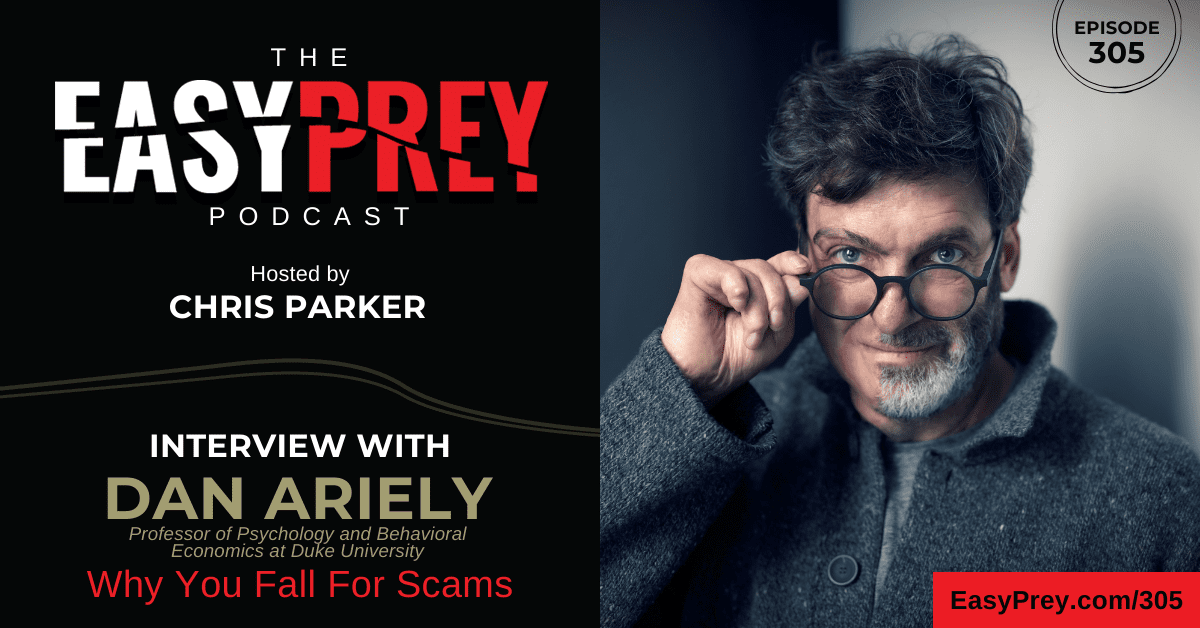

Why do smart, capable people fall for scams even when the warning signs seem obvious in hindsight? In this episode, Dan Ariely joins us to examine how intuition often leads us in the wrong direction, especially under stress, uncertainty, or emotional pressure. A renowned behavioral economist, longtime professor of psychology and behavioral economics at Duke University, and bestselling author of Predictably Irrational, The Upside of Irrationality, Misbehaving, and Misbelief, Dan has spent decades studying why rational people consistently make choices that don’t serve them.
We talk about the deeply human forces that shape how we decide who to trust, and how easily those instincts can be exploited in high-stakes situations involving fraud, financial loss, and digital deception. Dan shares a deeply personal story about surviving severe burns and the long process of self-acceptance that followed, using his own experience to show how hiding, blending in, and social pressure quietly influence behavior in ways most of us never stop to question.
We also explore why stress pushes people to search for patterns, stories, and a sense of control, even when those explanations aren’t accurate. Dan explains how our minds operate like a “vintage Swiss Army knife,” well suited for small, predictable communities but poorly equipped for modern risks like scams, cybersecurity threats, and low-probability, high-impact events. Topics include why near-misses teach the wrong lessons, why authority and urgency are so effective in manipulation, and why expecting people to be perfectly rational is a losing strategy. We also discuss practical ways to slow decisions down and bring in outside perspectives to help design safeguards that work with human nature.
“Slowing down a decision by even a small amount can dramatically change the outcome.” - Dan Ariely Share on XShow Notes:
- [01:52] Dan Ariely joins the episode to examine how human decision-making actually works under pressure.
- [03:41] How intuition can point us in the wrong direction during moments of stress and uncertainty.
- [05:26] Trust, authority, and urgency as core levers used in fraud and manipulation.
- [07:12] When decisions feel overwhelming, the brain’s tendency to rely on shortcuts.
- [08:58] Dan explains why rational thinking often breaks down faster than we expect.
- [10:34] Near-misses and how they quietly reinforce false confidence instead of caution.
- [12:09] Why repeated exposure to risk doesn’t necessarily make people better decision-makers.
- [13:55] Stress-driven pattern seeking and the human need for explanation and control.
- [15:32] Superstition, conspiracy thinking, and what they reveal about uncertainty tolerance.
- [17:18] Why modern threats like scams and cybercrime confuse brains built for simpler environments.
- [18:56] The “vintage Swiss Army knife” analogy and what it says about human cognition.
- [20:41] Authority cues and why skepticism often disappears in the presence of perceived expertise.
- [22:27] Slowing decisions down as one of the most reliable defenses against manipulation.
- [24:13] Dan reflects on how behavioral economics challenged traditional models of rational choice.
- [25:59] A personal story about surviving severe burns and the long path to self-acceptance.
- [27:44] How hiding and blending in can quietly shape behavior and self-perception.
- [29:31] Social pressure and its role in everyday compliance and risk-taking.
- [31:16] Why vulnerability doesn’t look the way people expect it to.
- [33:02] Expecting perfect rationality and why that assumption consistently fails.
- [34:47] Designing systems that account for human limits instead of ignoring them.
- [36:33] The value of outside perspective when decisions carry real consequences.
- [38:19] Practical ways individuals can reduce risk by changing how they decide.
- [40:05] When slowing down matters more than having more information.
- [41:52] Applying behavioral insights to fraud prevention and digital safety.
- [43:38] Why better tools help, but mindset still plays a critical role.
- [45:24] Final thoughts on working with human nature rather than fighting it.
- [48:02] What listeners can take away about decision-making, risk, and self-awareness.
Thanks for joining us on Easy Prey. Be sure to subscribe to our podcast on iTunes and leave a nice review.
Links and Resources:
- Podcast Web Page
- Facebook Page
- whatismyipaddress.com
- Easy Prey on Instagram
- Easy Prey on Twitter
- Easy Prey on LinkedIn
- Easy Prey on YouTube
- Easy Prey on Pinterest
- Dan Ariely
- Dan Ariely – LinkedIn
- Books by Dan Ariely
- Dan Ariely – YouTube
Transcript:
Dan, thank you so much for coming on the podcast today.
First of all, it's my pleasure, but let's see if you'll still thank me when we finish.
I'm sure we will. So can you give myself and the audience a little bit of background about who you are and what you do?
So maybe the best way for me to do this is to say something about why I have half a beard. I don't know if people are listening to your podcast or watching it, but if people are listening, it turns out I have half a beard. One half of my face is without hair, the other one is bearded, including with some white hair. And the story of this half a beard is, there's a few elements to it. The first one is that many years ago, I was badly burned. Most of my body is covered with scars, including the right side of my face. So the side of my face just doesn't have hair. And if you see from close, you can see it's not exactly symmetrical. It's just sort of symmetrical.
But the second part of the story is that for many years I shaved. In fact, I got advice to try and blend in and look less different because when I have stubble here, it looks still different, but when I shave, it looks less non-symmetrical. And then almost 10 years ago, I went on a month-long hike. At the end of the month, I looked like this, a little bit more hair. I looked in the mirror for the first time and I didn't like it. It's a very strange view to people who don't get used to it. It was very strange to me. I thought I would never want to live with a half a beard. I thought, I'll shave it, but I said, it took me a month to grow. I'll never do it again. Let me keep it for a few weeks just to get the feeling.
Then two strange things happened. The first strange thing was that some people approached me and thanked me for the half of it. Why? For example, the woman who works across the street from me left me a note in my mailbox saying that she also was burned, her burn was on her arm, and she has never worn a short-sleeved shirt. She's always hiding her scar. And she said that me being so out there with my injury helped her consider maybe she should stop hiding. So anyway, so people reached out and said it gave them some courage to stop hiding. I thought, okay, I'll keep this half a beard as a public announcement kind of thing.
But then the really interesting thing happened about four months down the line when I started feeling a higher self-acceptance for my own injury. And you know, I got injured when I was, many years ago, I've been with this injury a long time, and I asked myself, why now? And I thought to all the things that the people with the injuries were telling me, and they were telling me about hiding. And I realized that for somebody like me, half shaving is also blending in. I wake up in the morning, smooth on this side, stubble on this side, and the act of half shaving is also an act of looking less different. And letting go of that was incredibly healing.
Now, why am I telling you all this? One is so that people who are watching don't keep on wondering what is this half a beard thing about. But the second thing is that this is for me what social science and behavioral economics is about. It's about the things that we think are actually good for us, but are not, or the other way around. Here I am, a social scientist, and for a long time I shaved. I thought it would be a really good idea to blend in to look less different. And I failed to understand this really important concept of self-acceptance and the role of hiding in terms of the influence on myself. I thought about other people. I don't want other people to say anything and so on, but I did not think about self-acceptance. So for me, social science is about discovering these half appearances, discovering these things that our intuition is not pointing us in their direction.
And I think that in your world, we think about security and fraud and so on, we have a lot of those elements that don't fit with our intuitions. We think one thing, something else is happening. That's why we get into trouble. In your world, the trouble is not just having an awkward discussion or something. The trouble could be losing somebody's life savings. So that's a little story about me and a little bit about how I view social science or behavioral economics.
Interesting. I like that your background has played, that you've had to reexamine your own views on things based on your own experience. I think it's something as humans, we often don't, at least – I’ll rephrase it, in my friend group and people that I know, we often seem to not want to self-reflect and self-examine. What am I thinking and why am I thinking this?
Yeah. The reality is that we are really magnificent creatures. We are very interesting. We're very quirky, very odd. And it's really fun to try and understand ourselves. Puzzling. You know, we're capable of poetry and love and we're capable of hurting other people and hate. It's a very, very interesting, complex system.
So in your book, Misbelief, I think I think the subtitle is “what makes rational people believe irrational things.” Let's deconstruct that or talk about that, because I look at scams and fraud from the perspective of, we see something and externally when we look at someone who's been scammed, we say, oh, gosh, that's totally irrational. Why would we victim blame and say, well, why would you believe that? That's ridiculous. So clearly, and then we think to ourselves, well, that would never happen to me. And lo and behold, probably no one that I've talked to that hasn't been conned out of something, maybe it's only been $5. Or significantly larger or has done something like, you know, I clicked that phishing link that I shouldn’t have clicked on. I should have known better. So there's clearly we think we behave rationally, but we but we don't. And things seem to be able to influence the way we think more than we realize.
Yeah. So there's an overlap with things about misbelief and there are things that are different about this this world. But in the world of misbelief, and the question is, what gets people to wake up in the morning and say, I want to start believing that there's a cabal in charge. I want to believe in some dark force who is controlling things and very powerful and so on. And the story is very interesting, and if people have time, I recommend the book, but the first step of this is stress. And I don't mean the kind of stress that says, gee, I have so many emails, I don't know how I'll manage them. I mean the kind of stress that says, I don't understand the world.
So for example, there's a beautiful study that looks at tribes that fish, fishermen. And they compare fishermen who fish in lakes to fishermen who fish in the ocean. Which one has a more stable environment? The lake is basically the same every day, fluctuations are very small over a long period of time. The ocean, huge fluctuations, rains, storms, waves, and so on. Which of those two types of tribes do you think develop more superstitions? The ocean.
Yeah.
Why? Because we are really bad when we feel we don't have control. And what's interesting is that when people feel stressed, and they don't understand what's going on, we want the feeling of control. I'll give you another study. Imagine a frame with random white and black dots, which we call white noise. White noise can be auditory, but it could be visual. And I show you one of those and say, Chris, do you see a picture, an image in there? You say, Yes, so now I show you another one, another one, another one, I'll show you twenty of those. But they increase the stress that you're under.
So for example, in one study, you go skydiving, and I show you these things on the ground when you get to the plane, when you get high up just before you jump. What happens? As stress increases, people see more patterns. Why? Imagine you're in the jungle in our evolutionary history, and you're stressed because you think there might be a tiger nearby. What does your system do? Your system says, Oh, you see these two leaves? I see a tiger behind it. Your system goes into hyperdrive when we're stressed, trying to see patterns.
So when it comes to misbelief, the first thing that attacks us is stress. Something bad happened. We don't understand COVID, unemployment, illness, all kinds of things like that. And we're looking for a story. And the story needs to be something we can explain, ideally not us, it's somebody else to blame and so on. And that's how misbeliefs start. And then they have a life of their own and so on.
Now, before we go into that world, I want to say a few more words about your world. So a lot of our human skills are a double-edged sword. They're good and they're not so good. My metaphor for the human mind is that it's a vintage Swiss Army knife. What do I mean by Swiss Army knife? The Swiss Army knife is not particularly good at anything. There's not a single task, because if I can only have the tool of my choice, I would choose the… No, no, no. You would never choose the Swiss Army knife. What is the greatness of the Swiss Army knife? It's kind of okay in lots of things, and we can carry it with us. Kind of okay, lots of things. The human brain as a decision-making tool is kind of the same thing, not great at anything, kind of okay in lots of things, and we can carry it with us.
But when I use the term vintage Swiss army knife, what I mean is that our Swiss Army knife, our set of tools for making decisions, were forged in our evolutionary history. We were facing very different challenges. We were facing small communities of people that we will meet again, almost for sure, for a very long time. The food environment was very different. We didn't have to worry about retirement. We didn't have money. We didn't have compound interest. We didn't have cryptocurrency. So we still carry with us this vintage Swiss Army knife. Only now we face very new challenges. And guess what? Our tools are not ready for those tasks. And there are people out there that are trying to take advantage of us. So they recognize the places where we fail and try to take advantage of it.
So here's an example. Somebody analyzed and came with a conclusion that one of the best investments for companies in the US is to invest in lobbyists. Why? Because it turns out that people are cheap. If you go to somebody and you buy them a beer and a sandwich, in thirty minutes, they'll be your friends. Not lifetime friends, but they'll start seeing life from your perspective. Now, that's a wonderful thing. It's a wonderful thing that we can make friends so easily. All it takes is a beer and some time, and you can get somebody to be a friend. You mix it with politics, all of a sudden, it's kind of dangerous.
So in our evolutionary history, we wanted people to be able to create relationships quite quickly, to trust each other, to work together, to reciprocate. I do something for you. You feel comfortable to do something for me back. It's kind of wonderful, right? Even think about this podcast, right? You write me, say, hey, Dan, would you mind? Sure. Like, you know, you're another human being. Why? Why not? It's a beautiful thing. At the same time, it can be an opening for some really negative stuff.
“We have these tools from our evolutionary history that served us. But now in the modern environment, they expose us to be vulnerable.“ - Dan Ariely Share on XSo we need to understand that we have these tools from our evolutionary history that served us. But now in the modern environment, they expose us to be vulnerable. And in terms of trust, it's one of those things that keeps us very vulnerable. Our trust is wonderful. If you ask me, do I want humanity to be less trusting? The answer is no. I love how trustworthy people are. In general, people are very trustworthy. Do you know this game called the Trust Game?
I know trust falls, but I don't know if I'm thinking the same thing you are.
Okay, so imagine two people. They're in different rooms. They never met, they'll never see each other. Everything is anonymous. We say to person one, hey, person one, I'm giving you $100. You can do one of two things with this $100. You could either take it and go home, in which case you have $100, or you can send the money to person B in a different room, you'll never meet them, you don't know who they are. If you send the money to person B, the money will quadruple on the way, and when you come to person B, it'll be $400. And person B can do one of two things. They can take the money and go home, in which case your person A has zero and they have $400, or they can send you half back.
Now, it's an interesting game because you say, I don't know what the other person will do, but if they're worth trusting, I'll give them the money. If they're not, I will not. And the interesting news is that most people think that the other person is trustworthy. Most people, almost everybody sends the money, and almost everybody sends the money back. So here's an amazing news, we think we're trustworthy and we're trustworthy.
When you get into your realm, all of a sudden, this thing that usually works for us quite well can be incredibly dangerous. And we are carrying with us these tools that say, I care about other people. If I think about the most recent scam that somebody scammed me, it was out of empathy to the other person. Now, would I like to cancel empathy? No. But do we need to recognize that sometimes it creates damage? Absolutely, yes.
I had another thought that I want to show. One thing is to think about trust. Another thing that is worthwhile saying is that the issues of security are often in a category we call low probability events. And there's an interesting thing with low probability events that our learning cycle teaches us the wrong lesson. So let me explain. Imagine that I'm thinking about texting and driving. And imagine I think that the probability of texting and driving and something bad happened is 2%. One day I'm kind of in the traffic lights, the phone is buzzing, and I use my phone while driving and nothing bad happens. After all, it's only 2%. How do I come out on the other side of this event? People come out of this, oh, maybe it's not 2%, maybe it's only 1.8%.
With low probability events, every time we act badly, but nothing bad happens, we learn the wrong lesson. We become comfortable and say, hey, the world must be okay. So when I think about people who are using weak passwords or checking, doing all kinds of things that are not safe, every time that they do something that is not safe and nothing bad happens, people get the false sense of security. It's not really that dangerous. Look at me. I wrote my password on this napkin in my phone and took a picture of it and uploaded it to the cloud and nothing bad happened. And every time we do something that we shouldn't and nothing bad happened, we learn the wrong lesson because at the end of the day, we learn from experience. And the feedback mechanism of experience is not a good teacher.
So what is all of this to say? It's to say that we are fallible in very specific, predictable ways. You know, I called my first book Predictably Irrational because I wanted to emphasize the notion that we're not irrational in random ways. There are ways in which we're all irrational in the same way. And what's happening is that this is who we are. Now, the question is, are we going to change? And the answer is no. We're not going to change. And the people who are thinking about security need to understand that we are fallible. Like in the same way that you can't come to somebody and say, be cold resistant. No, we build refrigerators, we build heaters, we build sweaters, we build things to overcome our body limitations. In the same way, people are not going to be perfectly rational. We are who we are, and we need to create systems that accept us as who we are, and then build in a way that helps us overcome our limitations. I don't want people to be scammed. But I want to build systems where people cannot be scammed, given what people are, not systems that assume people are perfectly rational, and then expose them to risk.
“People are not going to be perfectly rational. We are who we are, and we need to create systems that accept us as who we are, and then build in a way that helps us overcome our limitations.” - Dan Ariely Share on XIn terms of building systems, it makes sense for, let's use your analogy of passwords. We could do password managers, and then we've got a system that will produce complex passwords, remember them for us so that we don't have to have that cognitive load of, gee, I've got to remember eight thousand 16-digit passwords that are totally random because I can't create things that are random. Okay, so we could build a system there, but how do we build systems on the psychology side when it's in-person interactions, when it's the human interactions? It's not like we're going to, okay, every time I talk with somebody, I've got this, you know, did they smile? Did they ask me, were the questions that they asked too personal? Because, you know, we're not all the same being, we don't all operate the same. How do we build the systems on the squishy side?
So let's not call it squishy, but because I think it's a hugely important part of us. It's a bit more difficult, but it's a hugely important part of us. So I don't think it's impossible. So what is impossible is to get somebody to be on alert all the time about every person who's smiling at them. Because again, most of the time people will just smile and be fine. Yeah. Right? If every time somebody smiled at me, it was a scam, we would learn. But if it's 0.5% of the time, or 1% of the time, like, I'm not going to be on full alert. Oh, they smile. Let me be on alert.
So can we think about systems that do this? And I think the answer is yes. So I recently met a startup that creates a little window on the side of your, let's say, Zoom, and they do a lot of background checks on people. So they can say, Oh, the LinkedIn profile of that person doesn't seem to fit their picture. Or I saw an interesting demonstration when they say, this person is using urgency. When people are using urgency, it's a signal. And they propose, please ask them this question.
You know, there's a terrible story that a lot of planes from Korea used to crash. And one of the reasons they used to crash is respect. You have a junior pilot and a senior pilot, and you think to yourself, you have two pilots, but you don't have two pilots because the junior pilot will not say anything to the senior pilot. Similarly, when you sit next to somebody on the car and you talk to them, there's no problem with attention. When you talk to somebody on the phone, you're actually at an increased risk of getting into accident. Why? Because if you sit next to somebody and the traffic is high or something is happening, you feel perfectly okay stopping talking and putting all your attention driving. But when you talk to somebody on the phone, they don't know what's happening. And out of politeness, you keep on the conversation flowing. You don't have the same freedom to just be quiet for 30 seconds and focus. So, you know, and it's kind of crazy because we're too polite for safety. So, can people be rude? Like we have a discussion and this thing alerts on the side. Can I basically say, Hey, Chris, can you prove to me please that you're a real person and not a scammer? Not going to happen.
Sorry for the randomness, but I used to go to, because I'm injured, I have lots of medical issues. So I used to go to doctor's offices and they always say, Hi, Dan, I'm doctor, whatever. Yeah. And I always wanted to say, Professor Ariely to you. You know, like, Why are they doctor and I'm Dan? And I would say, Okay, I'll say that. But then, you know, you're kind of in a white coat, your butt is hanging outside, you feel this small, and they come into that room. And at that moment, it's their room and not my room. And they say, Hi, Dan, I'm Dr. something. And I don't feel comfortable. I could feel comfortable saying it outside, but at the moment, the social pressure is very high with respect and so on. So at the moment when you're talking to somebody and they look like your boss or somebody, you're not going to say it.
So anyway, I think we can create a system like this. But if we understand, but we need to understand the reasons. We need to understand, okay, scammers use authority. And scammers use urgency. So anyway, I think, can we solve it? No. But can we get much better? I think the answer is yes. But we need technology on our side that helps us. if you say, Oh, let's just give people a module on risks, it's kind of amazing because when was the last time a module on anything, really fixed the real problem? We need things that help us in real time. But by the way, tell me, I'm not in your industry, so I'm an outsider. But it looks to me that the security industry is amazing, spending a ton of money on all kinds of things, and that the weakest link in the whole thing is the human side. And almost no money is spent on part. Tell me if I'm I might be wrong, but that's what it looks to me like.
I would not make the statement that no money is spent on the human side. I but I agree with the premise that there's a technology side. And I think the reason is it's more rational. And the human side, I can tell one person, explain something to one person, they go, oh, yeah, I get it. I explain it to another person and they don't get it because they haven't had the same life experiences. And every human is different. Every person responds differently to different situations. And, you know, it's harder to manipulate technology than it is to manipulate people, which kind of pushes back. I wanted to ask the question, and I've always often talked about, authority, urgency.
But you do agree that the amount of money spent on the human side is disproportionately too low?
It appears, yes, from my perspective, it's just disproportionately low. And I don't think it's because people don't want to, let's just do technology and technology solution. I just don't think that there is a good, proven, consistent way to help humans be more safe.
I agree with that. I just think that people are, I think that people in the technology world just don't understand social science. We are focusing a lot on all kinds of elements to do that. I think that the IT people have mostly closed themselves off from the rest of their organization. But by the way, I'll tell you something else. I hope it's okay. But I teach at Duke University. Mostly our IT people, I think, are looked at as our enemy.
Yeah.
They just make our life difficult. And what's interesting is they don't think it's their responsibility to recruit us to help them. They force us to change things and double authentication and software that doesn't work and things that happen all the time in random times. And it's a real pain. Nobody from the IT system has, at least at my institution, has ever come to us and say, Thank you for doing this. This week, we blocked X amount of things on your account. Here is what we've done for the university. Your help is… Like, you know, I'm very happy to walk around campus and pick pieces of trash and talk to students and do all kinds of things for the university. But the way that IT thinks about itself is not about having to recruit me to help. They just create these rules that force me.
And there's a very, very nice result on something called operational transparency. So imagine three conditions. Condition one, you search in a travel website, you press enter, boom, you get the results immediately, as immediately as possible. Condition two, you search, you press enter, you get the black screen and the wheel of death. You wait, you wait twelve seconds, you get the results. Condition three, you type, you press enter, and you wait twelve seconds, the same twelve seconds, but those twelve seconds are filled with, we're searching United, we're searching American, things are moving on the screen, optimizing the results for you. What happens now? When people get the results quickly, they're happy. When they have to wait twelve seconds, they hate it. When they wait twelve seconds, but those twelve seconds are filled with, we're searching United, we're tailoring the result, people are happier than if they didn't wait at all. That's it.
Why? Because all of a sudden, all of a sudden you say, my goodness, what have they done for me? It's unbelievable. Like, I'm so grateful the algorithm looked at this. Look, look what they do now. For me, nobody has an IT, even though they do magic for us. And they do. Nobody has ever shown me the magic and got me to be grateful. The only thing they get me to do is, why are you doing this? I don't understand the reason. I just know it's annoying. And also with me, with my disability, it's extra annoying. But the point is that I think that there is something about the technology world that is not taking human nature into account. They don't take into account IT at Duke doesn't take us as humans that says, these people are our allies. Let's help them see why we want a minute of their day from time to time. It all looks so random and capricious and like, why is this happening? And then I also don't think that they think about psychology in being attacked either.
Yeah, I would agree with some of that and disagree with some of it. I think there is a change in cybersecurity to start being more being more human, let's say, and realizing that I think there was there was probably an early on perception that we can solve all the security issues with technology. Whereas psychologists are saying, hey, we can solve all the problems with helping people be better people that we don't need the technology. Yeah, I'm making it up, but yeah.
So I think there is this movement now from a lot of people that are coming up in cybersecurity saying, look, we have to partner with people. We have to help the user understand why we're doing this and help them be part of the process. And so I think that process is some institutions, it's going to take longer to transition. Some have done really well with making it a collaborative environment. And then you get some organizations that try to make it collaborative and it kind of backfires of like, hey, take these, you know, take this hour long course on cybersecurity and like, ah, you know, everybody hates that.
But I wanted to go back and ask you that question about I've always looked at scam and fraud with there's an appeal, there's an element of authority, there's an element of urgency, there's an element of emotion. And it could be greed, it could be fear, it could be empathy. Why is the authority element, why are we wired to respect authority? in the way that you're talking about, like with Korean Airlines and in other areas, clearly I see in scams is, hey, I represent this entity. And all of a sudden like, oh, okay, I'm going to listen to you.
Yeah. So we don't always respect authority, but there are some areas where we certainly respect authority. And it's particularly the case when the environment is not our environment. Like if somebody came to your house and started giving you commands.
Yeah.
You know, it'll be very different. I'm not saying like, you might be so baffled. Like if somebody's up, make me coffee. Like, okay. But human society is very hierarchical, and we accept instructions. You know, some of the most amazing experiments in psychology were about adherence to authority. There were these old experiments where people were asked to torture other people under authority. And guess what? A shocking amount of people went ahead with that. We are basically, when somebody tells us something to do in an environment that we're not sure what is the right thing to do, we are very, very adherent to that instruction.
“When somebody tells us something to do in an environment that we're not sure what is the right thing to do, we are very, very adherent to that instruction.” - Dan Ariely Share on XThen you add time pressure to it. We're not sure what to do. We're not comfortable saying, are you sure this is okay? Out of politeness and so on. And of course, another thing that helps us is that we don't really think very carefully about the consequences of what we're doing. And then it also happens step by step. So it's rarely the case.
So another area of my research has been on dishonesty. And we have a very nice movie on that, kind of a documentary that captures this. But a lot of it is a slippery slope. So if you came and you said, oh, even in the experiments on the electrical shocks, it wasn't as if they say, oh, give this person a shock that could kill them. No, they started very low and they went high up. And once you listen to something, it's easier to listen and you form a relationship. But yes, when we don't know what are the exact rules to adhere to, we basically look outside to understand what is expected from us in this particular case. And what's expected from us can, if somebody's trying to take advantage of us. The same thing I told you about being in a doctor's office. So many people, they go to the doctor and the doctor says, Do you have any questions? And people say, No. And then they leave the office and you say, Do you really have no questions? They say, No, no, I do have questions. It just felt like they were really busy. I don't want to be a bother. Like they ask you, Do you have questions? And we doctors, by the way, we did want a study in which we said, we asked the doctors to say, instead of saying, “Do you have any questions?” the doctor said, “I know you have many questions. Please ask me your top three.” Very different result. All of the sudden, people have questions. So authority and respect are very much within us. By the way, it's true for all the animal kingdom. Hierarchy is a really big deal.
So how do we, what are some, you've talked about the doctor actually changing the way the doctor asks the questions. Are there questions that in our interactions with people that we should be asking ourselves, or will we do things that we should be asking ourselves? Well, why did I do? Like, what are some of the inner monologue that might be helpful for us in scam prevention or fraud prevention?
Okay, so first of all, when things are moving fast, it'll be really hard for people to ask themselves questions. You know, when you are in the middle of a scam on the street, very hard to stop and ask yourself questions. The whole thing is designed to get you into turbulence and do something. But one thing we could, if we have the opportunity, one very good thing to do is to decide never to act quickly on anything and have it as a rule. Not saying, oh, yes and no, nothing. I will not act on anything within less than, three hours. You know, I get the request, I get an e-mail, and so on. You can create a rule for yourself, and it's important the rule will be everywhere. If you have to say, oh, I usually act very quickly, but in this case, no.
The other thing that I would say is what is called take the outside perspective. So again, in the medical scenario, We ask people, here's the situation. You just got diagnosed by a doctor. Would you ask for a second opinion? People say no. If it was a friend of yours in the same situation, would you advise them to get a second opinion? Absolutely, yes. What's happening is that our cognitive part of our mind knows that we're in a dangerous situation. Our emotional part is too embarrassed, feel pressure, and so on. When we give other people advice, we're more cognitive than emotional. So you could stop and ask yourselves, if I had a friend that corresponded with this unbelievable beauty on Telegram, and she told him that her grandmother was sick and needed money, what advice would I give him? Now, you are thinking about it more rationally. Every time you give advice, you're more rational than emotional. So a trick we're saying is, think about the situation, give an advice to a hypothetical person who's very much like you, and then turn around and accept that advice.
That's probably the tricky part also.
That's right, but at least you're aware. You basically say to yourself, there is something, let me describe the situation. What would I really do here? So I think we need to get ourselves out of acting very quickly. And then the outside perspective is very good.
And then we do need technologies. We do need technology. AI is getting so much better. Like, I read about some scam where an image appeared on one of these platforms and video and it looks like the real person.
Yeah.
And, you know, where do you stop? And of course, a ton of scams with voice and so on.
So, by the way, there was a thing I wanted to do with somebody is to teach people and about scams more frequently. So from time to time, companies send people phishing emails, and when you click, they say, oh, this was a phishing e-mail. I don't think it happens enough. And it's only phishing. The reality is that we need a lot of practice in this. Like imagine that we created, like, an experience that felt more like a game. Here are three messages. Which one is the scam?
Yes. And there are people that are doing cybersecurity education from that point of gamification.
Yeah. I had one other. But it needs to be frequent. It cannot be a module once a year. It needs to be a little bit every day. And you need to feel that you're getting better at it. I'm learning, I'm figuring out, I understand the nuances. So it's, the term “gamification” is a very broad term.
Yeah.
But it needs to be something that is fun and not the standard security module.
Yeah. Can I end with asking a, I'm gonna frame it as a personal question, are you okay with that? So, have, I'm trying to think of like, you're talking about giving people advice. So if I give, hey, if you ran across someone doing this, what is the advice that you would get? Oh, then I think I can think from a rational perspective. And is part of that we don't actually ask those questions is because we're uncomfortable with … And I'm going to use your example with how we look that we're, I want to shave one side of my face so I fit in. I don't want to ask questions that make me look weak or different. I want to blend into the crowd, not stand out. Is that part of why we don't in these sort of situations, we don't go to outside sources?
Absolutely. So we are very much in a maintenance of our reputation business a lot of the time. So there were these really amazing experiments where you show people three lines, long, middle, and short. And then on the other side, there's one line. Let's say it's like the middle. And they're in a big group. And everybody but the participant is saying the wrong answer. And when you get to the participant, they look and they also give the wrong answer most of the time. And when you change the prestige of the people around the table, like in the college, maybe they're in the fraternity or sorority or something like this, the numbers are even higher.
We are basically in a constant struggle for maintaining our image in our own eyes, in the eyes of others. And we're embarrassed, we don't want to make mistakes. And the people on the other side can absolutely use that. Because if I come in as a high authority person, and I tell you that everybody but you have already given their signature, and you're the last one, and there's a deadline. I mean, we can make all kinds of things. And you say, What if I don't sign? How will they think about me? Am I the only one? You know, the story of the king is naked.
Yeah.
It's very, very tough. It's very, very tough to go against the grain, against the crowd, to say something. And we can all say, Oh yeah, we would do that. But at the moment, you're like me with a white coat, in a lot of social pressure in front of other people.
Are there ways that we can you know, dial it down a little, like, okay, so we can't eliminate our desire, the inherent wanting to fit in and to not stick out. Are there ways that we can dial it down just a little bit?
Yeah, so I'll give you an analogy. I did some studies on free, and I show that when people sell free ice cream, people stand in line for forty-five minutes, no problem. And the trick about free is to say, what if it was 10 cents? And you say, oh, I wouldn't stand here for forty-five minutes if it was 10 cents. Then don't do it for free. One of the things about authority is to basically replace that person and say, what if it was my buddy who was asking me this? In the free, you can say, what if it was not free? What if it was 10 cents? And you have a request from an authority figure, you can try to neutralize the authority by saying, what if it came from somebody who is not in an authority? Would I still feel the same urgency, the same need, the same hesitation to ask a question? So that's a good exercise, right? When you say, how much of my urgency to act here is because of the authority versus the content of the words?
“How much of my urgency to act here is because of the authority versus the content of the words?” - Dan Ariely Share on XAnd again, unfortunately, the people that are doing this are using the urgency and the authority and all of that to help us not to make those rational analogies. So we have to practice it.
We have to practice, yeah. And I think this approach of gamification is to practice, like, to practice and get better at it. right? We need to get better. Even getting better at rehearsing terminology, like, is it okay if I get back to you? Like, let's say the provost, in my case, the provost of the university called me and I thought that maybe, could I start practicing. Would it be okay if I waited and answered you tomorrow?
And if I practice this, it could be better, but we have to remember that time is on our side. Every delay helps us think in a better way. Getting more information, making sure we're doing something. And then the learning from low probability events. Every time we do things quickly because somebody asked us, without all the procedure, and nothing bad happened, we learned the wrong lesson.
It's gonna take lots of personal work for everybody.
So Dan, if people want to find out more about what you're writing or what you're doing, where can they find you online?
I have a website, danariely.com, D-A-N-A-R-I-E-L-Y.com. And then I have a couple of, I have two books that I wrote and a movie, a documentary. And I'll just say that right now I'm working on two books. One is about what is holding us back in terms of taking risk and how could we get people to be more bold in our actions in life. And the second one is I'm trying to analyze the last chapter of people's lives. What are the mistakes we make and how can we live a more fulfilled last chapter?
Oh, I look forward to being able to read them, but both of those topics are very interesting to me. I very much look forward to those coming out.
Thank you so much.
Yeah, and thank you so much for coming on the podcast today.
It was delightful. It's a fascinating topic. And I would, please keep me in mind as you learn more about this and when human nature comes into clash with these new technologies.
Absolutely.